Why ruminants chew cud
Cud chewing is one stage of a repeated digestive loop: forage enters the reticulorumen, selected fibrous material is regurgitated, remasticated, reinsalivated, and swallowed again, and particles eventually pass onward when their size, density, and digestion permit.
Last updated
One stomach, four connected compartments
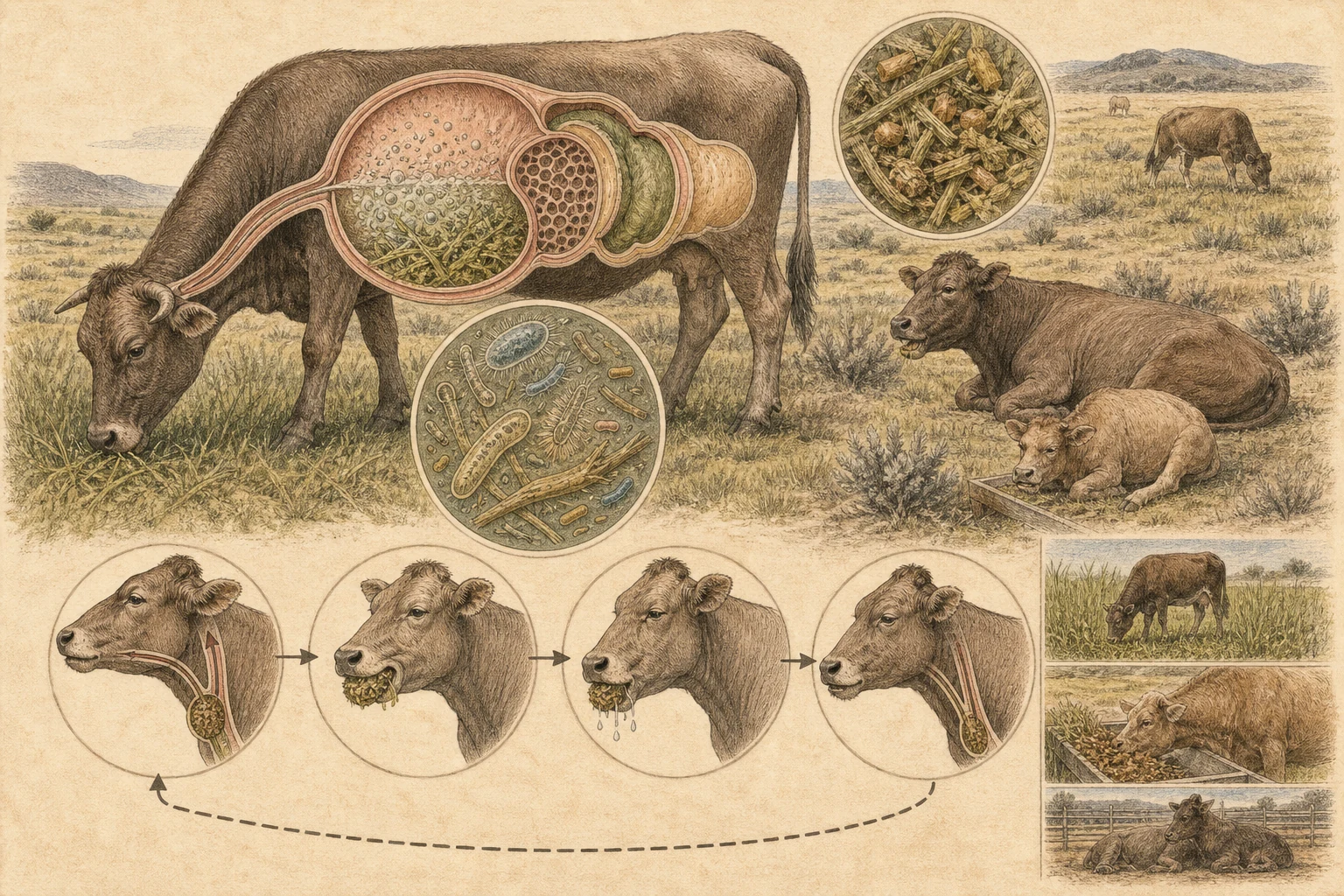
Adult true ruminants—including domestic cattle, sheep, goats, white-tailed deer, elk, and giraffes—possess a single stomach divided into four sequential compartments: the rumen, reticulum, omasum, and abomasum. The first two chambers, partially separated by a low tissue fold, operate together as the reticulorumen, a huge fermentation vat where rhythmic muscular contractions mix newly swallowed grass or browse with fluid, microbes, and rising fermentation gases while stratifying coarse floating fiber above denser, finer particles. Only after plant fragments are ground small and dense enough to clear the reticulo-omasal orifice do they pass into the leaf-folded omasum for water and mineral absorption, and finally into the abomasum, where host hydrochloric acid and digestive enzymes act like a non-ruminant stomach. [1][2]
- The rumen and honeycomb-lined reticulum act as a single sorting and mixing vat called the reticulorumen.
- Coarse, buoyant forage floats in a fibrous mat at the top of the rumen until rechewing and fermentation increase its density.
- The abomasum is the fourth compartment and functions as the acid-secreting, enzyme-producing true stomach.
Microbes open fibrous food
Vertebrates cannot synthesize the cellulase and hemicellulase enzymes required to cleave tough beta-linked polysaccharides inside plant cell walls. Instead, ruminants maintain a warm, anaerobic microbial ecosystem in the reticulorumen populated by specialized bacteria, ciliated protozoa, anaerobic fungi, and methanogenic archaea. As these microbes colonize bruised stems and leaves, they ferment structural carbohydrates into volatile fatty acids—principally acetate, propionate, and butyrate—which pass directly through the finger-like rumen papillae into the bloodstream to supply the bulk of the mammal's energy. Microbes washed onward into the abomasum and small intestine are themselves digested, turning low-protein winter twigs and sedges into a major source of microbial amino acids and vitamins for the host. [1][2][5]
- Rumen bacteria, protozoa, and fungi break down plant cellulose and hemicellulose that vertebrate enzymes cannot digest directly.
- Volatile fatty acids absorbed across the papillae of the rumen wall provide the majority of a ruminant's metabolic energy.
- Microbial cells flowing out of the forestomach are digested in the abomasum and intestine as a primary protein source.
Rumination runs a four-step loop
When a bedded deer, bison, or cow ruminates, it executes a coordinated four-part cycle: regurgitation, remastication, reinsalivation, and redeglutition. A contraction of the reticulum paired with negative pressure in the thorax draws a rough bolus of fibrous digesta from the reticulorumen up the esophagus into the mouth within a couple of seconds. Watch a resting ruminant's neck and you can often see that bolus slide upward just before the lower jaw begins its steady, side-to-side grinding across ridged selenodont cheek teeth. That thorough chewing shreds waxy plant cuticles to expose inner cell walls to rumen microbes, shrinks particle dimensions so fragments can eventually exit the forestomach, and mixes the cud with copious bicarbonate- and phosphate-rich saliva that buffers fermentation acids. [3][4][5]
- Each cud cycle consists of four stages: regurgitation, remastication, reinsalivation, and redeglutition.
- Side-to-side grinding across crescent-ridged cheek teeth fractures tough plant epidermis and shrinks particle size.
- Heavy saliva flow supplies sodium bicarbonate and phosphate buffers that keep rumen pH within a safe range for fiber-digesting microbes.
Diet changes the chewing schedule
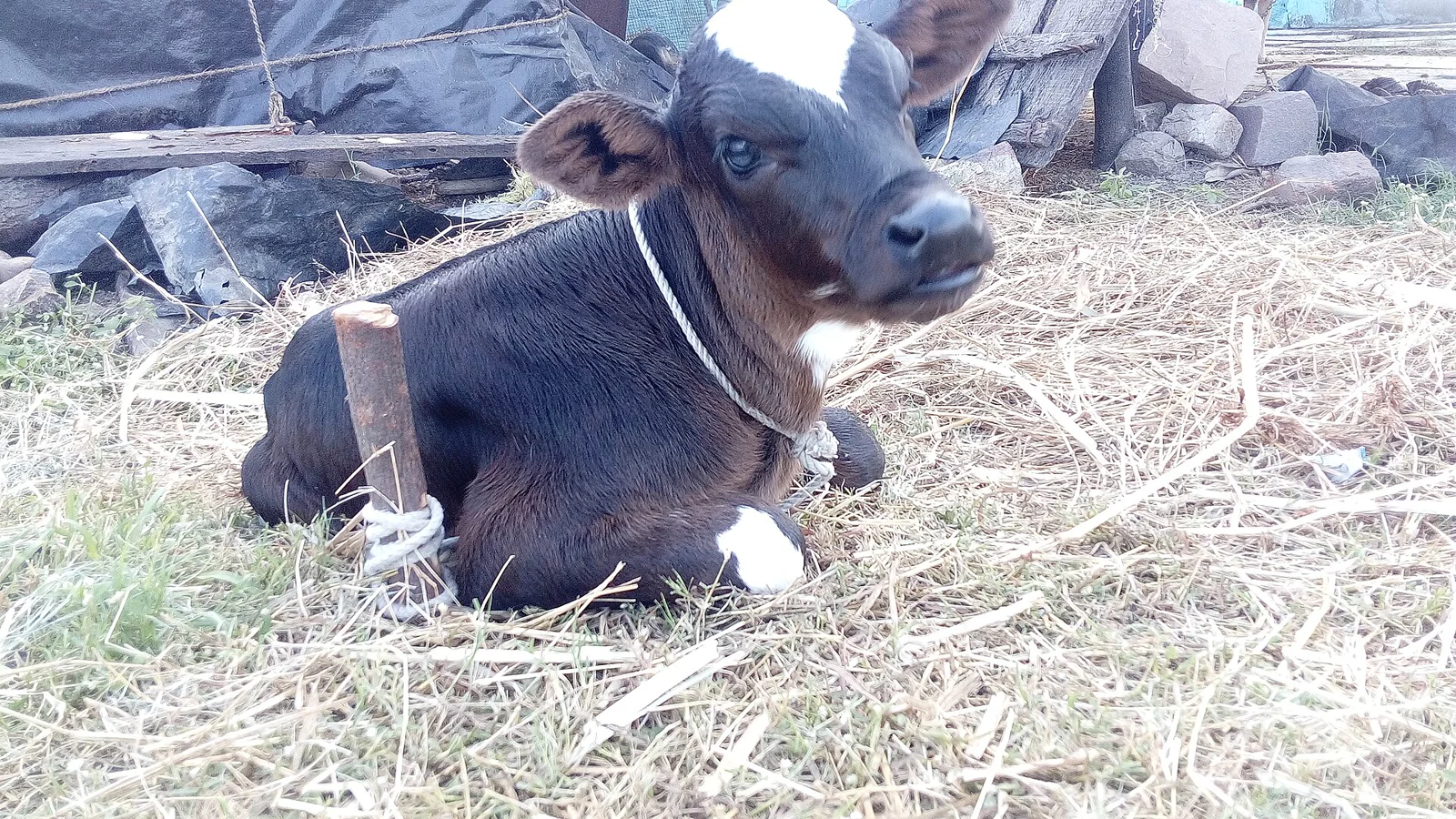
Rumination allows wild ungulates to crop exposed meadow grasses or woodland shoots rapidly and then retreat to cover, shade, or wind-sheltered beds to finish mechanical processing while keeping ears and eyes alert. However, cud chewing does not run on a rigid clock across all diets or life stages. Newborn calves, fawns, and lambs begin life as functional monogastrics whose esophageal groove shunts milk straight past the undeveloped rumen into the abomasum; rumination develops over weeks as they sample solid forage. In adults, coarse, mature hay or woody winter browse demands far more chewing bouts per day than tender spring pasture or finely ground concentrates, and sudden drops in daily rumination time often signal heat stress, calving, or rumen acidosis. [1][2][4]
- Cropping plants quickly and ruminating while bedded in cover reduces the time wild deer and bovids spend exposed in open feeding areas.
- Long, stemmy forage triggers substantially more daily cud-chewing bouts than lush leaves or finely ground grain diets.
- Suckling calves and fawns bypass the rumen via the esophageal groove and only start ruminating as solid plant intake builds the forestomach.
Related guides
Get Fauna and identify it in the field.
Where this guide comes from
Source-checked editorial guide. Last updated . This guide teaches identification and field skills; it is not a substitute for expert verification when it matters.
- University of Minnesota Extension — The ruminant digestive system ↗
- University of Alaska Fairbanks — Ruminant gastrointestinal anatomy ↗
- USDA ARS — Biomimetic application of rumination ↗
- The veterinary quarterly — Using rumination time to manage health and reproduction in dairy cattle: a review ↗
- The Open University — How do ruminants digest? ↗