How mammal fur insulates
Hair itself is only part of the insulation. A dense, deep coat creates small air spaces that resist convective mixing and conduct heat poorly; guard hairs protect the softer layer, and piloerection or seasonal growth can change the coat's effective thickness.
Last updated
The trapped air does most of the work
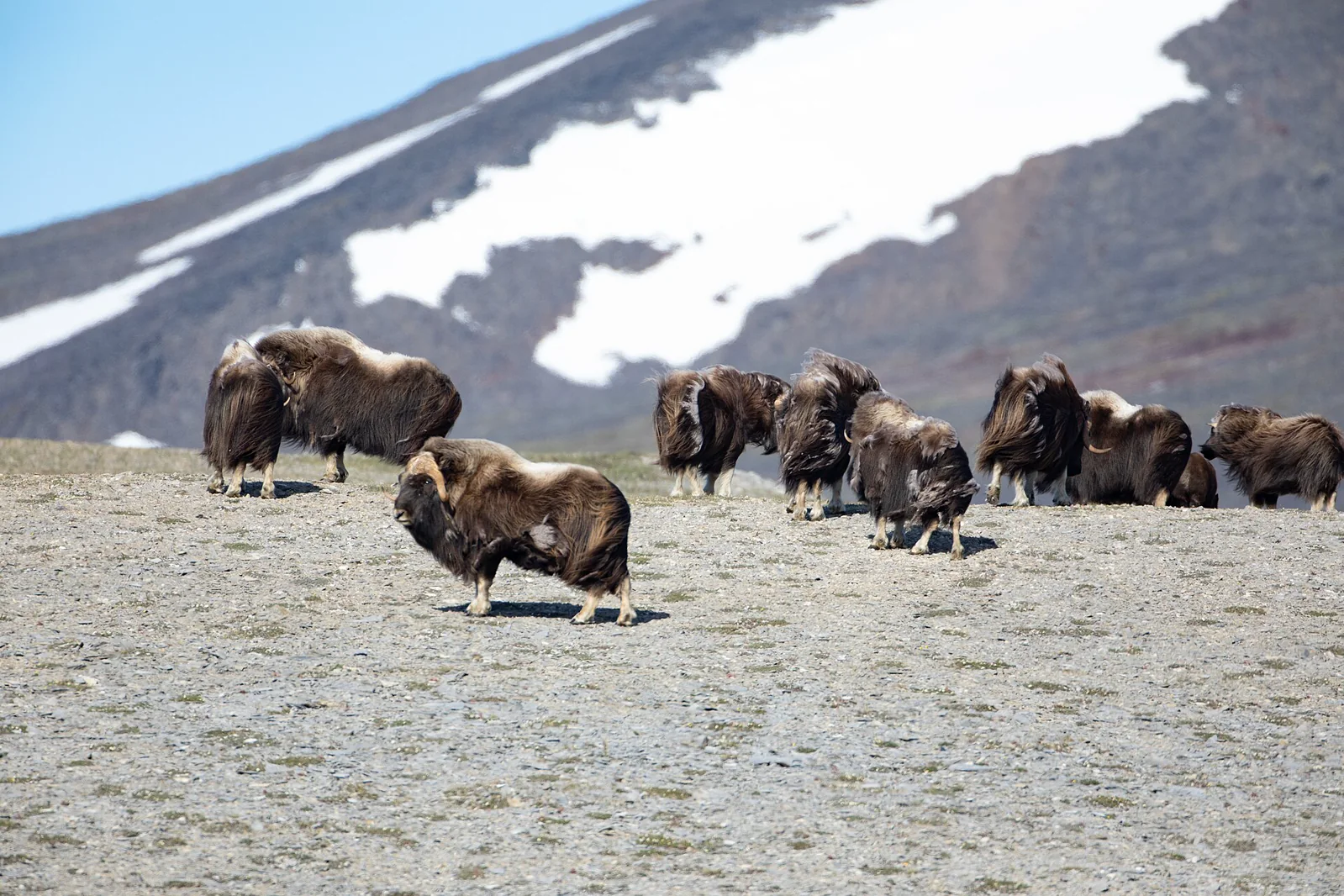
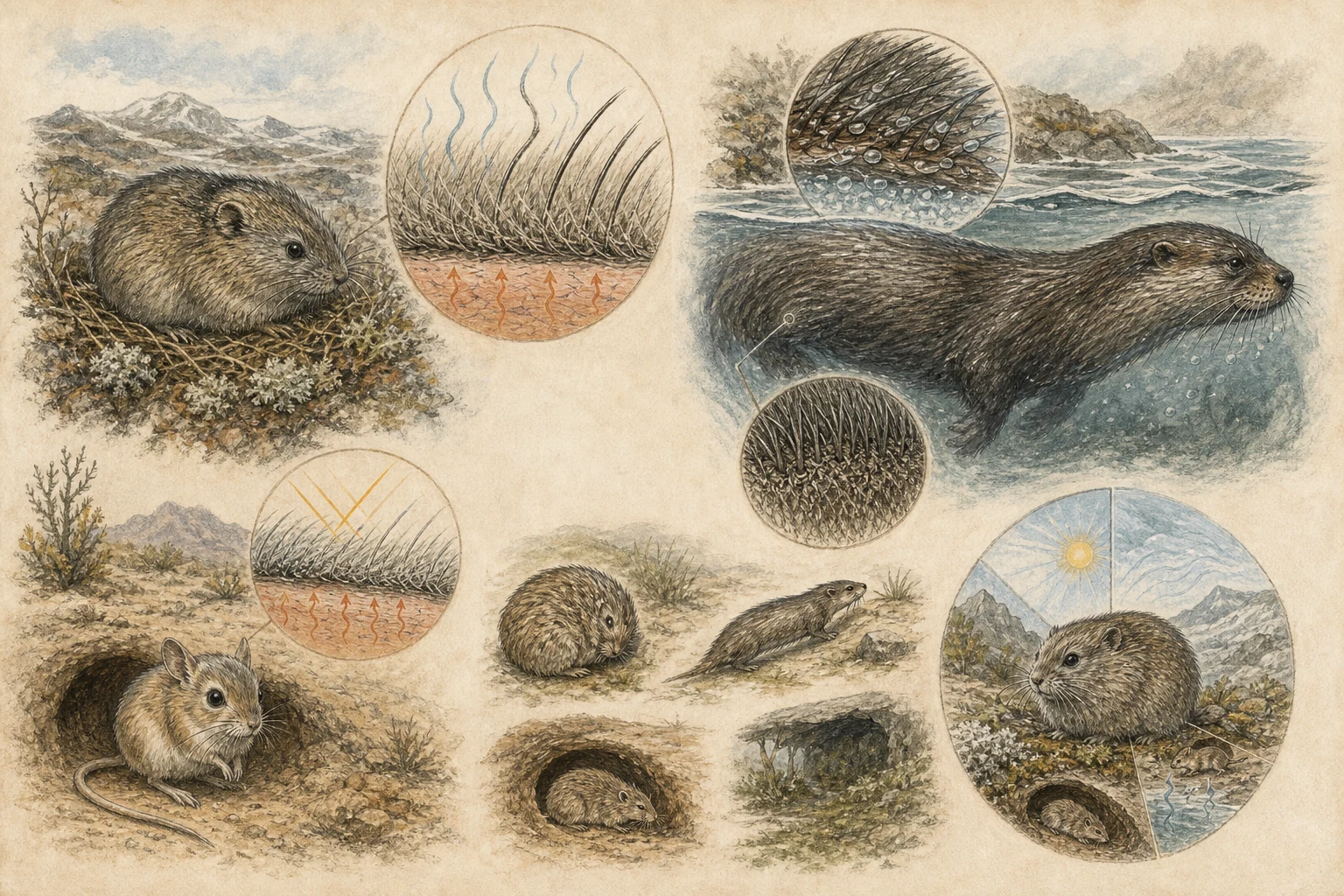
Keratin hair fibers by themselves are only modest thermal insulators; the real barrier inside a mammal's pelage is the deep pocket of motionless air trapped among millions of closely packed shafts. Because still air has very low thermal conductivity, holding a stagnant boundary layer next to the epidermis sharply slows conductive and convective heat loss from the warm body core to cold outside air. When gale-force tundra winds flatten a coat or blow cold air down to the skin, that boundary layer collapses and heat loss spikes—which is why muskoxen (Ovibos moschatus), foxes, and deer bed out of the wind or curl their tails over their noses. [1][2]
- Still air trapped between packed hair shafts provides most of the thermal resistance in a mammalian coat.
- Thermal insulation increases with effective coat depth and hair density until strong winds compress or penetrate the pelage.
- Curling into a tight ball or bedding behind snowdrifts and boulders protects the still-air boundary layer from convective stripping.
A coat is layered and adjustable
Most terrestrial and semiaquatic mammal coats combine two distinct structural tiers: a lofty inner blanket of short, crimped, high-density underfur (such as the ultra-fine qiviut of muskoxen) and an outer canopy of longer, stiffer guard hairs. The guard hairs shed rain and snow, block wind shear, take mechanical abrasion from brush, and prevent the soft underfur from matting flat. Mammals adjust this two-part system across both minutes and months: smooth arrector pili muscles attached to each follicle pull hairs upright (piloerection) to thicken the dead-air layer on frosty mornings, while photoperiod-driven spring and autumn molts swap thin summer coats for deep winter pelage. [1][2]
- Crimped, fine underfur traps dead air near the skin while stiffer outer guard hairs shed wind, rain, snow, and abrasion.
- Contracting arrector pili muscles raise the hair shafts (piloerection), temporarily deepening the insulating air layer.
- Temperate and boreal mammals grow dense winter underfur in autumn and shed it in ragged patches during spring molt.
Water tests the seal around the air
Liquid water conducts heat roughly 25 times faster than air at the same temperature, so an aquatic mammal whose skin wets thoroughly faces rapid hypothermia unless it has thick blubber. Semiaquatic mammals such as beavers, river otters, and mink—and above all marine sea otters (Enhydra lutris), which have virtually no insulating blubber—solve this by packing barbed, interlocking underhairs so densely (up to 100,000 or more hairs per square centimeter in sea otters) that surface tension and natural sebaceous lipids keep water from reaching the skin. When crude oil fouls a sea otter's pelage, it mats those microscopic air pockets, letting icy seawater flood the skin and triggering fatal heat loss. [3][4][5]
- Sea otters pack up to 100,000 or more hairs per square centimeter, relying on trapped air rather than blubber for cold-water survival.
- Vigorous surface grooming aligns guard hairs, spreads natural skin oils, and blows fresh air bubbles into the underfur.
- Crude oil or surfactant contamination collapses the water-repellent hair lattice and lets cold water contact the skin directly.
More fur is not simply better
A thick coat is a two-way thermal barrier: it slows heat escaping in winter, but it can also block intense solar radiation from baking the skin in hot environments while making it harder to dump internally generated metabolic heat during running or digging. Museum-specimen analyses across desert rodents show that arid-zone species balance reflectance, dorsal-to-ventral coat depth, and hair density to shield their backs from overhead sun while leaving thinner ventral pelage as a thermal window to release body heat into cool burrow soil. Small body size, seasonal torpor, nocturnal foraging, and vascular heat windows in ears and legs always work alongside pelage. [2][5]
- Desert rodents balance denser, reflective dorsal fur that blocks solar heat gain with sparser belly fur that vents heat into cool burrow soil.
- Thick winter pelage can cause overheating during hard running unless animals dump excess heat through panting or thinly furred extremities.
- Apparent coat shagginess or color alone cannot predict thermal performance without considering wind, moisture, and posture.
Related guides
Get Fauna and identify it in the field.
Where this guide comes from
Source-checked editorial guide. Last updated . This guide teaches identification and field skills; it is not a substitute for expert verification when it matters.
- The Mammal Society (UK) ↗
- Evolution; international journal of organic evolution — Thermal adaptation of pelage in desert rodents balances cooling and insulation ↗
- Conservation Physiology — Oiling and sea-otter fur ↗
- NOAA Ocean Today — Sea otter anatomy ↗
- Biological Journal of the Linnean Society — Mammalian insulation ↗