Estimating animal size from a distance
Use a reference in the same plane or a calibrated photogrammetric setup, measure defined landmarks, account for distance and perspective, repeat across suitable frames, and report a range rather than pretending a visual impression is exact.
Last updated
Angular size needs distance or scale
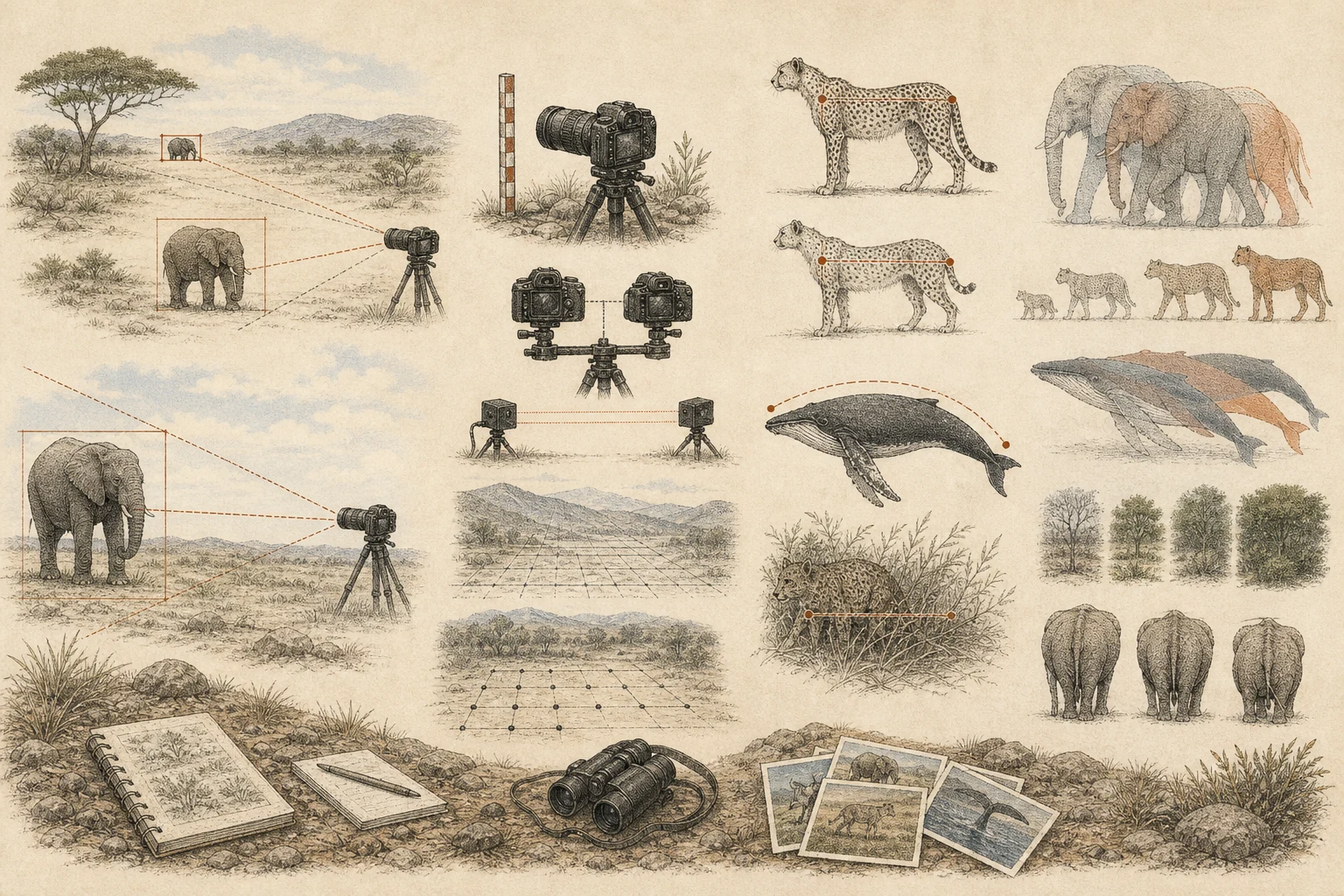
A crow perched on a close fencepost and a raven soaring across a distant ridge can fill the exact same fraction of your binocular view, because the eye and camera lens register angular subtense rather than linear centimeters. Without an independent measure of range or an object of known dimensions sitting in the exact same depth plane as the animal, apparent bigness is an optical trap—especially across featureless snowfields, mudflats, open water, or sky. If a bird or mammal pauses directly beside a fencepost, brick, or boulder, you can return later after the animal has left on its own to measure that exact landmark, provided the animal and reference shared the same distance plane. [1][2]
- Compare an animal only against reference objects standing at the exact same distance, never foreground weeds or distant trees.
- Wait until the animal leaves naturally before walking up to measure a perch, track bed, or boulder used as a scale bar.
- Pair reticle-equipped binoculars or scopes with a laser rangefinder, since angular milliradians cannot yield length without range.
Calibrate the whole image pathway
Photogrammetry turns photographs into non-invasive rulers by linking pixel counts on a sensor to focal length, subject distance, and optical geometry. Researchers measure whales and seals with altitude-calibrated drones, size felids at camera traps by photographing calibration poles at marked distances across the detection zone, and scale marine life using parallel laser dots or stereo-camera rigs. If you use a telephoto lens or trail camera to estimate shoulder height or body length, keep focal length fixed, record uncompressed images with intact EXIF metadata, avoid unrecorded digital crops, and validate the setup beforehand by photographing a meter stick across the full range of distances and frame positions. [1][3]
- Test your camera and lens on a measured target across several distances to quantify barrel distortion and range error first.
- Keep zoom settings fixed and save uncropped original files so pixel-to-angle geometry remains recoverable.
- For fixed trail cameras, photograph a graduated scale pole at multiple marked stations through the camera's field of view.
Pose can dominate the error
Even a perfectly calibrated optical system will underestimate length if the animal is angled toward or away from the lens, hunched against cold wind, or arched in motion. A bobcat walking quartering away foreshortens its head-to-tail axis, a seal curved on uneven cobble hides its true axial length, and fluffed winter plumage makes a perched hawk appear bulkier without changing skeletal measurements. Define strict anatomical landmarks before measuring—such as shoulder height at the dorsal scapula when standing square, or straight-line carapace length—and select only frames where the body axis lies perpendicular to the line of sight. Measure multiple independent frames from the same pass to gauge how posture shifts the result. [3][4]
- Select only broadside frames where the animal stands or swims perpendicular to the camera axis without spinal curvature.
- Use consistent skeletal or rigid landmarks such as shoulder height, bill culmen, or carapace length rather than puffed fur or feathers.
- Measure several frames from the same sequence to see how much stride phase and neck extension alter your reading.
Use size as evidence, not a verdict
Because distance error, lens geometry, and body posture stack together, remote size estimates should always be recorded as a plausible range—such as 55 to 65 centimeters shoulder height—alongside the reference object, distance method, landmark definition, and number of frames measured. Remember too that juveniles, females, and males overlap broadly in dimensions across related species, so a rough size impression rarely clinches a tricky identification without structural proportions, plumage or pelage marks, voice, and habitat context. Above all, non-invasive measurement exists to keep wildlife undisturbed; if you lack a clear scale or range reading, log the size as uncertain rather than stepping closer. [2][4]
- Report body-size estimates as a bounded range paired with the scaling method and landmarks used.
- Combine estimated dimensions with structural ratios—such as bill-to-head or tail-to-body proportions—that do not depend on absolute distance.
- Never approach wildlife to shrink range error or place a scale object while the animal is still present.
Related guides
Get Fauna and identify it in the field.
Where this guide comes from
Source-checked editorial guide. Last updated . This guide teaches identification and field skills; it is not a substitute for expert verification when it matters.
- Methods in Ecology and Evolution — Pinhole-camera estimates of animal size ↗
- NOAA Fisheries — Photogrammetry ↗
- Ecology and evolution — A non-invasive approach to measuring body dimensions of wildlife with camera traps: A felid field trial ↗
- PloS one — An accurate and adaptable photogrammetric approach for estimating the mass and body condition of pinnipeds using an unmanned aerial system ↗