Habitat vs. ecological niche
Habitat is the physical and biological setting used by an organism; niche is a multidimensional concept linking tolerances, resources, timing, and interactions. The familiar shorthand of an address and a job is memorable, but it hides important scale and context.
Last updated
Define habitat relative to an organism
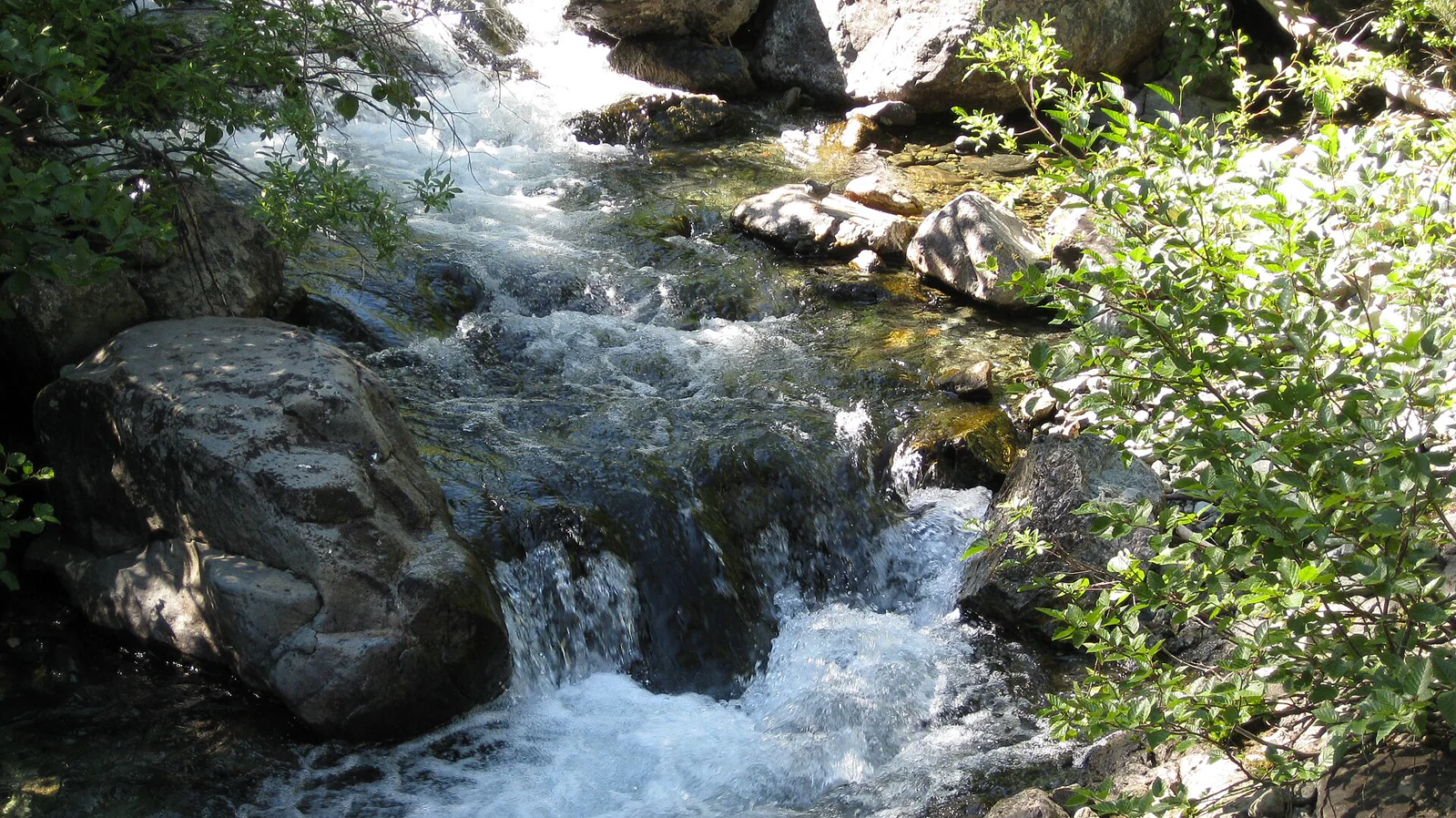
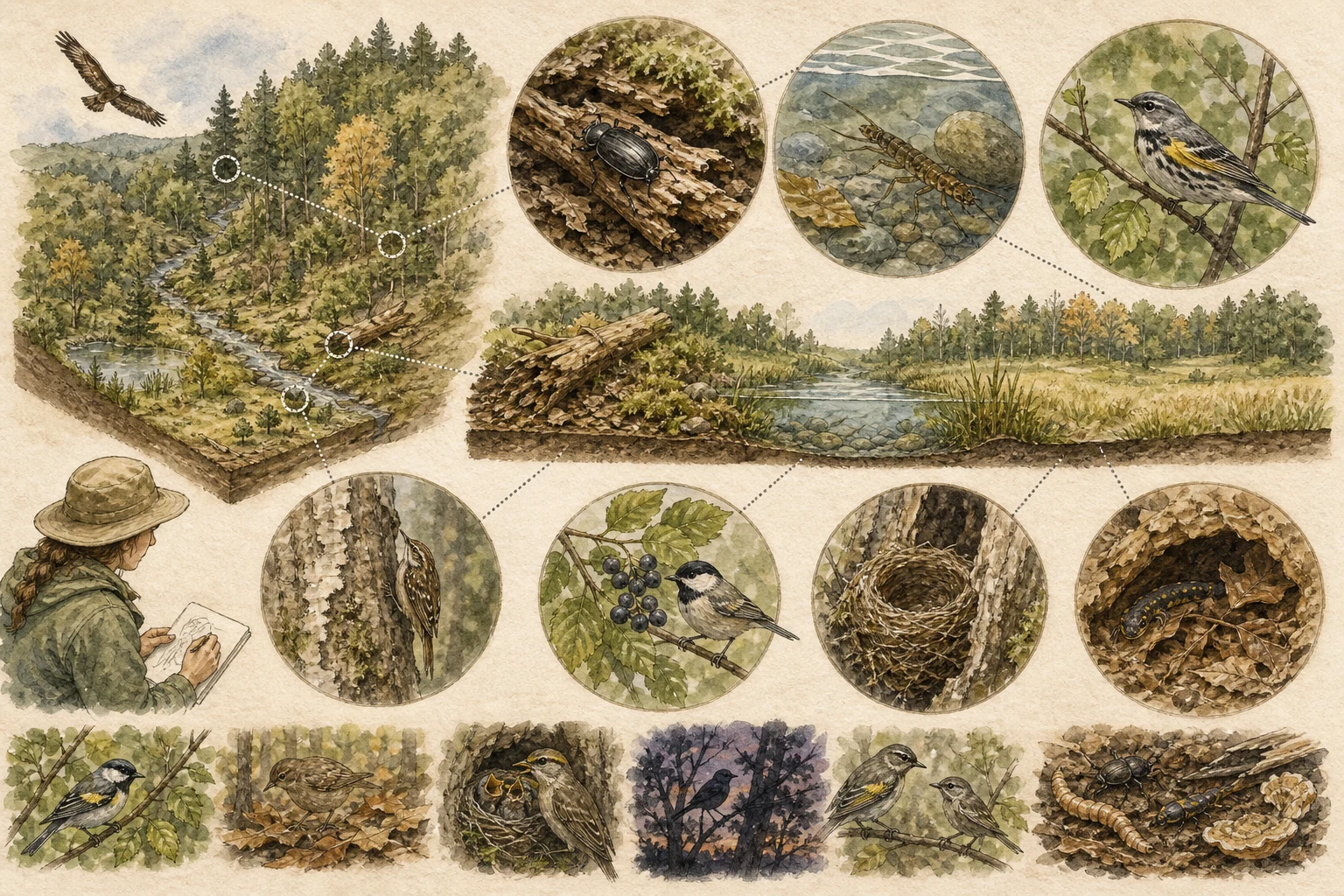
Habitat is not a generic synonym for vegetation type or biome; it is the specific physical and biological setting that supplies the resources—food, water, thermal shelter, breeding sites, and cover—needed by a particular species at a stated spatial scale. A single cold mountain cascade in the Pacific Northwest is macrohabitat for an American dipper foraging underwater along the cobbles, while the thin boundary layer on the underside of one submerged boulder is the entire larval habitat of a net-spinning caddisfly. Always anchor a habitat description to the organism and life stage you are watching. [1][4][6]
- Field check: describe habitat at both the landscape level (riparian conifer forest) and the microhabitat level (mossy boulder face in fast riffles).
- Habitat is organism-specific: a dead standing snag is complete breeding habitat for a bark beetle and one nesting element inside a woodpecker's territory.
- Remember that migratory birds and amphibians require distinct seasonal or life-stage habitats connected by passable corridors.
Treat niche as multidimensional
While classroom analogies often contrast habitat as an organism's 'address' and ecological niche as its 'profession,' modern ecology treats the niche as a multidimensional space combining environmental tolerances, resource use, timing, and biotic interactions. A species' fundamental niche encompasses the full range of temperatures, dissolved oxygen levels, moisture regimes, prey sizes, and nesting substrates under which it could survive and reproduce without interference, whereas its realized niche is the narrower slice of conditions and resources it actually uses when competitors, predators, pathogens, and mutualists are present. [2][3][5]
- An ecological niche integrates abiotic tolerances (temperature, pH, moisture), resource use (diet, shelter), and biotic interactions.
- Competition and predation often restrict a population from its broader fundamental niche into a smaller realized niche in the wild.
- Common trap: reducing 'niche' to a single dietary label like 'insectivore' without considering timing, microclimate, and foraging strata.
Shared habitat does not mean identical niche
Stand in a northern spruce-fir forest in June or beside a rocky stream riffle and you will see half a dozen closely related species sharing the exact same habitat while occupying distinct ecological niches. Wood warblers in the same conifer crown partition foraging height and branch zones from trunk to outer needles; stream stoneflies, mayflies, and caddisflies on the same cobble bed divide food resources by scraping algae, shredding dead leaves, or filtering drifting particles across different seasonal windows. Resource partitioning in time, space, and diet allows co-occurring species to coexist without one competitively excluding the others. [3][4][5]
- Coexisting species in the same woodland or stream often partition resources by foraging height, prey size, or daily and seasonal timing.
- Aquatic macroinvertebrates sharing one riffle separate into functional feeding groups such as shredders, scrapers, collectors, and predators.
- Observing two species in the same bush does not mean they compete directly—watch what they eat and how they forage.
Build each concept from field observations
In your field notebook, you can record concrete building blocks for both habitat and niche during a single observation session. Start with nested habitat notes: substrate, immediate microhabitat cover, plant community, water feature, and surrounding topography. Then layer in niche dimensions you actually witness: air or water temperature, time of day, foraging maneuver, specific food item or host plant, and interactions such as territorial chasing, flock association, or pollination. Keep in mind that a handful of sightings documents local habitat use and realized behavior at one moment, whereas mapping a species' full niche requires data across environmental gradients. [1][2][4][5]
- Field check: pair physical place notes (substrate, canopy, elevation) with behavioral role notes (foraging maneuver, food item, time of day).
- Distinguish where an animal is merely resting or passing through from the microhabitats where it actively feeds or breeds.
- Avoid claiming a species 'requires' a specific tree or rock type from one sighting—check regional accounts across its wider range.
Related guides
Get Fauna and identify it in the field.
Where this guide comes from
Source-checked editorial guide. Last updated . This guide teaches identification and field skills; it is not a substitute for expert verification when it matters.
- U.S. Environmental Protection Agency — Habitats and ecosystems ↗
- Nature Education — Ecological niche glossary ↗
- Nature Education — The maintenance of species diversity ↗
- National Park Service — Aquatic macroinvertebrate habitat and life history ↗
- U.S. Environmental Protection Agency — Ecological niche theory ↗
- National Park Service — Habitat and niche concepts ↗