Why sea otters use tools
A hard object can act as a hammer, a portable chest anvil, or a fixed anvil, letting an otter pry loose or fracture prey that teeth and paws alone handle less efficiently. The behavior is flexible rather than compulsory, and it is especially associated with hard-shelled snails and bivalves.
Last updated
A tool changes the mechanical problem
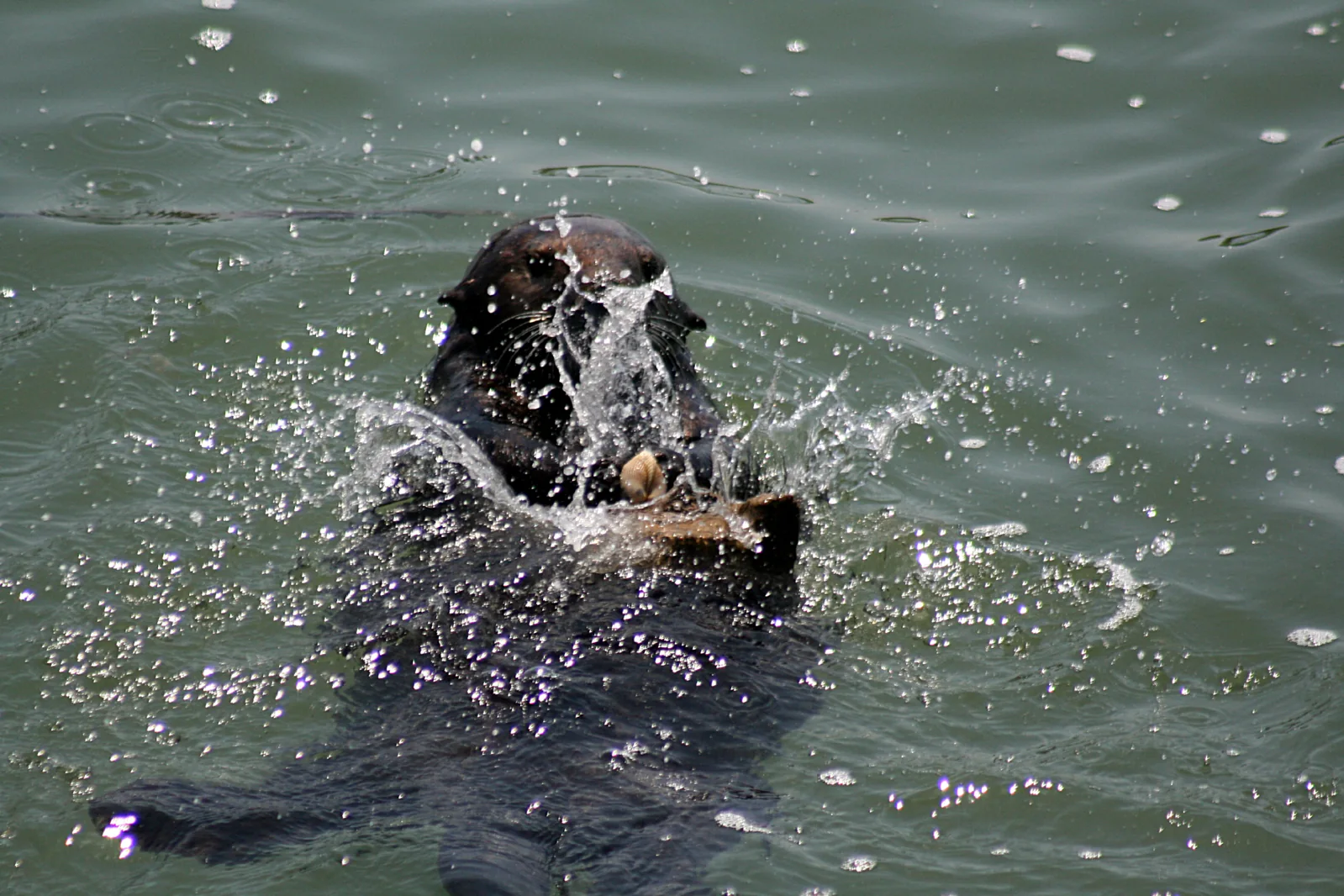
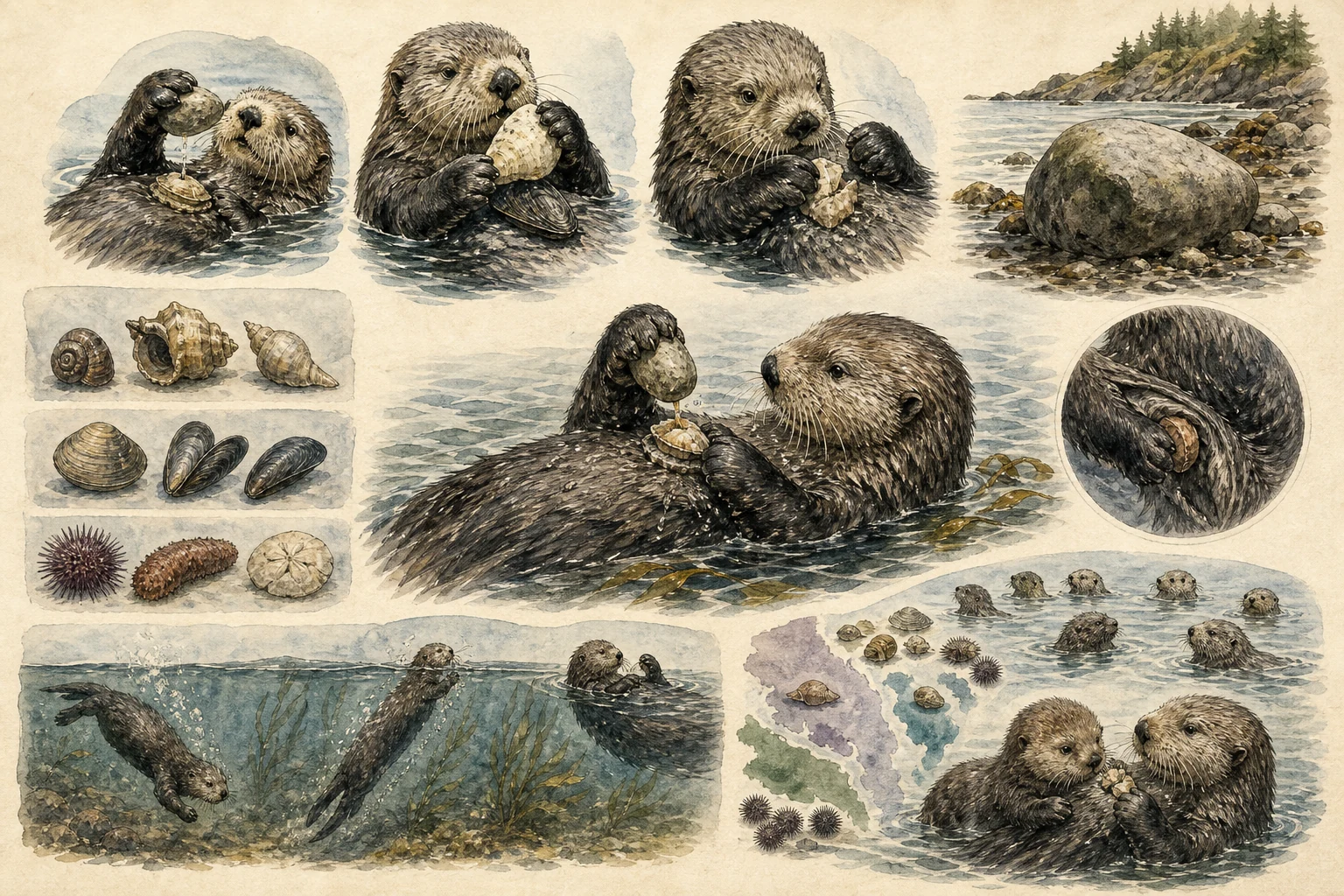
Sea otters (Enhydra lutris) lack the blubber reserves of seals and must consume roughly a quarter of their body mass daily in benthic invertebrates, many of which are heavily armored or cemented to rock. When bunodont molars and jaw muscles alone would risk tooth fracture or slow down handling, an otter changes the mechanics by introducing an external hard surface. Floating on its back, it may balance a flat cobble on its chest as a portable anvil and smash a clam or turban snail down onto it, reverse the arrangement to hammer a large shell with a rock, beat clustered mussels against an emergent shoreline boulder, or hammer underwater with a heavy stone to dislodge a clinging abalone foot from a crevice. [2][4][5]
- Chest rocks serve as portable anvils for pounding snails and bivalves, while handheld stones work as hammers on larger shells.
- Divers sometimes use stones underwater to knock tightly clamped abalone loose from rocky reefs.
- Soft-bodied worms, thin-shelled crabs, and small sea urchins are typically crushed with the paws and blunt molars without tools.
Tool use is famous, not universal
Although photographs of California sea otters tapping rocks on their chests have made tool use iconic, long-term field tracking across eight North Pacific populations—from the Aleutian Islands down to central California—shows that tool use ranges from less than 1 percent to over 70 percent of observed feeding dives. Prey anatomy and local abundance drive most of that spread. Where big, easily cracked sea urchins or soft-bodied infauna are abundant, otters rarely carry stones. Where energy-rich prey have become scarce and individuals specialize on thick-shelled marine snails (such as Tegula) or deeply buried heavy clams, tool use rises sharply because mechanical pounding makes otherwise unprofitable armor worth harvesting. [1][3]
- Multi-year surveys across eight North Pacific sea otter populations show tool-use rates varying from near zero to over 70 percent of dives.
- Hard-shelled marine snails and thick-valved clams trigger the highest rates of rock and shell tool use.
- Even within the same kelp forest or estuary, individual sea otters specialize on different prey suites and differ strongly in tool frequency.
The feeding sequence joins dive and surface
Because sea otters must breathe air and prevent waterlogged fur, nearly all prey processing happens at the sea surface between shallow foraging dives. During a single dive of one to three minutes, an otter probes kelp holdfasts, rocky crevices, or soft estuary mud with sensitive forepaws and vibrissae, tucking several snails, clams, or a favored hammer stone into the loose skin fold—the axillary pouch—stretching across its chest under the left foreleg. Once floating supine on the surface, it retrieves one item at a time with nimble, pad-tipped forepaws, braces the anvil on its chest, delivers rapid rhythmic blows you can hear as sharp clicks across calm water, and rolls 360 degrees to rinse shell shards from its dense pelage. [2][5]
- Loose skin folds beneath the forelimbs form axillary pouches where an otter stows multiple prey items and a chosen rock during a dive.
- Rhythmic rock-on-shell tapping carries clearly across calm bays and estuaries while the otter floats on its back.
- Frequent rolling and vigorous paw grooming between bites clear shell fragments that could foul the insulating underfur.
Habits can leave biological and physical records
Genetic comparisons of southern sea otters in California found that neither mitochondrial haplogroups nor overall genetic relatedness predicted whether an individual became a frequent tool user, ruling out a simple inherited tool-use genotype. Instead, calves spend months floating beside their mothers, sharing prey items and adopting maternal diet specializations and tool-handling techniques through social learning and ecological opportunity. Where otters repeatedly haul clusters of blue mussels (Mytilus) to the same intertidal boulders for anvil pounding, they leave distinctive archaeological signatures: battered rock ridges polished on protruding edges and dense underwater shell middens where one valve is fractured diagonally while the other remains attached to the hinge. [3][4]
- Pups adopt their mother's prey specialization and tool-handling habits during prolonged maternal dependency rather than through genetic inheritance.
- Repeated mussel pounding on shoreline boulders polishes rock ridges and creates recognizable underwater shell middens.
- Otter-broken mussel shells show a characteristic diagonal fracture across one valve rather than prying wear at the margin.
Related guides
Get Fauna and identify it in the field.
Where this guide comes from
Source-checked editorial guide. Last updated . This guide teaches identification and field skills; it is not a substitute for expert verification when it matters.
- U.S. Geological Survey — Variation in sea-otter tool use ↗
- U.S. Geological Survey — Sea otter foraging behavior ↗
- Biology letters — Mitogenomes and relatedness do not predict frequency of tool-use by sea otters ↗
- Scientific reports — Wild sea otter mussel pounding leaves archaeological traces ↗
- IUCN SSC Otter Specialist Group ↗