Carrying capacity and limiting factors
In simple population models, carrying capacity is the abundance around which density-dependent growth balances. In nature, food, water, shelter, disease, predators, weather, and human activity vary, so the effective capacity can rise or fall by season, age structure, behavior, habitat condition, and the timescale being considered.
Last updated
K belongs to a model
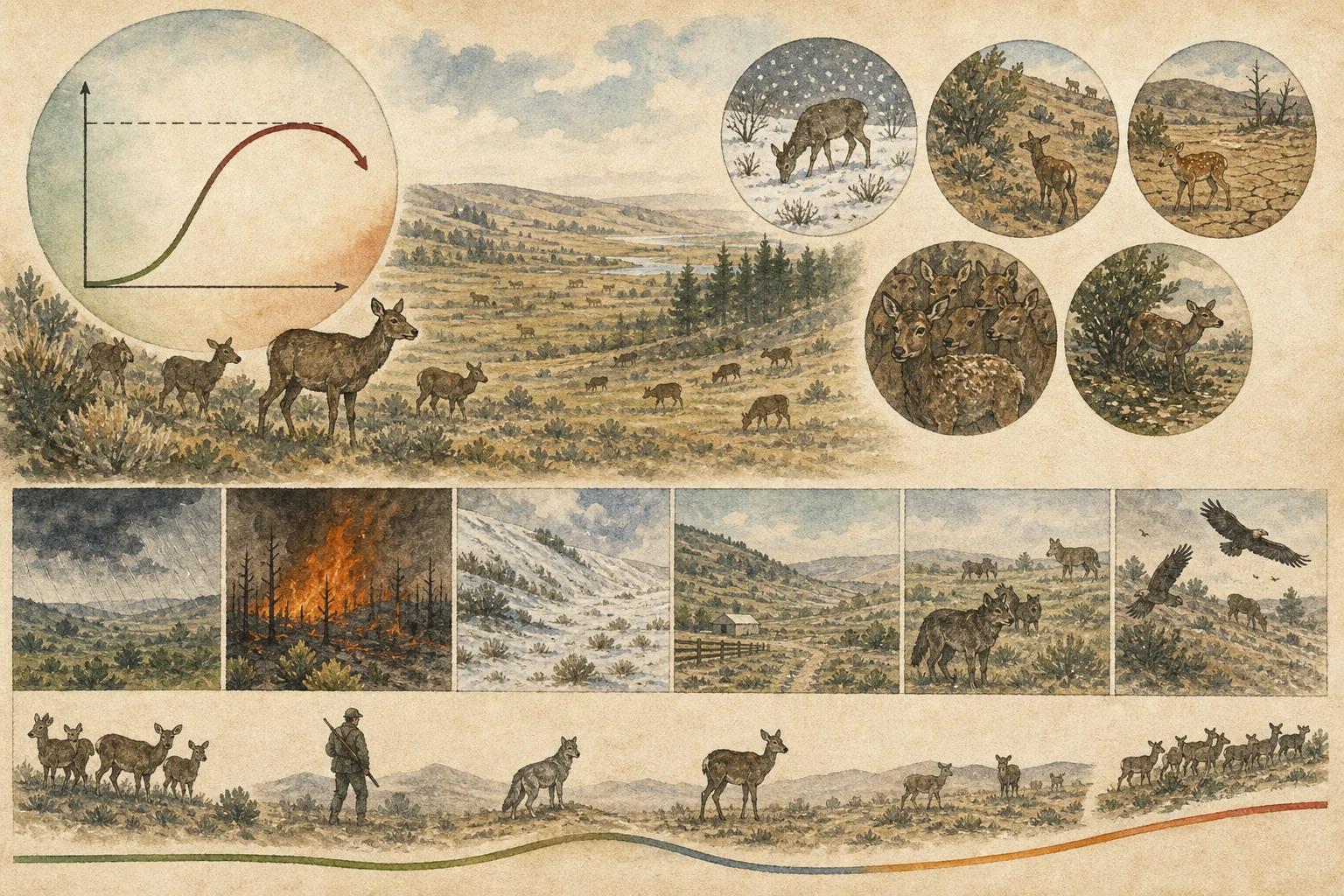
In the classic logistic growth equation, per-capita population growth slows linearly as abundance approaches carrying capacity (K), equals zero right at K, and turns negative whenever numbers exceed it. That mathematical formulation yields a tidy S-shaped curve only under strict assumptions: a closed population with no immigration or emigration, an unchanging environment, identical individuals, and instantaneous feedback between population density and birth or death rates. Wild populations of ungulates, birds, or insects frequently overshoot available forage because winter mortality and reproductive adjustments lag behind summer growth. Treating K as an statistical parameter estimated from demographic time series prevents mistaking it for a rigid headcount stamped onto a reserve. [1][2]
- In the logistic equation, K is the equilibrium abundance where per-capita birth and death rates balance in a closed, constant environment.
- Time lags in reproduction and resource recovery allow wild populations to temporarily overshoot their estimated carrying capacity.
- K is a model-based estimate tied to specific assumptions and time periods rather than a fixed ceiling visible in the field.
Different factors limit different life stages
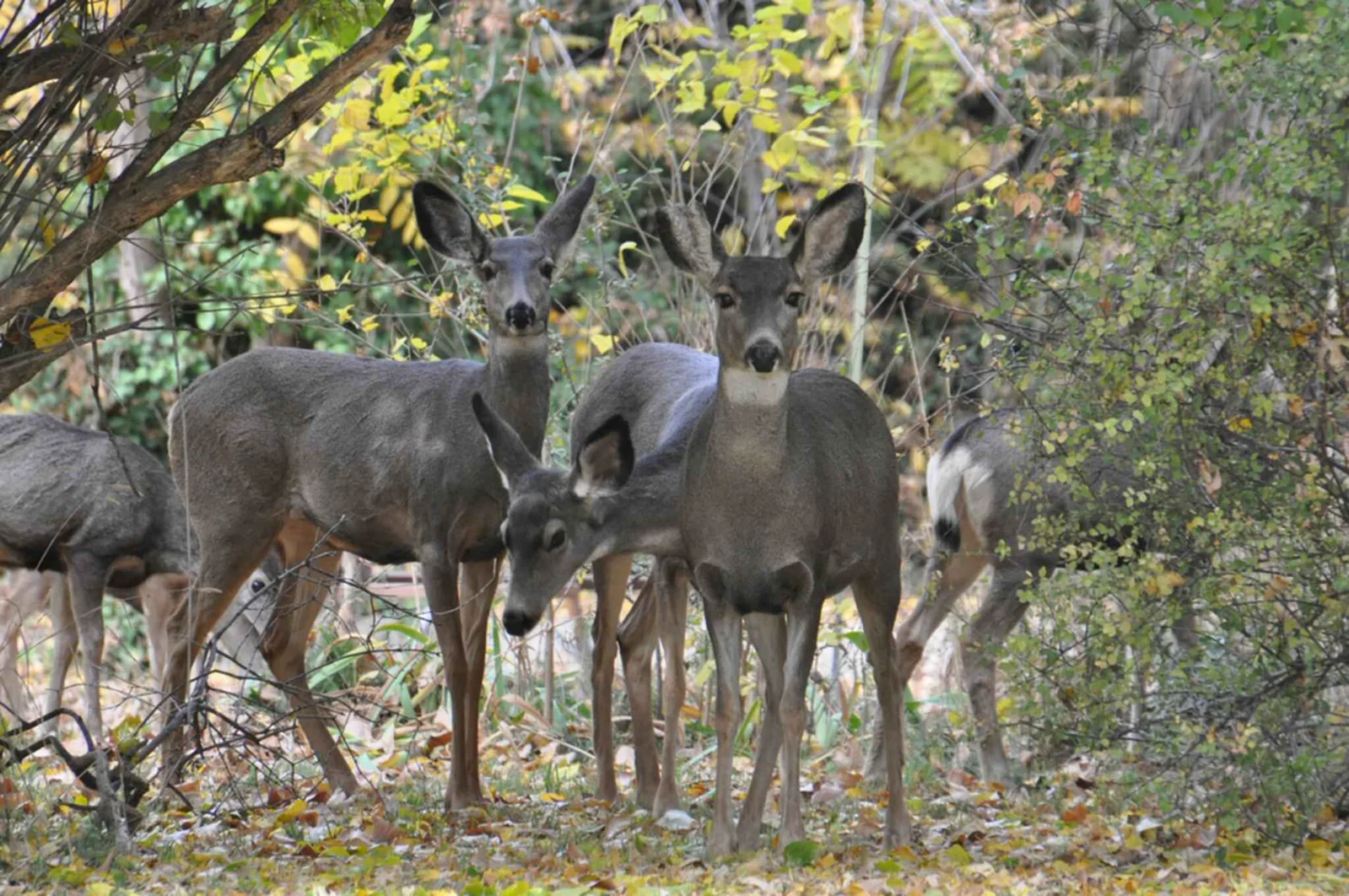
A population is rarely constrained by a single universal bottleneck across the entire year; instead, limiting factors shift with season, habitat patch, and life stage. For a herd of mule deer in the intermountain West, digestible bitterbrush and sagebrush twigs exposed above deep snowpack may limit overwinter survival of fawns, whereas spring protein availability governs lactation and summer fawn recruitment. For cavity-nesting ducks or owls, abundant aquatic or rodent prey cannot raise breeding numbers if old snags with suitable nest holes are scarce. Ecologists pinpoint active limiting factors by measuring age-specific survival, fecundity, body fat reserves, and experimental resource additions across multiple years. [2][3]
- Winter browse availability, breeding cavities, predator pressure, and disease can limit different age classes of the same population.
- A resource that is abundant across a region can still limit growth if snow, territoriality, or distance makes it inaccessible when needed.
- Identifying the active limiting factor requires tracking age-specific survival and reproduction rather than guessing from a single habitat survey.
Capacity changes with conditions
Because carrying capacity emerges from the interaction between organisms and their environment, it rises and falls as weather, disturbance, and community composition change. A wet spring in semi-arid rangeland flushes annual forbs and grasses that boost rodent and herbivore productivity, whereas a multi-year drought or severe wildfire can slash forage and thermal cover for a decade. Overgrazing by abundant browsers during a hard winter can itself damage shrub regeneration, lowering the landscape's capacity in subsequent years. Shifts in a population's age structure, social spacing, or shared competitors also alter per-capita resource demand, meaning the same valley supports different sustainable densities across seasons and decades. [1][4]
- Drought, rainfall, fire, and succession continually raise or lower the resources a landscape supplies from year to year.
- Heavy browsing during a population overshoot can degrade slow-growing winter shrubs and reduce carrying capacity for years afterward.
- Competitors, predators, and changes in population age structure alter how many individuals a given food supply can support.
Abundance alone cannot reveal the limit
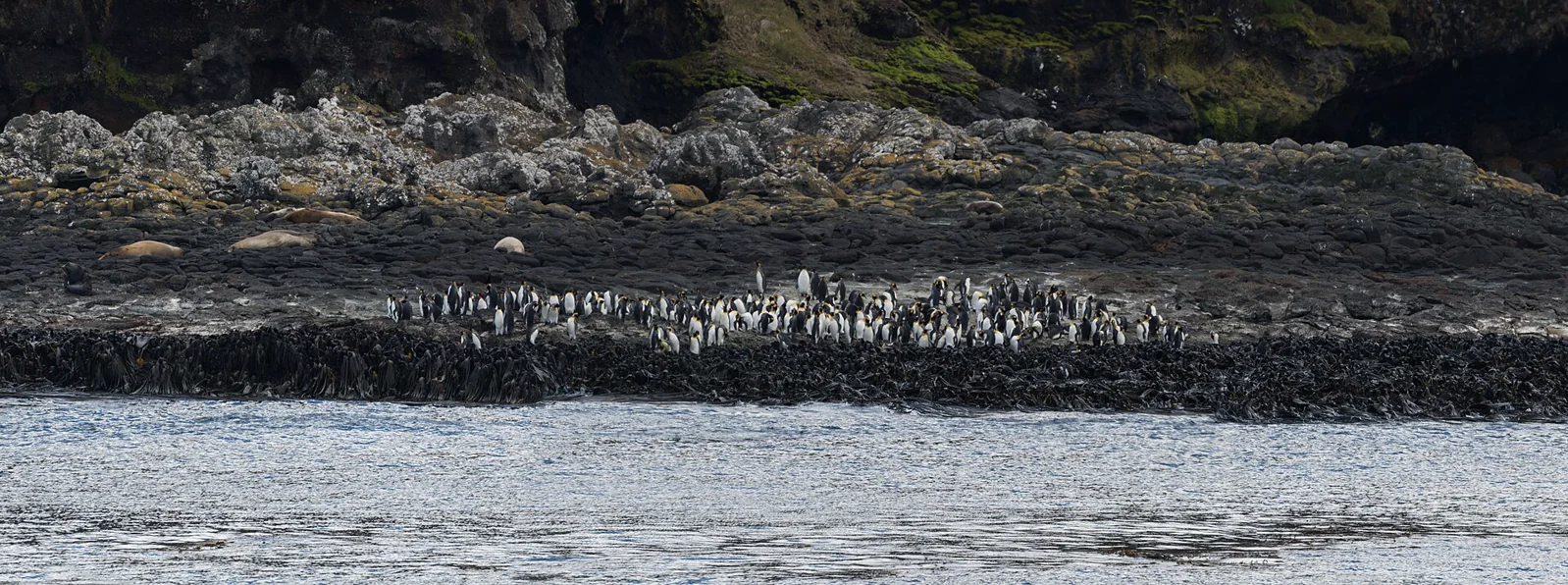
Counting a herd of deer on an open refuge flat or tallying winter waterfowl on an estuary tells you current abundance, not whether the population sits below, at, or above carrying capacity. A low count might reflect heavy harvest, recent disease, predator recovery, or incomplete colonization of abundant habitat; a high count might capture a transient seasonal aggregation or a temporary overshoot already depleting winter browse. Wildlife managers therefore pair census counts with physiological and habitat indicators—such as marrow fat, twin rates, fawn survival, and browse-line measurements—while explicitly separating biological carrying capacity from social or agricultural tolerance limits set by human communities. [3][4]
- A single headcount cannot distinguish a stable population at capacity from a transient aggregation or a temporary overshoot.
- Biologists pair abundance surveys with body-condition scores, juvenile recruitment, and vegetation browse indices to assess population status.
- Cultural or management targets for acceptable crop damage or forest regeneration are human policy choices distinct from ecological K.
Related guides
Get Fauna and identify it in the field.
Where this guide comes from
Source-checked editorial guide. Last updated . This guide teaches identification and field skills; it is not a substitute for expert verification when it matters.