How elephants communicate with infrasound
Large vocal folds generate a low fundamental frequency plus higher harmonics. Low-frequency energy attenuates relatively slowly, so another elephant may detect a rumble beyond visual range; identity, context, habitat, wind, vegetation, and noise determine what information remains available.
Last updated
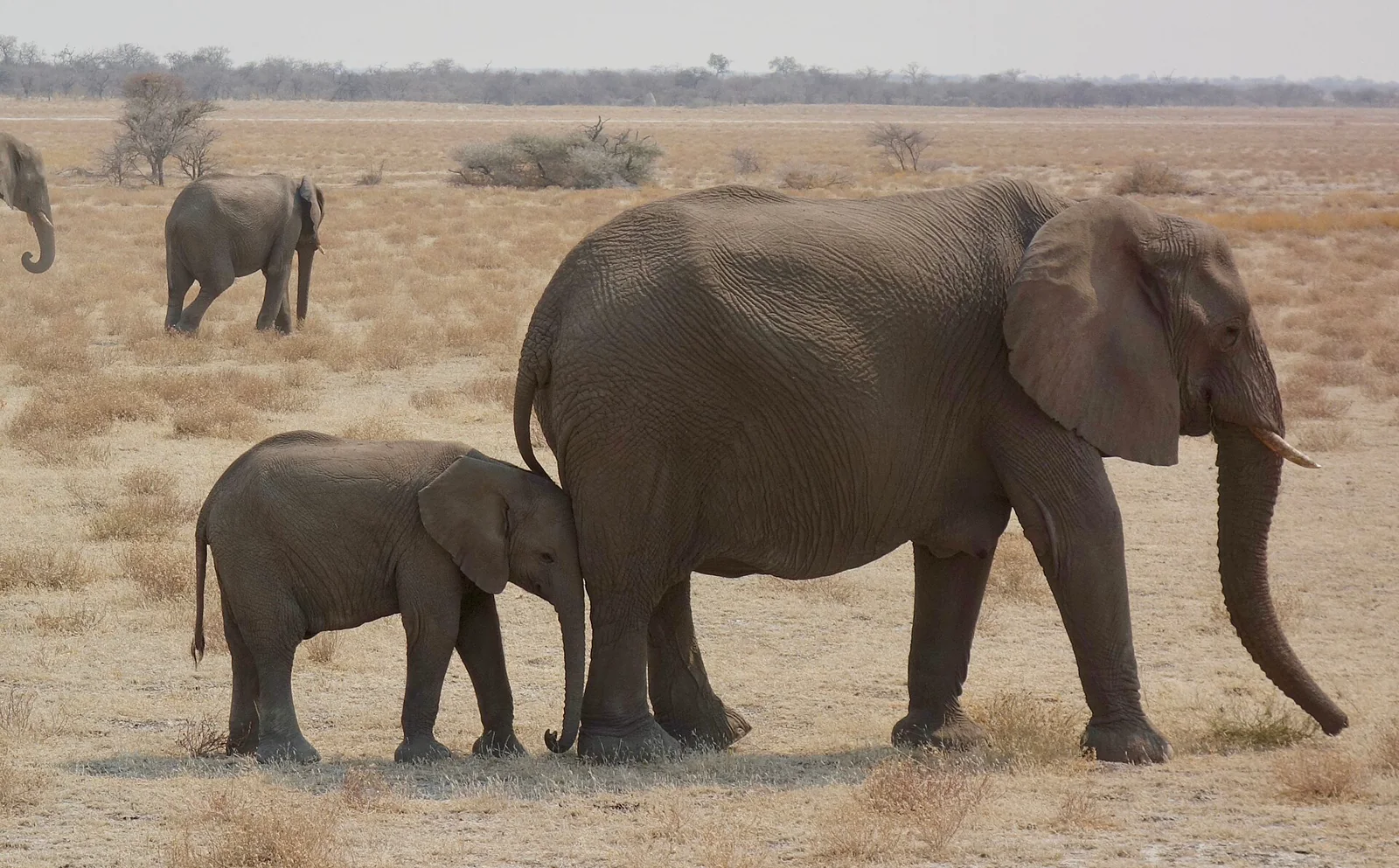
Infrasound is one component of a rumble
Acousticians define infrasound as acoustic energy below roughly 20 hertz, the typical lower threshold of human hearing. When an African savanna elephant (Loxodonta africana), African forest elephant (Loxodonta cyclotis), or Asian elephant (Elephas maximus) produces a low rumble, its fundamental frequency often drops into that 10 to 20 hertz infrasonic band. However, the same vocalization generates a stacked series of higher-frequency harmonics extending well into the human audible range, which is why an observer standing near a family group hears a deep, resonant throbbing purr rather than silence. Rumbles also sit alongside audible trumpets, roars, barks, snorts, cries, and combination calls in a broad vocal repertoire. [1][2]
- Adult elephant rumbles combine an infrasonic fundamental frequency below 20 hertz with higher harmonics audible to nearby people.
- At close range, a rumble sounds like a deep, vibrating bass purr or distant thunder rather than a completely silent signal.
- Elephants also produce audible trumpets, roars, snorts, and cries that serve distinct close- and medium-range social functions.
Large anatomy makes low frequencies possible
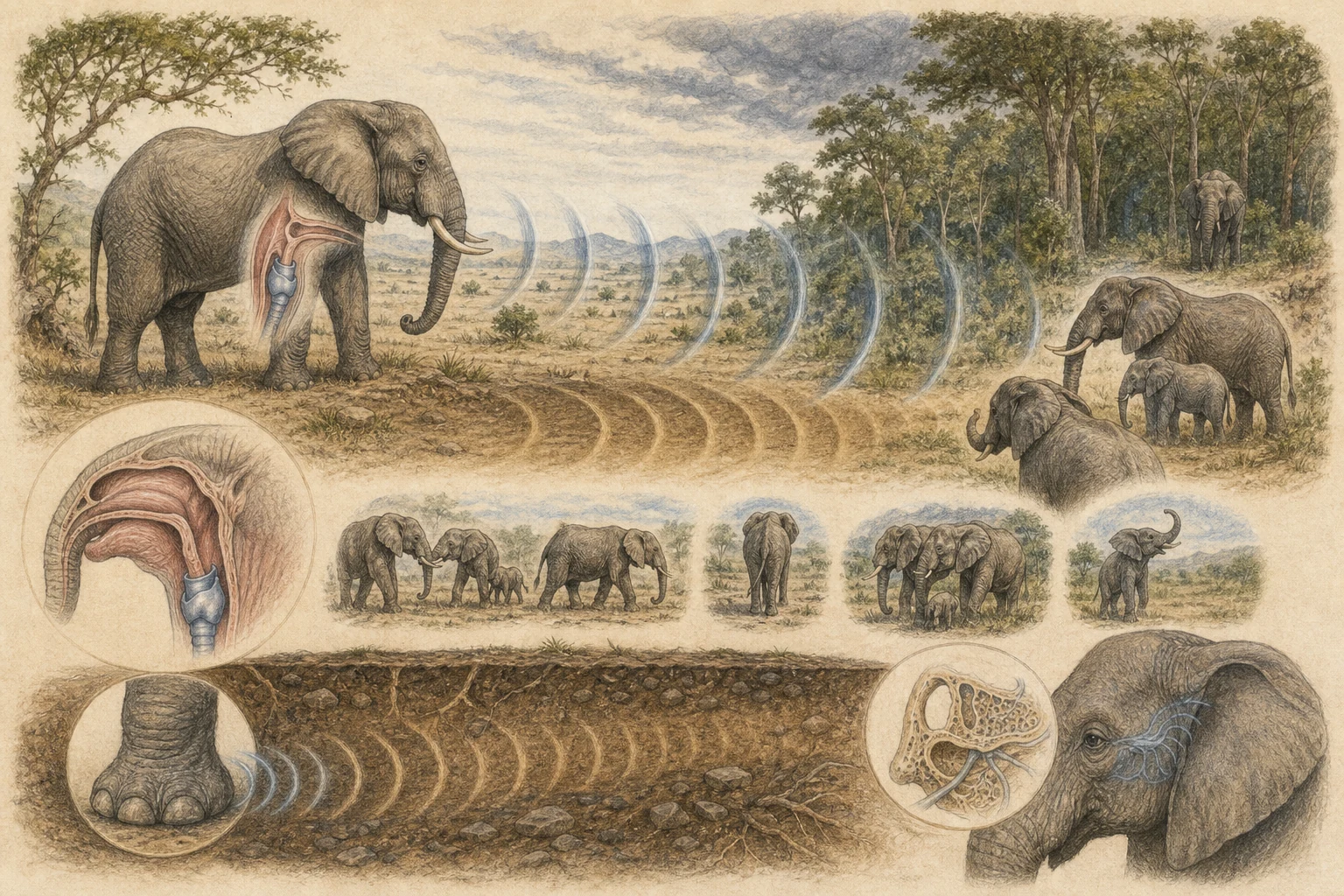
An elephant generates rumbles by driving exhaled air from its lungs past massive vocal folds inside an elongated larynx, setting up self-sustained tissue oscillations whose low pitch reflects the folds' length and mass. Those sound waves then pass through resonant pharyngeal pouches and nasal passages—including the long muscular trunk—which filter and shape the harmonic spectrum. Because low-frequency sound waves have wavelengths of many meters, they diffract around tree trunks and suffer far less atmospheric absorption than high-pitched calls. Depending on wind shear, evening temperature inversions, savanna grass or rainforest foliage, and ambient noise, airborne rumbles can reach listening elephants several kilometers away. [1][2]
- Massive laryngeal vocal folds and a long vocal tract extending through the trunk produce low fundamental frequencies and resonant formants.
- Long-wavelength low frequencies bend around vegetation and lose less energy to air absorption than high-pitched vocalizations.
- Calm evening temperature inversions over open savannas extend airborne detection range compared with windy midday turbulence.
Structure and context carry the information
Field studies across East and southern Africa show that rumbles coordinate herd departures, maintain contact across dense bush, reunite separated mothers and calves, mediate exuberant family greetings, and advertise estrus or musth during reproduction. Subtle modulations in frequency contour, duration, formant spacing, and amplitude encode the caller's individual identity, sex, age class, reproductive state, and emotional arousal. When a distant rumble arrives, listening elephants often freeze in place, spread their large pinnae wide, pivot their heads to triangulate the airborne wave, or lift one foreleg while orienting toward the caller. Bioacousticians pair microphone arrays and machine-learning classifiers with focal behavioral observations to decode which call variants trigger approach, bunching, or flight. [1][2][3]
- Listening elephants often freeze, fan their ears outward, and orient their heads to localize a distant rumble.
- Formant frequencies, pitch contour, and duration encode caller identity, reproductive state, and social urgency.
- Automated acoustic monitoring arrays use rumble spectrograms to track forest and savanna elephant presence without visual contact.
Ground vibration is related but distinct
When an elephant emits a high-amplitude rumble, acoustic energy couples from the animal's body and the air into the soil as Rayleigh surface waves that travel through the substrate. Field playback experiments using seismic shakers demonstrate that elephants detect and discriminate ground-borne vibrations—distinguishing familiar from unfamiliar herds or reacting with wariness to human-generated vehicle and mining tremors—likely through two complementary pathways: bone conduction through the toe bones, limbs, and shoulders to the middle ear, and mechanoreceptors (Pacinian corpuscles) embedded in the fatty cushions of the feet. Geophones buried along trails can likewise detect and triangulate both rumbles and heavy footfalls across hundreds of meters. [3][4][5]
- Vocal rumbles and heavy locomotion launch seismic surface waves that travel through soil alongside airborne sound.
- Elephants sense ground vibrations via Pacinian corpuscles in their cushioned foot pads and bone conduction through the skeleton.
- Resting one forefoot lightly on the ground or leaning forward onto the front legs can enhance seismic reception.
Related guides
Get Fauna and identify it in the field.
Where this guide comes from
Source-checked editorial guide. Last updated . This guide teaches identification and field skills; it is not a substitute for expert verification when it matters.
- ElephantVoices — Elephant acoustic communication ↗
- ElephantVoices — Elephant communication ↗
- Journal of the Royal Society, Interface — Elephants and algorithms: a review of the current and future role of AI in elephant monitoring ↗
- Proceedings. Biological sciences — Noise matters: elephants show risk-avoidance behaviour in response to human-generated seismic cues ↗
- Journal of the Royal Society, Interface — Seismic localization of elephant rumbles as a monitoring approach ↗