How beavers build dams
A beaver dam is a maintained, leaky barrier rather than a concrete wall. It reduces current and raises local water depth, helping create aquatic access and refuge; as flow finds gaps and materials shift, beavers add branches, sediment, and vegetation where construction cues are strongest.
Last updated
The dam changes access, not the sleeping chamber
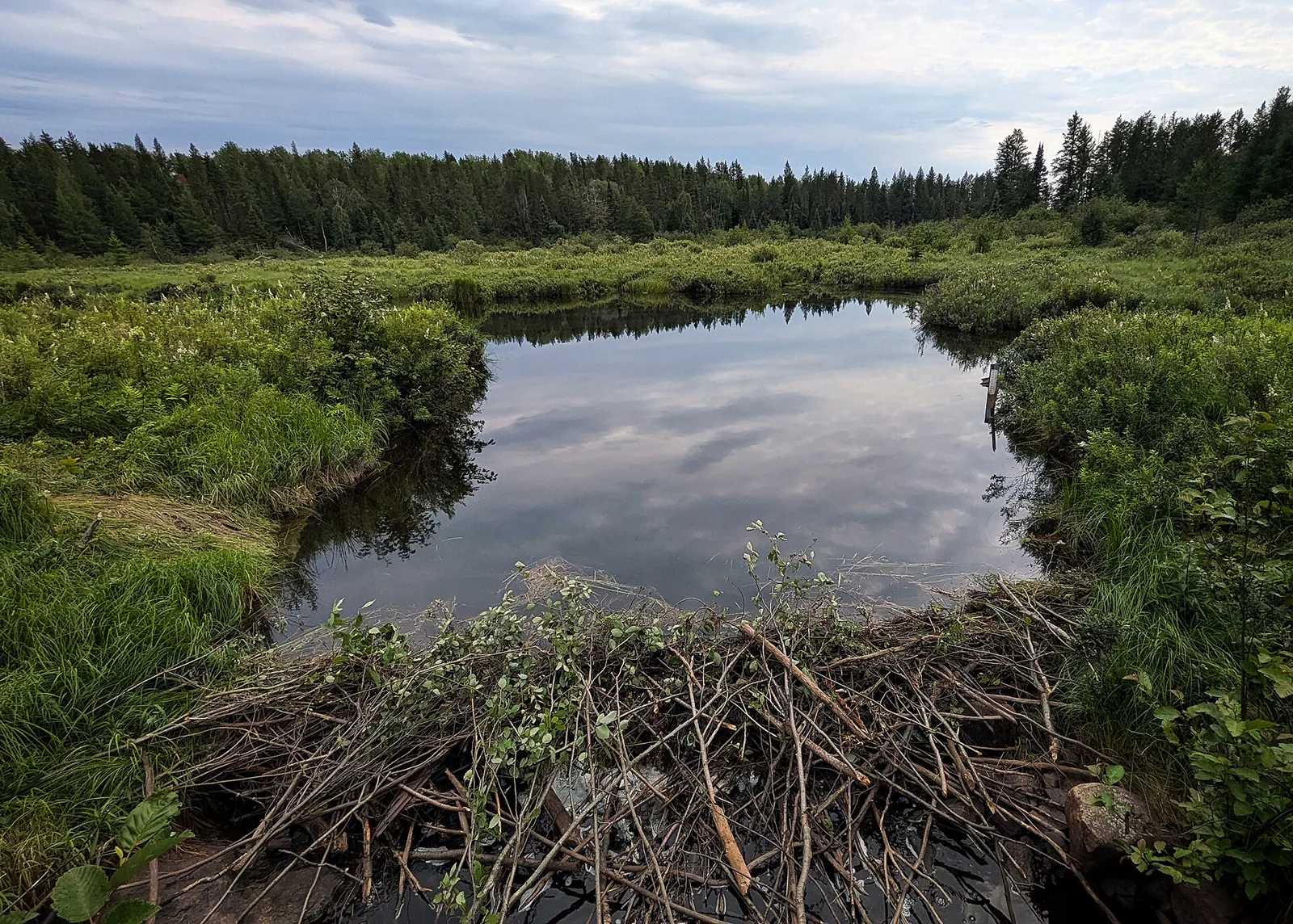
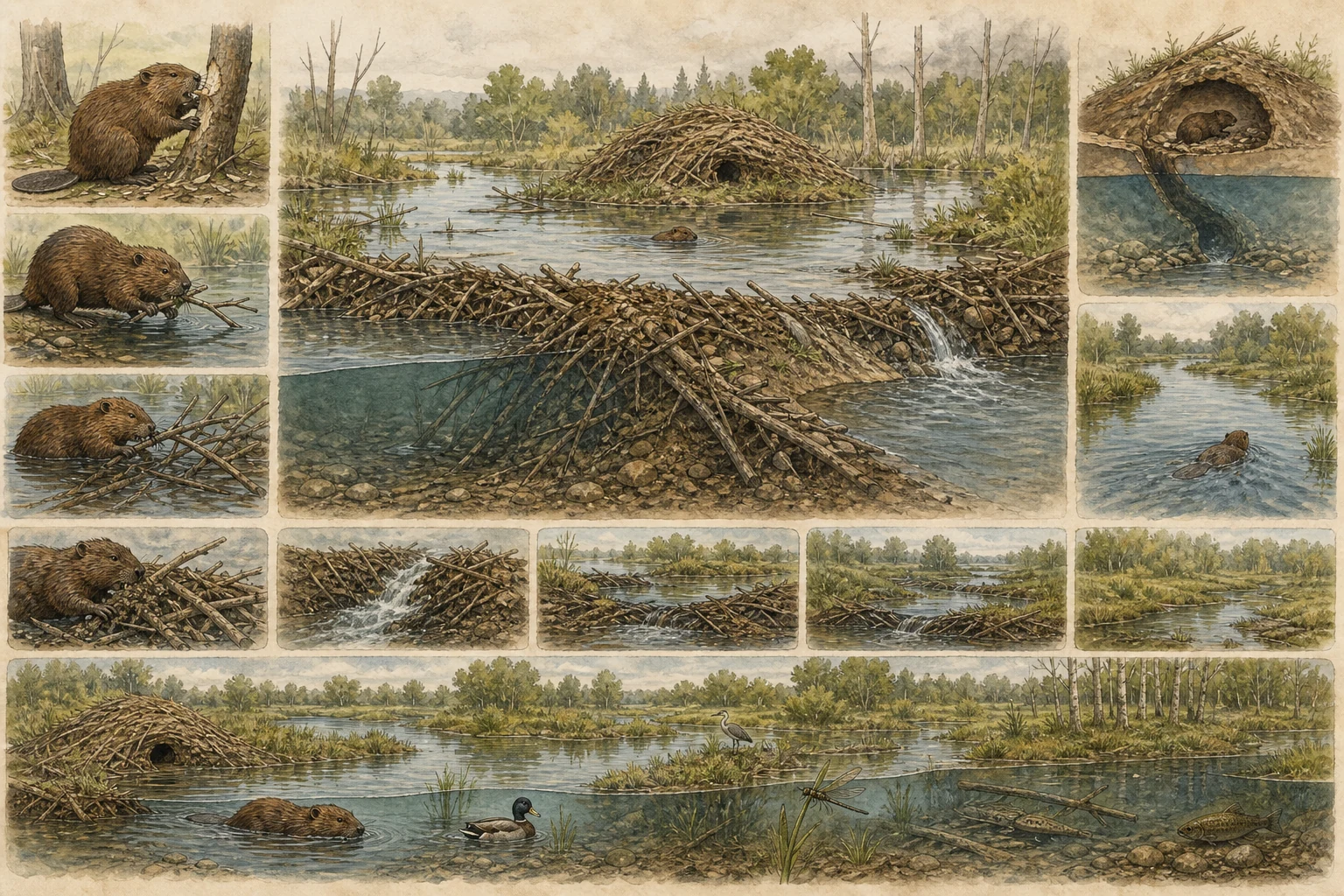
Walk along an active beaver pond and it is easy to confuse the linear stick barrier crossing the stream channel with the rounded dome where the family sleeps. Neither North American beavers (Castor canadensis) nor Eurasian beavers (Castor fiber) live inside their dams. Instead, the dam impounds a shallow creek to raise and stabilize water levels around a separate stick lodge or streamside bank burrow. Deeper water keeps underwater plunge-hole entrances concealed beneath winter ice and out of reach of wolves, coyotes, bears, and lynx, while flooding low floodplain margins so beavers can swim directly to willow, aspen, birch, and alder stands and float heavy winter food caches back to the lodge without hauling logs far across dry land. [1][2]
- Dams are linear channel barriers that control water depth; beavers sleep and raise kits inside separate lodges or bank dens.
- Deep impounded water keeps lodge entrances submerged below winter ice and conceals entry routes from terrestrial predators.
- Beavers living on already deep rivers or lakes often occupy bank burrows and build no dam at all.
A framework becomes a packed, permeable barrier
Beavers fell trees and shrubs using ever-growing, iron-enamel incisors, then tow branches in their jaws or carry mud and cobbles clutched against the chest with their dexterous forepaws. To start a dam across a riffle or constriction, they wedge heavy butt ends into the streambed or brace stems against boulders, logs, and bank roots, interweaving cross-branches into a latticework crest. They then plaster the upstream face with dredged pond mud, gravel, stones, and uprooted sedges. Acoustic and hydrodynamic cues from trickling or rushing water guide ongoing maintenance: whenever spring runoff or shifting wood opens a noisy gap, resident beavers pack fresh sticks and sediment directly onto the leak, leaving a resilient, seeping filter rather than an impermeable concrete wall. [2][3]
- Stems wedged into the bed or braced against boulders form the structural frame, while mud and stones seal the upstream face.
- The sound and feel of rushing water at a breach trigger targeted nightly repairs by colony members.
- Even well-maintained beaver dams remain porous, allowing slow seepage through and around the woven woodwork.
Site conditions shape the design
How tall, wide, or persistent a beaver dam becomes depends heavily on local geomorphology and riparian plant communities. Narrow, low-gradient headwater streams with abundant willow, poplar, or alder encourage stair-step sequences of primary and secondary dams that spread across valley bottoms and calm high-velocity floods. In steep mountain canyons or wide, flashy rivers with high stream power, peak snowmelt or storm flows frequently blow out stick barriers, forcing colonies either to rebuild seasonally or rely on bank dens and narrow side channels. Both Castor canadensis and Castor fiber adjust their construction to substrate: where woody stems are scarce in tundra or rocky streams, dams incorporate substantially more cobbles, peat blocks, and mud. [4][5]
- Low-gradient streams in broad valleys often support multi-dam complexes that divide the drop in water level across several steps.
- High stream power during snowmelt or storm surges regularly breaches dams in steep or confined channels.
- Where trees are sparse, beavers build lower barriers reinforced heavily with stones, gravel, and peat sod.
The engineering continues downstream
When a dam slows channel velocity, suspended silt, sand, and organic detritus settle onto the pond floor, gradually aggrading incised stream beds and storing carbon and nutrients. Laterally, impounded water recharges alluvial aquifers, elevates floodplain water tables, and feeds dug beaver canals that radiate into surrounding wet meadows. Over years, flooded conifers die back into standing snags used by woodpeckers, herons, and cavity-nesting ducks, while amphibians, dragonflies, and juvenile fishes occupy the slackwater margins. Global reviews emphasize, however, that downstream effects depend on biome and thermal regime: in cool northern or montane basins, groundwater exchange beneath dams can buffer summer stream highs, whereas shallow ponds in warm, unshaded lowland ditches may raise local water temperatures. [1][4][5]
- Impounded ponds trap fine sediment and organic matter, raising incised streambeds and reconnecting channels to their floodplains.
- Flooded timber creates standing deadwood snags and open-canopy wetlands used by amphibians, waterfowl, and woodpeckers.
- Effects on downstream water temperature, dissolved oxygen, and fish passage vary with valley shade, groundwater exchange, and climate.
Related guides
Get Fauna and identify it in the field.
Where this guide comes from
Source-checked editorial guide. Last updated . This guide teaches identification and field skills; it is not a substitute for expert verification when it matters.