Why mammals have whiskers
A whisker is a lever seated in a specialized, nerve-rich follicle. Contact or fluid motion bends the shaft and stimulates receptors at its base; the nervous system combines that signal with the whisker’s position and the animal’s own movement to infer what is nearby.
Last updated
The follicle is the sensor
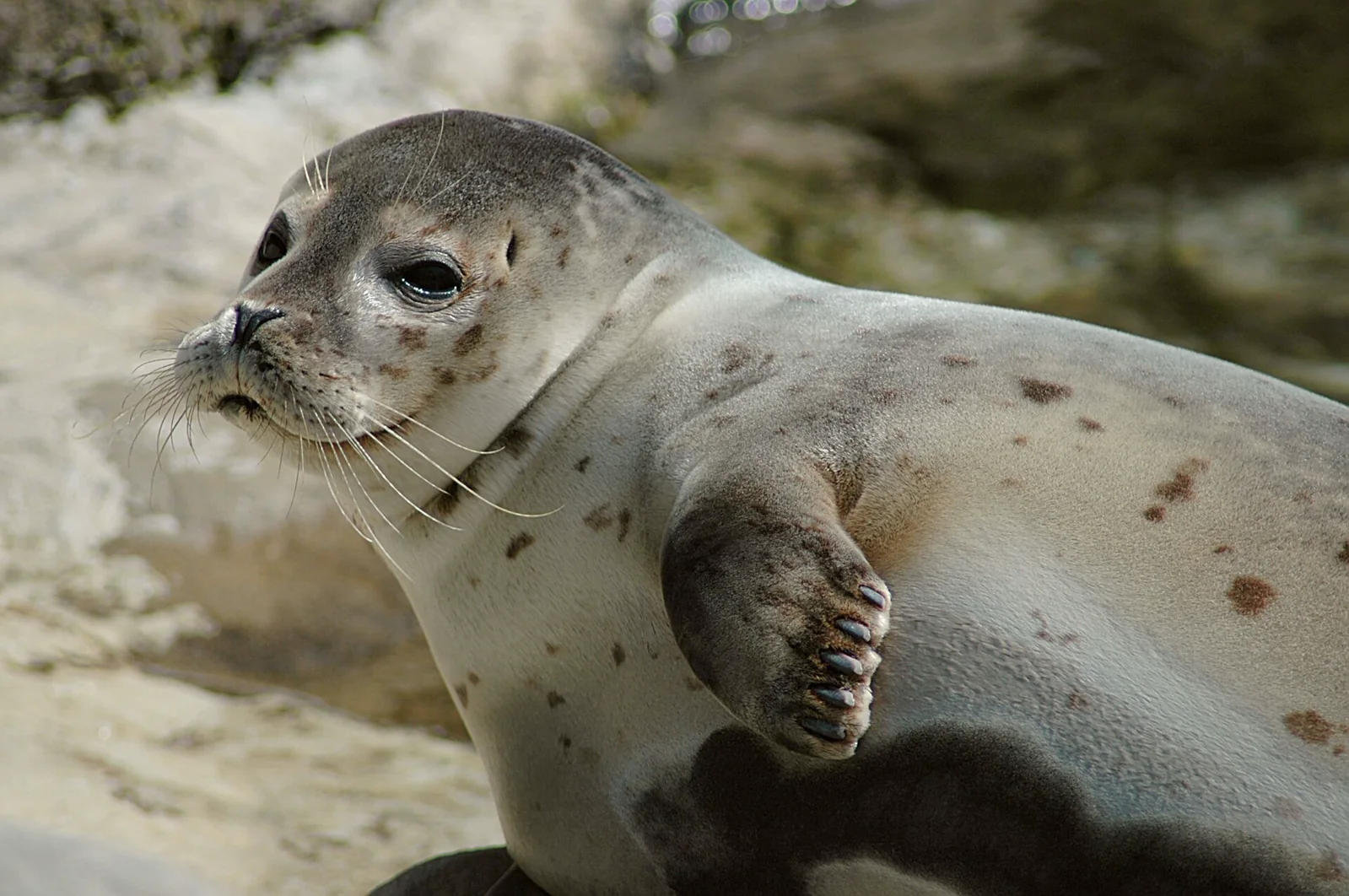
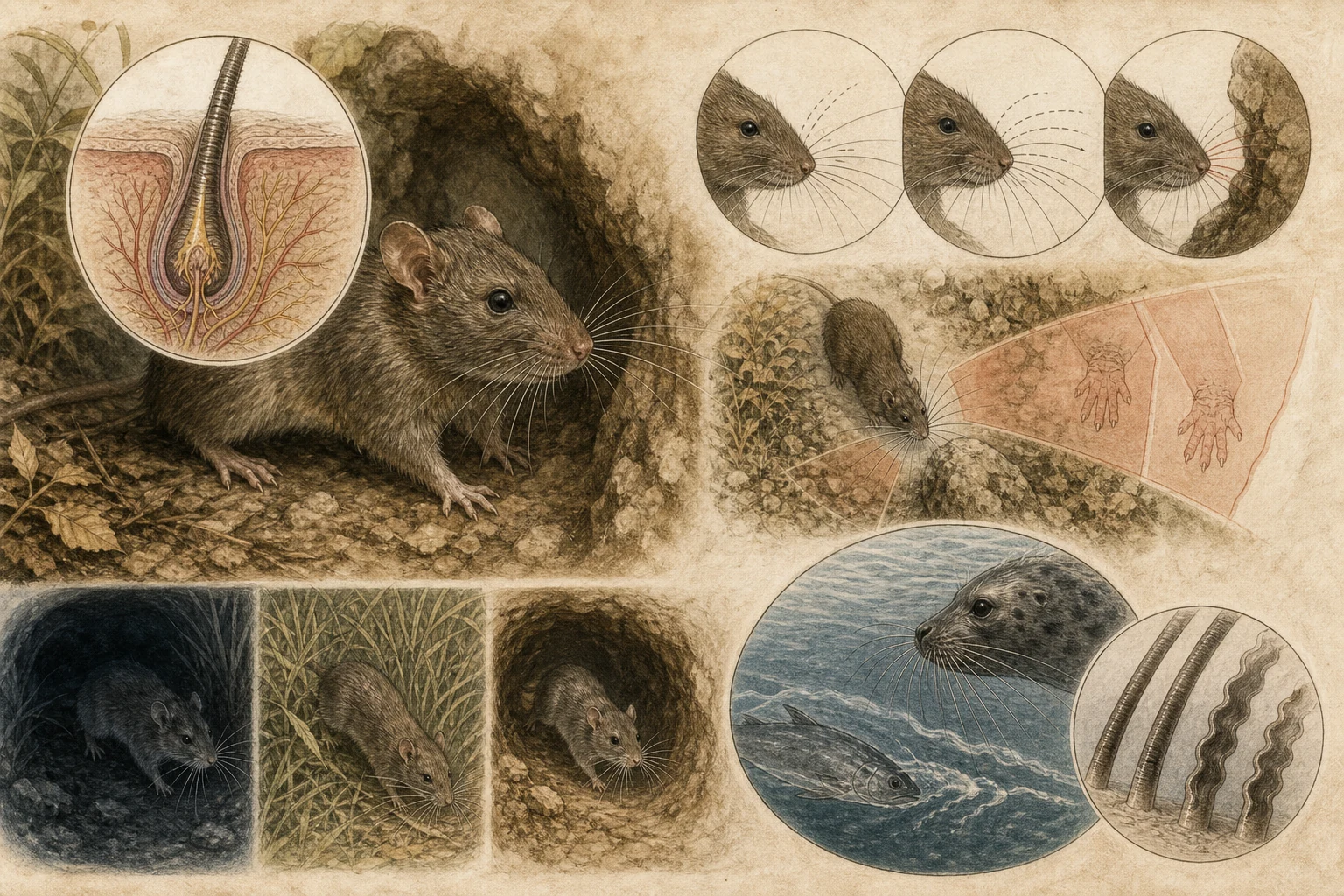
The visible shaft of a mammalian whisker, or vibrissa, consists of dead keratinized hair with no nerve endings along its length. Instead, the stiff, tapered shaft works as a mechanical lever anchored deep inside a specialized follicle-sinus complex surrounded by blood sinuses and dense mechanoreceptors. When the tip or shaft brushes bark, stone, or water eddies, bending moments at the base deform those receptor endings and trigger rapid, precisely timed action potentials in the trigeminal nerve. In brown rats (Rattus norvegicus) and house mice (Mus musculus), long macro-vibrissae sit in ordered rows and columns along the mystacial pad to sweep broad spaces, while a dense brush of short micro-vibrissae around the lips and chin inspects objects held close to the mouth. [1][2]
- Whisker shafts contain no nerves; all touch and vibration sensing happens inside the blood-filled follicle-sinus complex at the base.
- Rodents carry two complementary sets: sweeping mystacial macro-vibrissae on the snout and dense micro-vibrissae around the lips.
- Each follicle maps to a dedicated processing module in the trigeminal pathway and somatosensory cortex.
Movement adds spatial information
When a rat, mouse, or shrew investigates a log or stone crevice, its facial muscles rhythmically sweep the mystacial macro-vibrissae forward and back several times per second in a behavior called whisking. A single passive bend only tells the nervous system that a force occurred; to reconstruct where an edge sits in three-dimensional space, the brain integrates which specific follicle fired with the whisker's protraction angle, radial bend, slip velocity, and the animal's own head posture. Controlled behavioral trials show that rodents use these active sweeps to measure gap width before jumping, judge surface orientation, and distinguish subtle textures from micro-vibrations as fine hairs catch and release across rough substrates. [1][2]
- Active whisking sweeps facial vibrissae back and forth in rhythmic cycles controlled by intrinsic and extrinsic snout muscles.
- The brain combines follicle identity, protraction angle, and bending torque to compute radial distance and object shape.
- Stick-slip micro-vibrations along the hair shaft allow rodents to distinguish fine surface textures in complete darkness.
Whiskers can guide the whole body
Whiskers do more than inspect food at the nose tip; across small quadrupedal mammals such as hazel dormice, red squirrels, and rats, the downward- and forward-projecting vibrissal array spans the exact ground zone where the forefeet are about to land. As an animal runs along a tangled branch, through tall grass, or inside an unlit burrow, whisker tips touch obstacles milliseconds before the paws or eyes reach them, allowing rapid stride adjustments and safe footing. Semiaquatic North American beavers (Castor canadensis) similarly rely on sensitive facial vibrissae when navigating dark underwater bank tunnels or maneuvering cut branches inside an unlit lodge, using tactile cues around the head alongside scent, hearing, and paw contact. [3][5]
- In small climbing and running mammals, the facial whisker field overlaps the landing zone of the front paws.
- Forefoot placement adjustments follow whisker contact within milliseconds when animals cross uneven branches or gaps.
- Beavers use facial vibrissae to detect submerged branches and tunnel walls in turbid water and dark lodges.
Water creates a different tactile problem
In water, foraging pinnipeds use facial vibrissae as hydrodynamic sensors that detect the lingering vortex wakes left by swimming fish seconds after the prey has passed. Harbor seals (Phoca vitulina) and grey seals possess flattened whiskers with a striking beaded, undulating profile along their margins. Fluid-dynamics experiments demonstrate that these wavy undulations disrupt coherent vortex shedding as the seal swims forward, suppressing self-generated vibration of the whisker shaft so that external disturbances from a fleeing herring or bottom current stand out clearly against a quiet baseline. Unlike terrestrial rodents that rapidly whisk in air, hunting seals typically protract their vibrissae into a stiff forward fan that reads hydrodynamic trails in dark or turbid coastal waters. [1][4][5]
- Harbor seal whiskers have an undulating, beaded cross-section that minimizes self-induced vibration during forward swimming.
- Suppressing vortex-induced self-noise lets seals detect the faint hydrodynamic wakes of fish in murky or dark water.
- Hunting pinnipeds hold their mystacial vibrissae protracted forward into the flow rather than whisking them rapidly like rats.
Related guides
Get Fauna and identify it in the field.
Where this guide comes from
Source-checked editorial guide. Last updated . This guide teaches identification and field skills; it is not a substitute for expert verification when it matters.
- Philosophical transactions of the Royal Society of London. Series B, Biological sciences — Active touch sensing ↗
- Frontiers in systems neuroscience — Whisker-Mediated Touch System in Rodents: From Neuron to Behavior ↗
- Proceedings. Biological sciences — Whisker touch sensing guides locomotion in small, quadrupedal mammals ↗
- Journal of the Royal Society, Interface — Creating underwater vision through wavy whiskers: a review of the flow-sensing mechanisms and biomimetic potential of seal whiskers ↗
- NOAA Fisheries — Harbor seal ↗