How animals sense vibrations
A vibrating medium bends hairs, strains joints, moves sensory masses, or displaces water; timing and amplitude across receptors help locate a source, while substrate properties filter which frequencies travel.
Last updated
Mechanoreceptors turn deformation into electricity
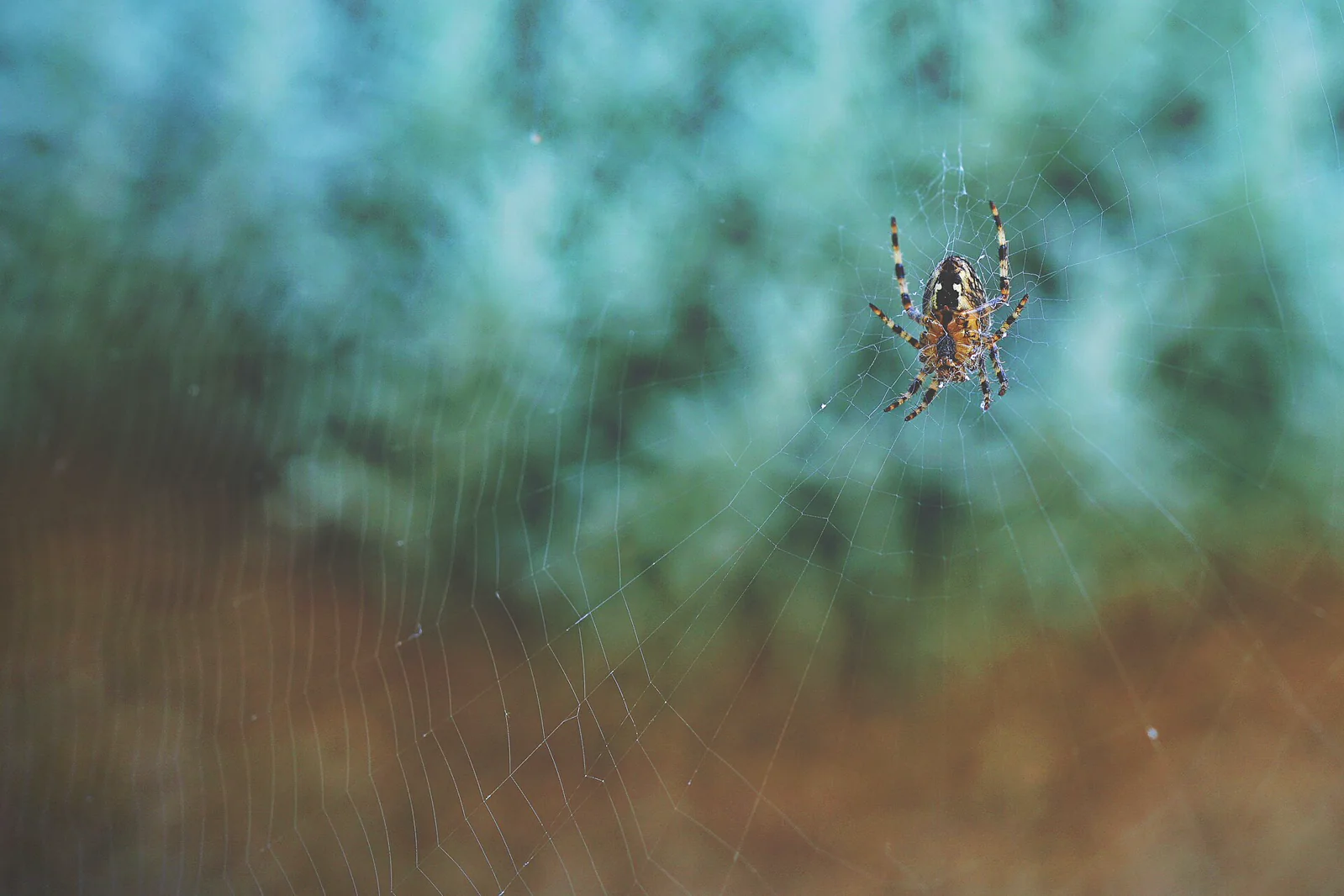
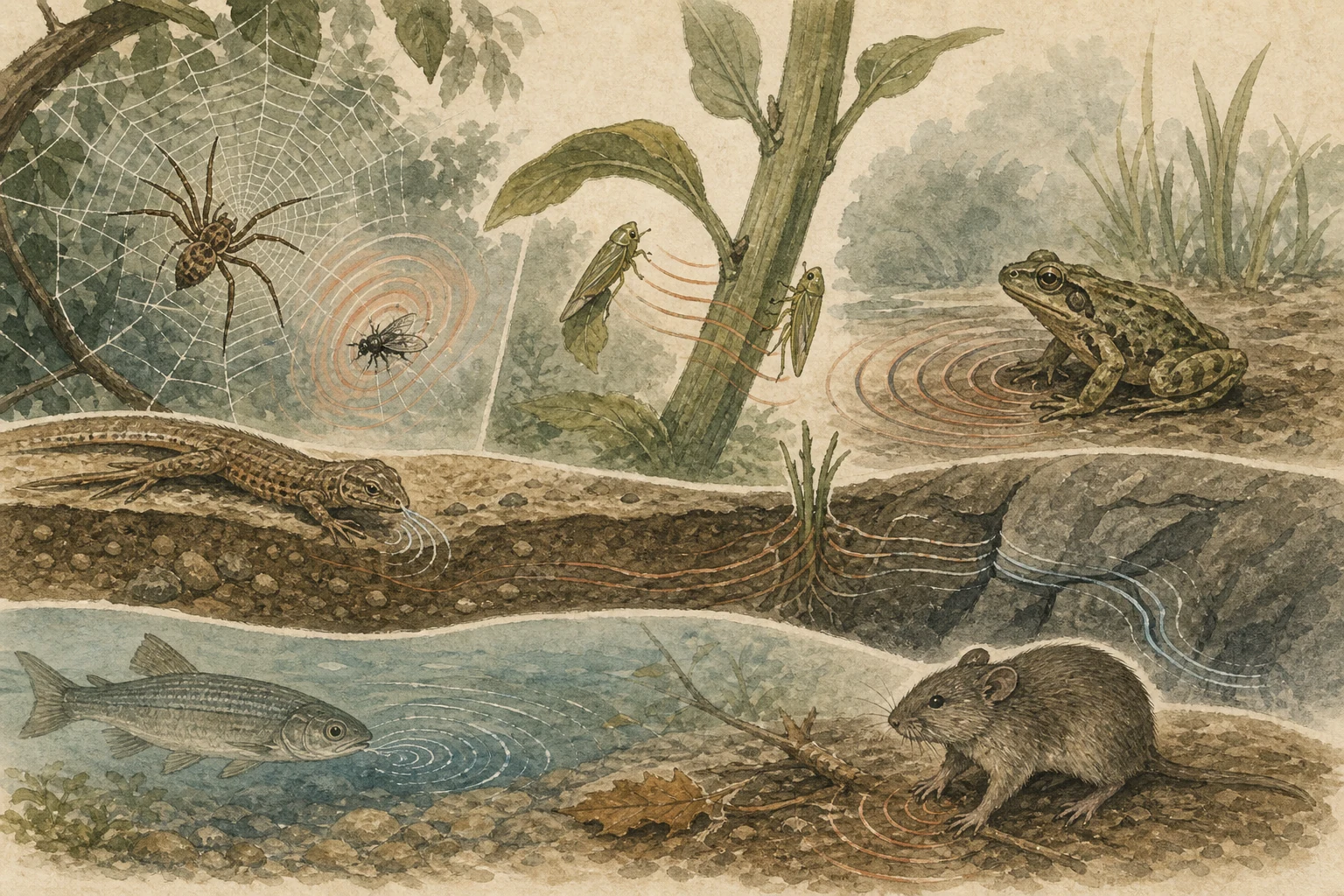
Every vibration sense rests on physical transduction: when a silk thread, plant stem, sand grain, or water boundary moves by nanometers or micrometers, it bends a sensory hair, stretches a cuticular slit, flexes a joint organ, or shifts an internal mass, pulling open mechanically gated ion channels in sensory neurons. Spiders monitor minute exoskeleton strains through lyriform slit sensilla near their leg joints; insects detect substrate oscillations through subgenual and chordotonal organs inside their legs; fishes sense near-field water particle motion through superficial and canal neuromasts along the lateral line as well as inner-ear otoliths; and mammals use Pacinian and lamellar corpuscles in paws, snouts, or bone. [1][2]
- Spider slit sensilla and insect subgenual organs detect tiny mechanical strains transmitted up the legs from silk or plant stems.
- Fish lateral-line neuromasts sense local water displacement and vortices within a few body lengths, distinct from far-field sound pressure.
- Vertebrates can couple substrate vibrations to the inner ear through planted feet, specialized footpads, or lower jaws pressed to the ground.
The medium edits every message
Unlike airborne sound spreading through open sky, substrate-borne vibrations—studied in the field of biotremology—are shaped by the geometry, stiffness, and boundaries of the material carrying them. Bending waves traveling along a willow twig, tension waves along radial orb-web silk, Rayleigh waves rolling across dry desert sand, and hydrodynamic wakes in a stream each filter frequencies differently and reflect off nodes, leaf petioles, or pebbles. Small insects such as planthoppers even use cyclic elastic recoil mechanisms in the abdomen to launch effective vibrational pulses into plant stems despite their tiny body mass, choosing stems and postures that maximize mechanical coupling. [2][3]
- Remember that plant stems transmit bending waves whose speed and attenuation vary with stem thickness, woody stiffness, and leaf nodes.
- Notice whether an insect or spider stands across multiple radial threads, veins, or twigs to compare vibration arrival across all legs.
- Treat substrate structure as part of the communication channel: a signal that carries across continuous vine stems stops at an air gap.
Vibrations reveal prey, mates, rivals, and danger
For tens of thousands of arthropod and vertebrate species, substrate vibrations form a primary information network for foraging, reproduction, and survival. An orb-weaving or funnel-web spider sitting at its hub discriminates the high-frequency flutter of a trapped fly from the rhythmic plucking of a courting male and the slow sway of wind; treehoppers and stoneflies exchange intricate species-specific vibrational duets along shared branches without making a sound audible to human ears; sand scorpions and golden moles triangulate burrowing prey from surface waves; and frog embryos or caterpillars flee when an approaching snake or wasp vibrates their leaf. [1][4]
- Watch how a spider at the hub turns toward the exact radial thread plucked by prey before rushing out.
- Look for silent abdominal bobbing or tremulation in plant-dwelling bugs, lacewings, and stoneflies communicating through stems.
- Notice how caterpillars, sawfly larvae, or leaf-sitting frogs freeze or drop when a predator's footstep vibrates their branch.
Observe the channel without plucking it
Because human ears are poorly coupled to solid substrates, we routinely walk through a forest or meadow oblivious to the vibratory traffic underfoot and in the foliage—while our heavy bootfalls broadcast seismic shockwaves to every burrow and web nearby. When watching spiders, herps, or plant-hopper assemblages, move with slow, cushioned steps, avoid brushing against the focal plant or boardwalk railing, and watch how the animal positions its tarsi, palps, or lower jaw on the substrate. Never pluck spiderwebs with grass stems, tap burrow entrances, or shake branches to provoke a rush, which damages silk architecture and wastes the animal's energy. [3][4]
- Tread softly and avoid leaning on trees, fences, or boardwalk rails that transmit your movement directly into the animal's substrate.
- Note foot placement, leg span across silk radii, or jaw-to-ground contact as visible clues to active vibration sampling.
- Never pluck webs or tap stems to test a spider or insect; wait for natural wind gusts or prey landings to see authentic responses.
Related guides
Get Fauna and identify it in the field.
Where this guide comes from
Source-checked editorial guide. Last updated . This guide teaches identification and field skills; it is not a substitute for expert verification when it matters.
- Learning & behavior — Biotremology in arthropods ↗
- PLoS biology — Planthopper bugs use a fast, cyclic elastic recoil mechanism for effective vibrational communication at small body size ↗
- Conservation physiology — Exploiting common senses: sensory ecology meets wildlife conservation and management ↗
- Frontiers in Ecology and Evolution — Control vs. constraint in material-bound vibration transmission ↗