How bat echolocation works
A bat's sonar scene is built pulse by pulse. Echo delay, direction, intensity, and spectral detail carry information about objects, while the bat continually changes call timing and structure as it searches, approaches a target, or flies through clutter.
Last updated
Build the scene from echo delay
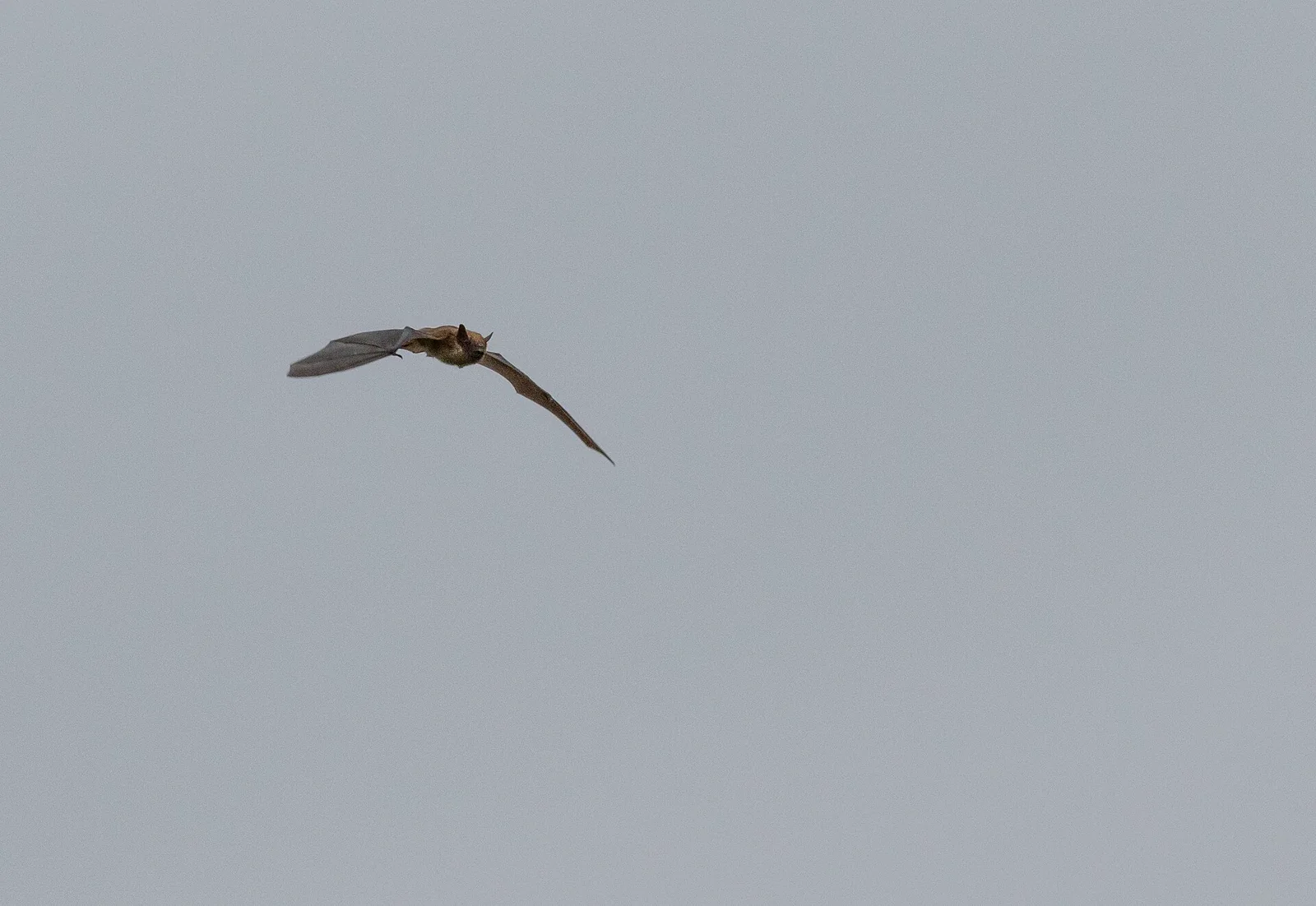
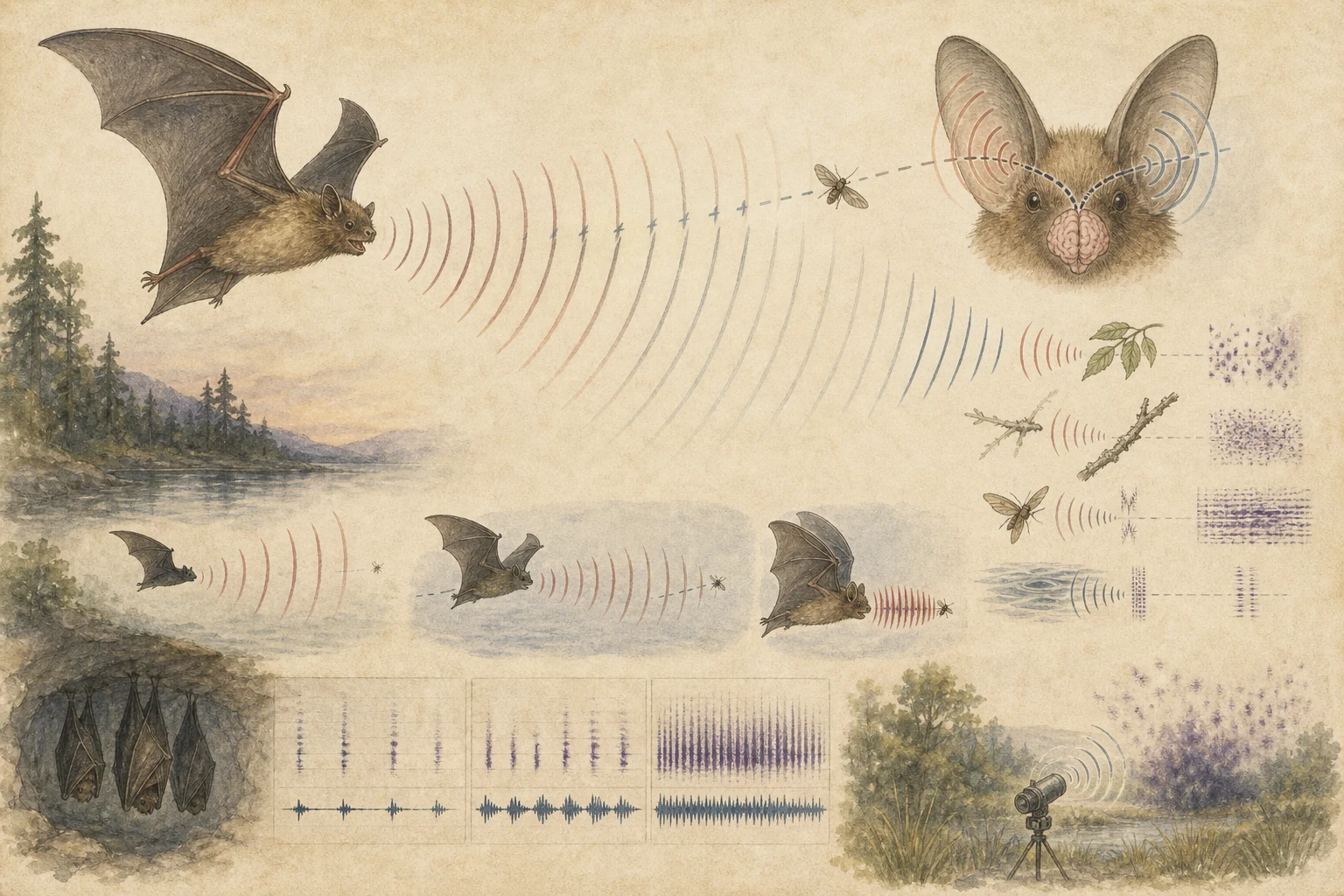
An echolocating bat produces a brief acoustic pulse—usually in the larynx and emitted through the mouth or specialized noseleaf, though some fruit bats use tongue clicks—and listens as sound reflects off surrounding surfaces. Because sound travels through air at a predictable speed, the millisecond delay between emission and returning echo encodes target distance. Subtle differences in arrival time, intensity, and spectral notches between the two external ears indicate azimuth and elevation, while Doppler shifts and amplitude glints reveal a fluttering insect's wingbeats. [1][2][3]
- Round-trip travel time between outgoing pulse and returning echo tells the bat how far away an object is
- Binaural differences in echo timing, loudness, and ear-filtered frequencies pinpoint horizontal and vertical angle
- Tiny acoustic glints produced by a moth's beating wings can betray prey against a background of foliage
Match the call to the acoustic problem
No single sonar design works everywhere, so call architecture reflects habitat clutter and foraging mode. Open-air aerial hawkers often emit longer, narrowband or shallow frequency-modulated pulses that carry far across clear sky, whereas bats maneuvering inside dense forest understory rely on short, broadband frequency-modulated sweeps that localize nearby twigs and leaves without echo overlap. High-duty-cycle bats such as horseshoe bats combine a long constant-frequency tone with a terminal sweep to detect fluttering insects amid heavy background clutter. [2][3][5]
- Long, narrowband calls maximize detection distance in open air above canopies, fields, and lakes
- Short, broadband frequency-modulated sweeps give sharp distance and texture resolution in cluttered forest
- Distantly related bats hunting in similar habitats often evolve convergent call frequencies and shapes
Listen for phases, not one repeated ping
Because each pulse yields a single snapshot, an insect-hunting bat restructures its emissions continuously as it closes on prey. During the search phase it spaces pulses out so distant echoes return before the next call leaves; once a target is detected, the approach phase shortens both pulse duration and inter-pulse interval; and in the final fraction of a second before capture, the bat fires a rapid terminal feeding buzz of up to 150–200 pulses per second to track last-instant evasive maneuvers. [1][2][3]
- Search-phase calls are spaced widely enough to wait for faint echoes returning from distant targets
- Approach-phase pulses shorten and speed up as the bat locks onto an insect and reduces range
- A terminal feeding buzz packs dozens of rapid pulses into a fraction of a second right before prey capture
Recordings reveal activity, with limits
Ultrasonic microphones and spectrogram software translate high-frequency bat calls into visual traces and audible playback, powering continent-scale monitoring programs such as the North American Bat Monitoring Program. At the same time, call plasticity creates real identification boundaries: the same bat alters its call slope and frequency when shifting from a forest corridor into a clearing, or when flying near conspecifics. Acoustic files therefore measure activity and narrow candidate groups best when paired with habitat notes, search-phase sequences, and validated regional reference libraries. [2][3][4]
- Focus species comparisons on clean search-phase call sequences recorded away from heavy clutter and surfaces
- A single bat changes call duration and bandwidth when moving between closed canopy and open water
- Acoustic detectors measure pass activity rather than exact headcounts, since one foraging bat can pass repeatedly
Related guides
Get Fauna and identify it in the field.
Where this guide comes from
Source-checked editorial guide. Last updated . This guide teaches identification and field skills; it is not a substitute for expert verification when it matters.
- National Park Service — Echolocation ↗
- Proceedings. Biological sciences — Bat echolocation calls: adaptation and convergent evolution ↗
- Journal of Experimental Biology — Sensing in a noisy world ↗
- U.S. Geological Survey — Science in support of the North American Bat Monitoring Program ↗
- Journal of Mammalian Evolution — The vocal apparatus and bat echolocation ↗