How mammals communicate by scent
Chemical communication lets a signal remain after its producer has left. Mammals release complex mixtures in urine, feces, saliva, skin secretions, and specialized glands, but what a receiver can learn depends on the species, chemistry, age of the mark, environment, and social setting.
Last updated
Separate a signal from a detectable smell
Every living mammal sheds metabolic odors onto the ground and into the air, yet not every smell is an evolved communication signal. Biologists distinguish an incidental chemical cue—such as breath or body odor that a predator or prey animal detects to its own advantage—from a true signal deposited in a repeatable posture or location that evolved because it modifies receiver behavior or physiology. In the field, deliberate over-marking, scraping, or glandular rubbing alongside investigative sniffing by later arrivals provides the clearest behavioral evidence of signaling. [1][2]
- Incidental body odors can betray an animal's presence without having evolved as communicative messages
- Deliberate deposition postures, repeated latrine use, and over-marking indicate evolved chemical signaling
- Receivers inspect marks through nasal sniffing, licking, or the lip-curling flehmen response that draws scents to the vomeronasal organ
Read both the material and its placement
Mammals deploy a wide chemical toolkit—urine, feces, saliva, interdigital pedal secretions, and specialized subcaudal, preorbital, flank, or chest glands—and pair them with strategic placement in the landscape. Marks are concentrated along trail junctions, ridge lines, territorial borders, and prominent rocks or tufts where conspecifics are most likely to pass. Volatile molecules evaporate rapidly to announce a fresh visit, while heavier lipids and carrier proteins bind volatile compounds to surfaces so the chemical signature persists across days or weeks. [1][2]
- Marks cluster at trail intersections, prominent rocks, boundary ridges, and shared community latrines
- Light volatile compounds broadcast recency while heavier proteins and lipids extend a mark's lifespan
- Heat, rain, ultraviolet light, and skin or soil microbes continuously transform a scent mark as it ages
Expect profiles, not single-word messages
Mammalian social odors are rarely single-molecule commands; most are complex chemical bouquets containing dozens or hundreds of compounds whose relative proportions encode individual identity, sex, genetic relatedness, health, and endocrine status. Receivers learn the odor profiles of neighbors and kin and weigh them against prior encounters. While early research focused heavily on male territoriality, chemical ecology shows that female scent signals play central roles across mammal lineages—advertising estrus timing, mediating female competition and rank, and coordinating mother-offspring recognition. [1][3]
- Complex blends of volatiles, peptides, and proteins encode individual identity, kinship, health, and hormone state
- Receivers compare a mark's chemical signature against learned memories of familiar neighbors versus strangers
- Female scent signaling coordinates reproductive timing, social dominance, and maternal bonding across many mammal groups
Use species behavior to interpret a mark
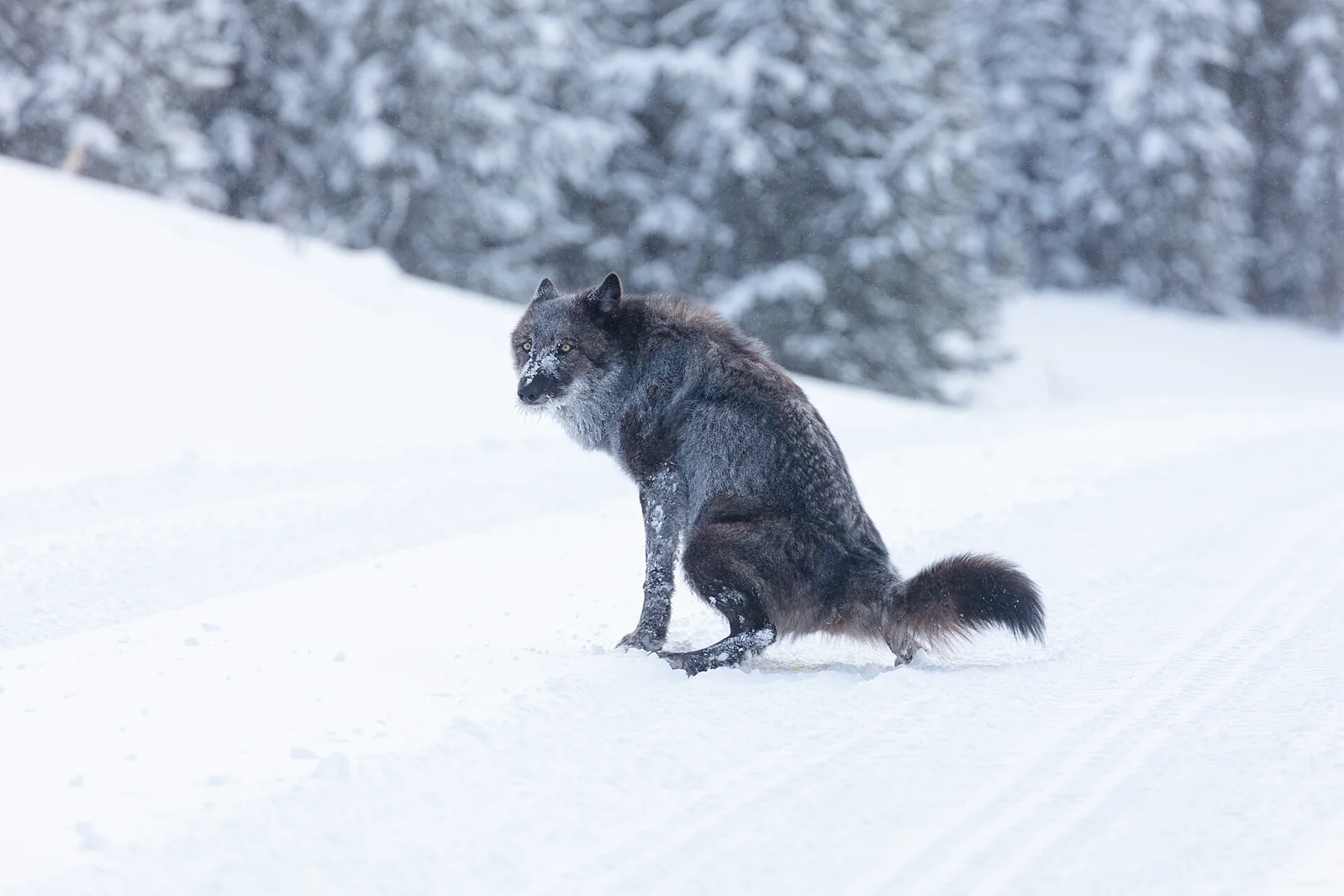
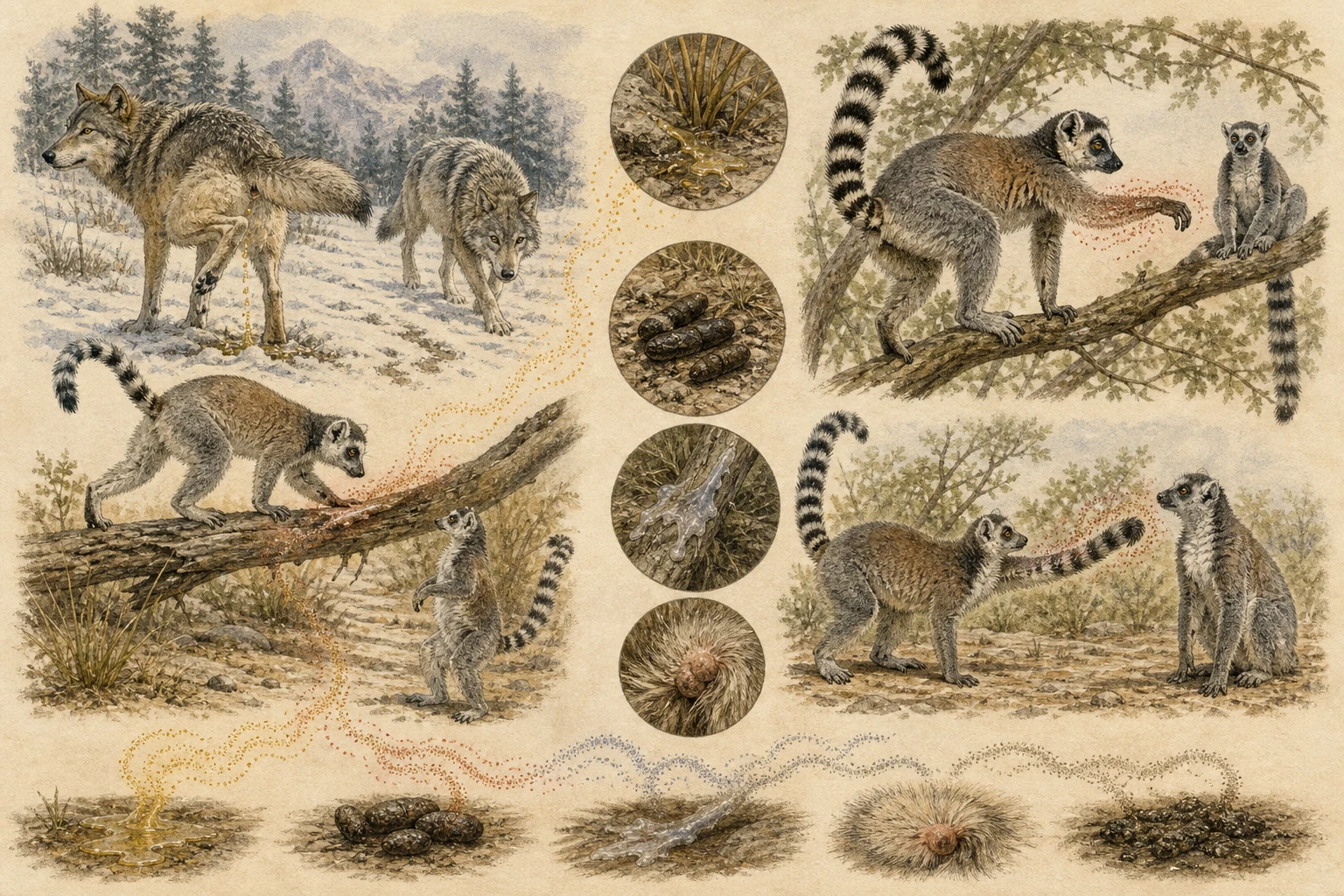
Interpreting scent behavior in the field requires knowing how a particular species combines posture, gland anatomy, and social structure. In Yellowstone, breeding wolf pairs use raised-leg urination and ground scratching along travel corridors to advertise territory occupancy to neighboring packs. Ring-tailed lemurs in Madagascar press brachial and antebrachial glands against branches to leave lingering route marks, and during seasonal disputes males draw their bushy tails across their wrist spurs to wave airborne odor directly at rivals. [4][5]
- Dominant wolves pair raised-leg urination with hind-foot ground scratching along pack travel routes
- Ring-tailed lemurs leave long-lasting branch marks with chest and wrist glands and wave scented tails in visual-chemical displays
- Note posture, substrate, over-marking sequence, and whether the animal sniffs thoroughly before depositing its own mark
Related guides
Get Fauna and identify it in the field.
Where this guide comes from
Source-checked editorial guide. Last updated . This guide teaches identification and field skills; it is not a substitute for expert verification when it matters.
- Philosophical transactions of the Royal Society of London. Series B, Biological sciences — Mammalian social odours: attraction and individual recognition ↗
- Sensors (Basel, Switzerland) — Analytical methods for chemical and sensory characterization of scent-markings in large wild mammals: a review ↗
- Journal of chemical ecology — Female Chemical Signalling Underlying Reproduction in Mammals ↗
- Smithsonian's National Zoo — Ring-tailed lemur ↗
- National Park Service — Yellowstone wolf ecology ↗