How marine mammals dive
Marine mammals dive on one breath by carrying substantial oxygen in blood and muscle, adjusting heart rate and circulation, tolerating low oxygen, and managing gases as pressure rises. These responses are flexible and differ greatly between shallow and deep divers.
Last updated
Oxygen travels in more than the lungs
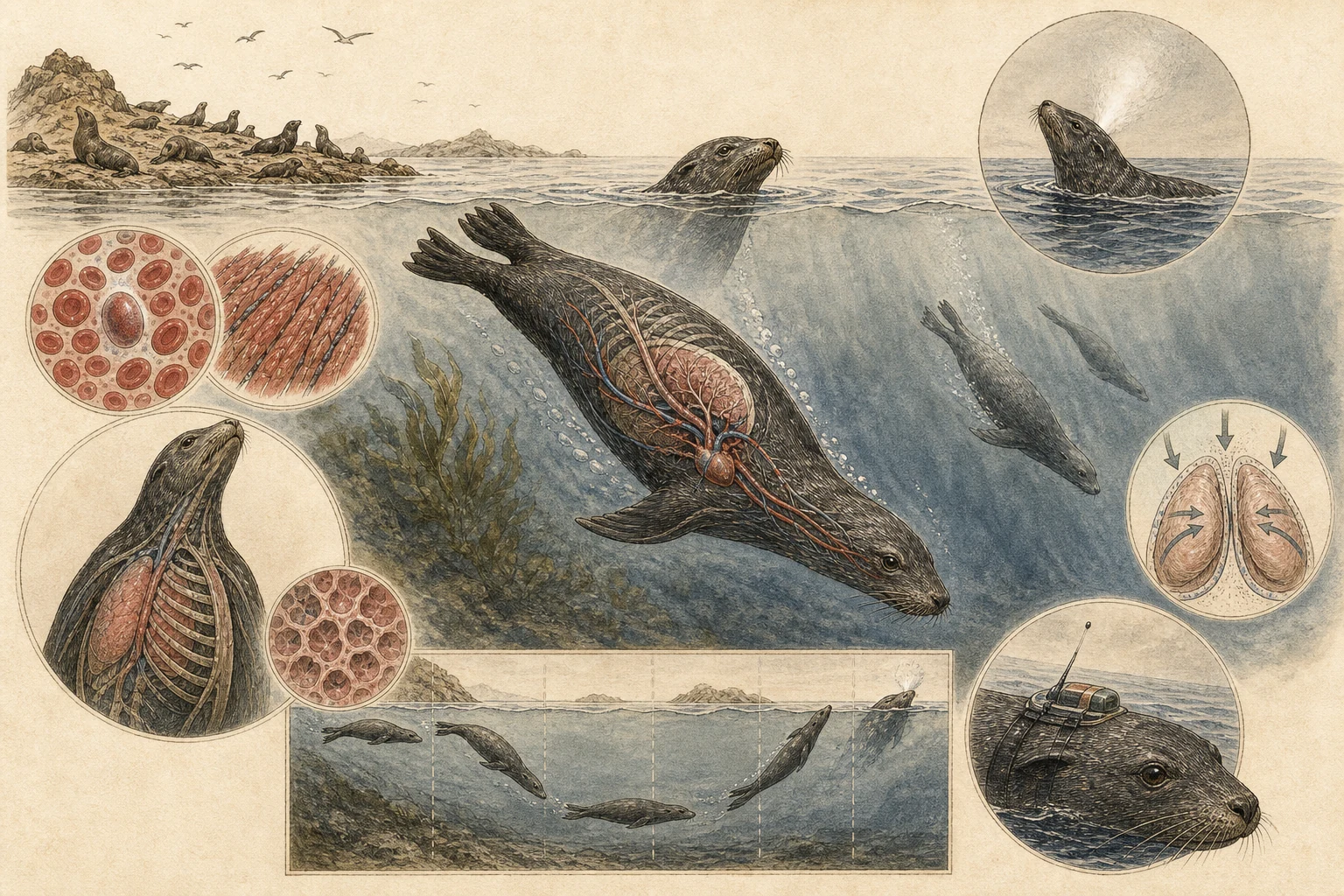
Deep-diving marine mammals do not achieve long breath-holds by carrying oversized lungs; in fact, many extreme divers have smaller lung volumes relative to body mass than terrestrial mammals. Instead, they pack oxygen into massive blood volumes rich in hemoglobin and dark skeletal muscles dense with oxygen-binding myoglobin. In northern elephant seals and deep-diving toothed whales, blood and muscle hold the overwhelming majority of total body oxygen, whereas shallow-diving coastal species rely more on their lungs—and juvenile divers must build these biochemical stores gradually as they mature. [3][5][6]
- Deep divers store most of their oxygen chemically bound to blood hemoglobin and muscle myoglobin rather than in lung air
- High myoglobin concentrations give the swimming muscles of deep-diving seals and whales an almost black color
- Pups and calves start life with lower oxygen stores and develop full diving capacity only as blood and muscle mature
The dive response budgets a finite supply
Once submerged, a diving mammal rations its onboard oxygen through bradycardia—a marked slowing of the heart—paired with selective peripheral vasoconstriction that narrows blood flow to skin, gut, and kidneys while preserving delivery to the brain and heart. Working locomotor muscles rely heavily on their own local myoglobin reserves. Biologging tags measuring heart rate and blood oxygen in free-ranging seals and cetaceans show that this cardiovascular adjustment is not a rigid on-off switch: animals modulate heart rate dynamically with planned dive depth, prey pursuit, and even anticipation before surfacing. [1][2][3]
- Slowing the heart rate and constricting peripheral blood vessels conserves circulating oxygen for the brain and heart
- Swimming muscles draw on internal myoglobin stores while isolated from main arterial blood flow during long dives
- Free-ranging divers adjust the intensity of bradycardia according to dive duration, exercise level, and anticipation
Pressure changes the respiratory system
Every ten meters of descent adds roughly one atmosphere of hydrostatic pressure, compressing gas-filled spaces according to Boyle's law. Marine mammals have compliant rib cages and reinforced upper airways that allow the alveoli to compress progressively at depth, shunting remaining air into rigid cartilaginous passages where little gas enters the bloodstream. Limiting gas exchange under high pressure helps prevent excessive nitrogen absorption and decompression sickness, though species differ in whether they dive on inhalation or exhalation and at what depth alveolar collapse occurs. [2][4]
- Flexible chest walls allow high water pressure to compress lung alveoli without crushing rib structures
- Pushing air out of gas-exchanging alveoli into reinforced airways reduces nitrogen uptake at great depth
- True seals often exhale before diving whereas sea lions, fur seals, and cetaceans typically dive on an inhalation
A dive is one part of a repeated cycle
A foraging bout consists of descent, bottom searching or chasing, ascent, and a surface interval that must recharge oxygen stores and clear carbon dioxide and any lactic acid before the next plunge. Archival tags reveal how closely biomechanics and physiology cooperate: negatively buoyant divers switch from active stroking to prolonged, low-cost gliding during descent, saving precious oxygen for hunting at depth. Because an animal that pushes beyond its aerobic dive limit requires a disproportionately long recovery at the surface, most wild foraging dives stay within aerobic bounds. [1][2][4][5]
- Divers alternate stroking with buoyancy-assisted gliding on descent and ascent to cut the oxygen cost of swimming
- Staying within the aerobic dive limit lets an animal make repeated foraging dives with brief surface pauses
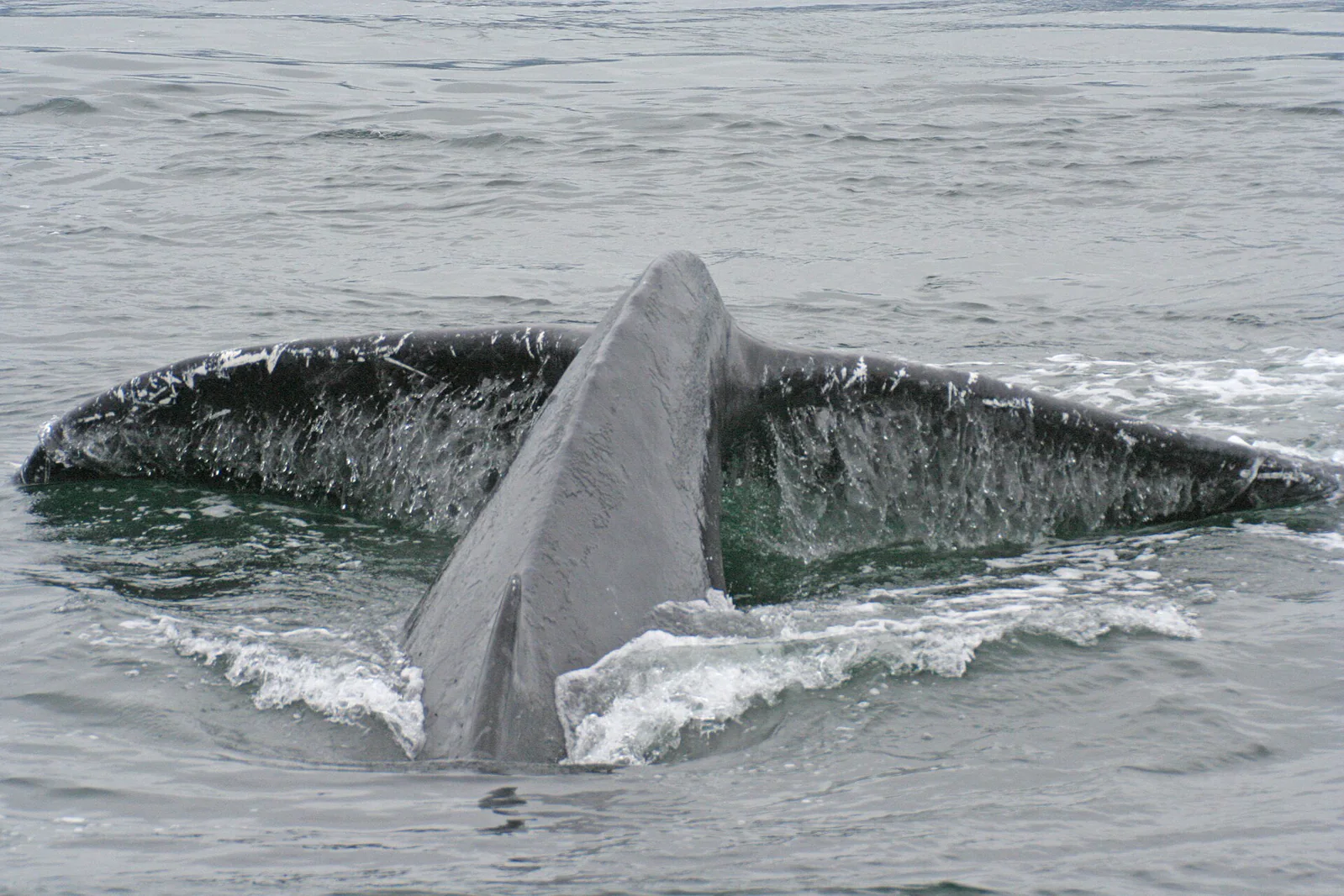
- Surface intervals, breath counts, and fluke-up postures give shore and boat observers clues to underwater effort
Related guides
Get Fauna and identify it in the field.
Where this guide comes from
Source-checked editorial guide. Last updated . This guide teaches identification and field skills; it is not a substitute for expert verification when it matters.
- Philosophical transactions of the Royal Society of London. Series B, Biological sciences — Diving physiology of marine mammals and birds: the development of biologging techniques ↗
- Experimental physiology — Cardiorespiratory adaptations in small cetaceans and marine mammals ↗
- Frontiers in physiology — Natural Tolerance to Ischemia and Hypoxemia in Diving Mammals: A Review ↗
- Respiration physiology — Respiratory adaptations in diving mammals ↗
- University of California San Diego Earthguide — Oxygen and elephant-seal diving ↗
- NOAA Fisheries — Cetacean muscle myoglobin and dive capacity ↗