Symbiosis: mutualism, commensalism, and parasitism
Biologists classify a close interspecific relationship by its effects on the partners: both benefit, one benefits with no detected effect on the other, or one benefits while harming the other. Those signs summarize evidence in a particular context, not fixed personalities of the organisms involved.
Last updated
The signs describe effects, not intentions
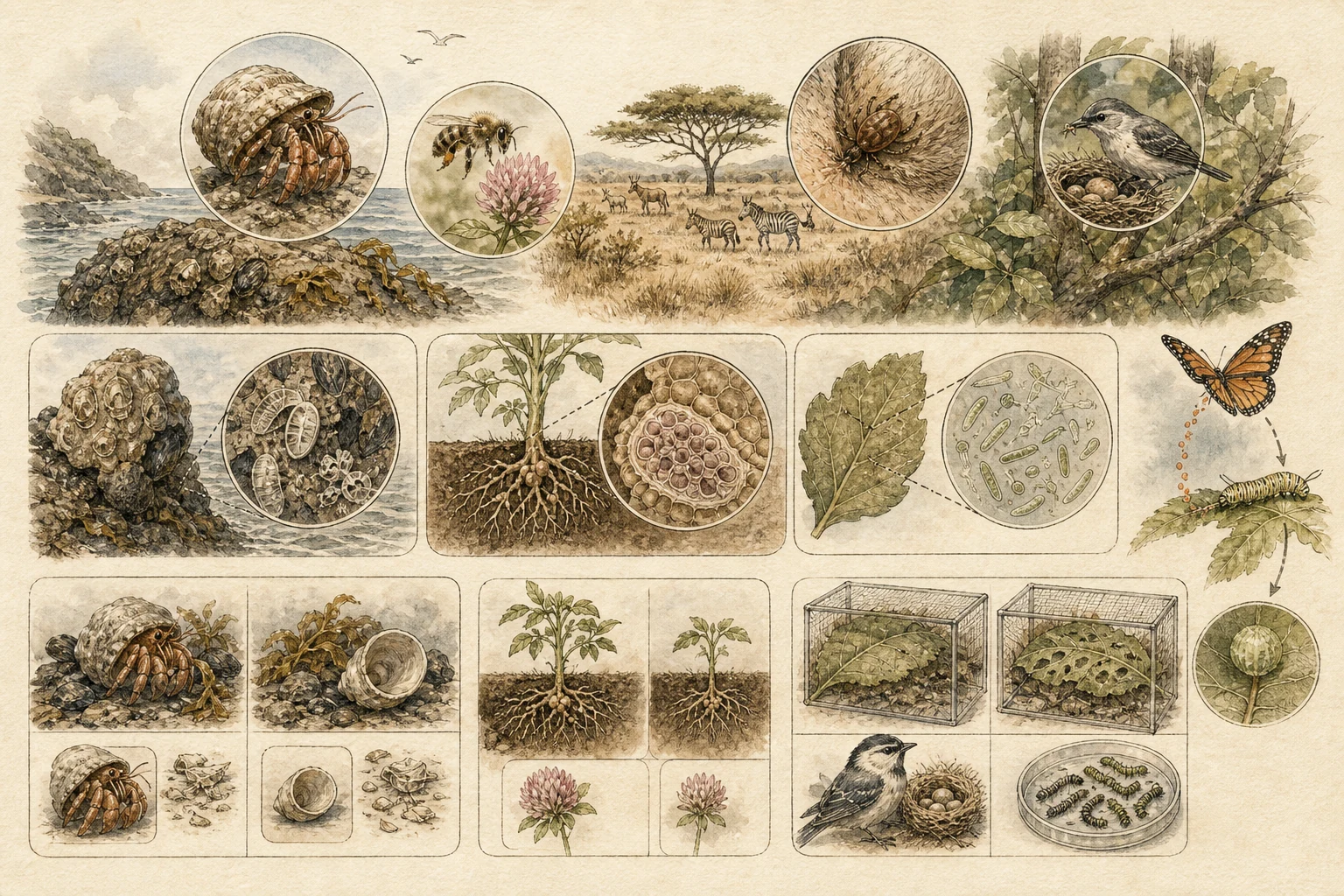
Ecologists use plus, zero, and minus signs as accounting shorthand for measurable changes in survival, growth, or reproduction when two species live in close contact. Mutualism is recorded as plus/plus, commensalism as plus/zero, and parasitism as plus/minus. Those symbols summarize demographic outcomes rather than motives such as kindness, indifference, or malice. In the field, the zero in commensalism is the hardest claim to establish: an epiphyte perched on a rainforest branch or a barnacle riding a whale shell gets a clear transport or light advantage, but proving that the host pays no energetic, drag, or tissue cost requires careful measurement under specific seasonal and environmental conditions rather than a quick visual impression. [1][3]
- Plus, zero, and minus notation tracks fitness outcomes like survival and offspring count, never an organism's intentions.
- Commensalism (+/0) is a provisional finding because subtle drag, shading, or nutrient costs to the host often go undetected in short studies.
- Seeing two species side by side on a reef or tree trunk documents spatial association, not which partner gains or loses.
A partnership can move along a continuum
The net benefit or cost of a partnership shifts as surrounding resources, physical stress, and community members change. A root-colonizing microbe or gut symbiont may boost host growth in nutrient-poor soil or on a tough diet, yet act as a net carbon drain when mineral nutrients are already abundant. Similarly, ants or cleaner organisms that defend a host against herbivores or ectoparasites provide a strong advantage only while those enemies are active; when enemies are scarce, tending or feeding the partner can cost more than it returns. Because natural selection acts on each partner's reproductive success separately, interactions slide along a parasite–mutualist continuum across habitats, seasons, and life stages. [1][4]
- Nutrient-provisioning microbes can shift from helpful mutualists to costly carbon sinks when soil or dietary nutrients become plentiful.
- Defensive partnerships pay off when predators or parasites are common but can become net burdens in enemy-free habitats.
- Interaction labels belong to a specific ecological context and life stage rather than permanently defining a pair of species.
Symbiosis operates at different depths
Symbiotic associations range from ectosymbionts living on feathers, bark, or skin to endosymbionts housed inside specialized host tissues or directly within host cells. Some partners are acquired anew from the surrounding soil or water every generation, whereas others pass vertically from parent to offspring through eggs, seeds, or vegetative fragments. Ancient intracellular partnerships shaped eukaryotic evolution itself—mitochondria and chloroplasts originated from bacterial endosymbionts—yet structural intimacy never guarantees harmony. Obligate intracellular pathogens and brood parasites are every bit as physically or developmentally integrated with their hosts as beneficial endosymbionts, proving that deep dependence can evolve toward exploitation just as readily as cooperation. [1][2]
- Ectosymbionts live on outer surfaces while endosymbionts reside within host tissues or inside individual cells.
- Vertical transmission from parent to offspring often aligns partner fates more tightly than horizontal acquisition from the environment.
- Physical intimacy and obligate dependence occur in severe parasites and pathogens just as often as in mutualists.
Test a label with comparisons
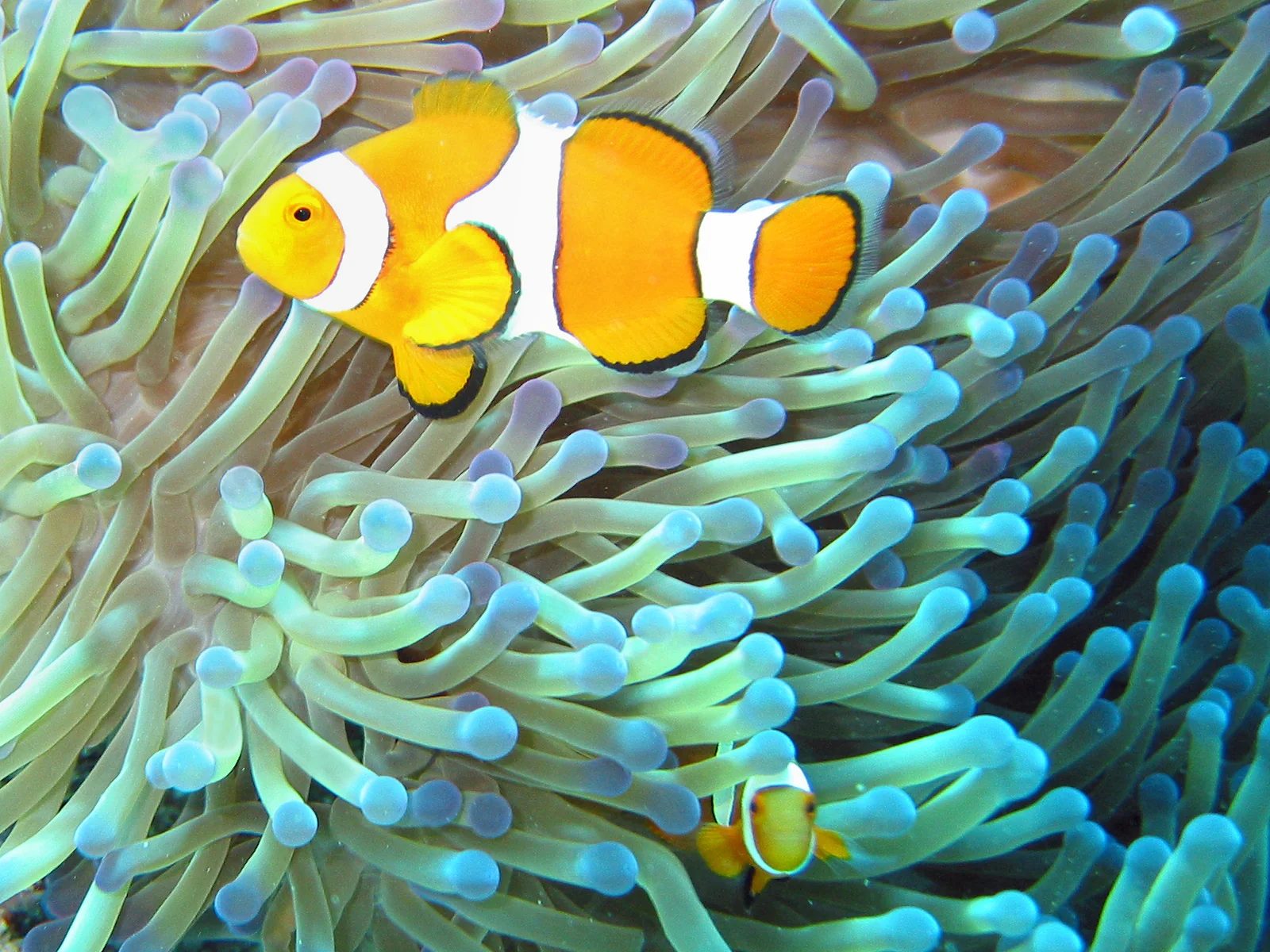
Classifying a wild association requires comparing hosts and partners across controlled or naturally contrasting conditions and tracking survival, growth, or reproductive output. Researchers might exclude one partner, vary nutrient or predator levels, or follow individuals across multiple habitats to uncover hidden costs and seasonal reversals. A clownfish weaving among sea anemone tentacles on the Great Barrier Reef is striking natural history: mucus chemistry protects the fish from stinging nematocysts while the fish can aerate tentacles, remove debris, and drive off butterflyfish. Even so, the formal ecological label comes from measured demographic consequences for both reef partners, never simply from observing them sharing space. [3][4]
- Partner removal experiments and cross-environment comparisons are needed to separate true mutualism from one-sided exploitation.
- Clownfish and host sea anemones exchange shelter and defense on reefs, but their net fitness effects still depend on local predators and environment.
- Field observers should describe what two organisms are physically doing—sheltering, cleaning, feeding, or attaching—before assigning a fitness label.
Related guides
Get Fauna and identify it in the field.
Where this guide comes from
Source-checked editorial guide. Last updated . This guide teaches identification and field skills; it is not a substitute for expert verification when it matters.
- Philosophical transactions of the Royal Society of London. Series B, Biological sciences — A new lexicon in the age of microbiome research ↗
- Journal of theoretical biology — Symbiosis in eukaryotic evolution ↗
- Nature Education — Species interactions and competition ↗
- Nature reviews. Microbiology — Microbial evolution and transitions along the parasite-mutualist continuum ↗