Lichens as living partnerships
The lichen-forming fungus builds most of the thallus, retains water and minerals, and houses a photobiont that fixes carbon; cyanobacterial partners may also fix nitrogen. Other fungi and bacteria can be regular associates. Together they form structures and tolerances not obvious from either main partner alone.
Last updated
The classic partnership builds a new body
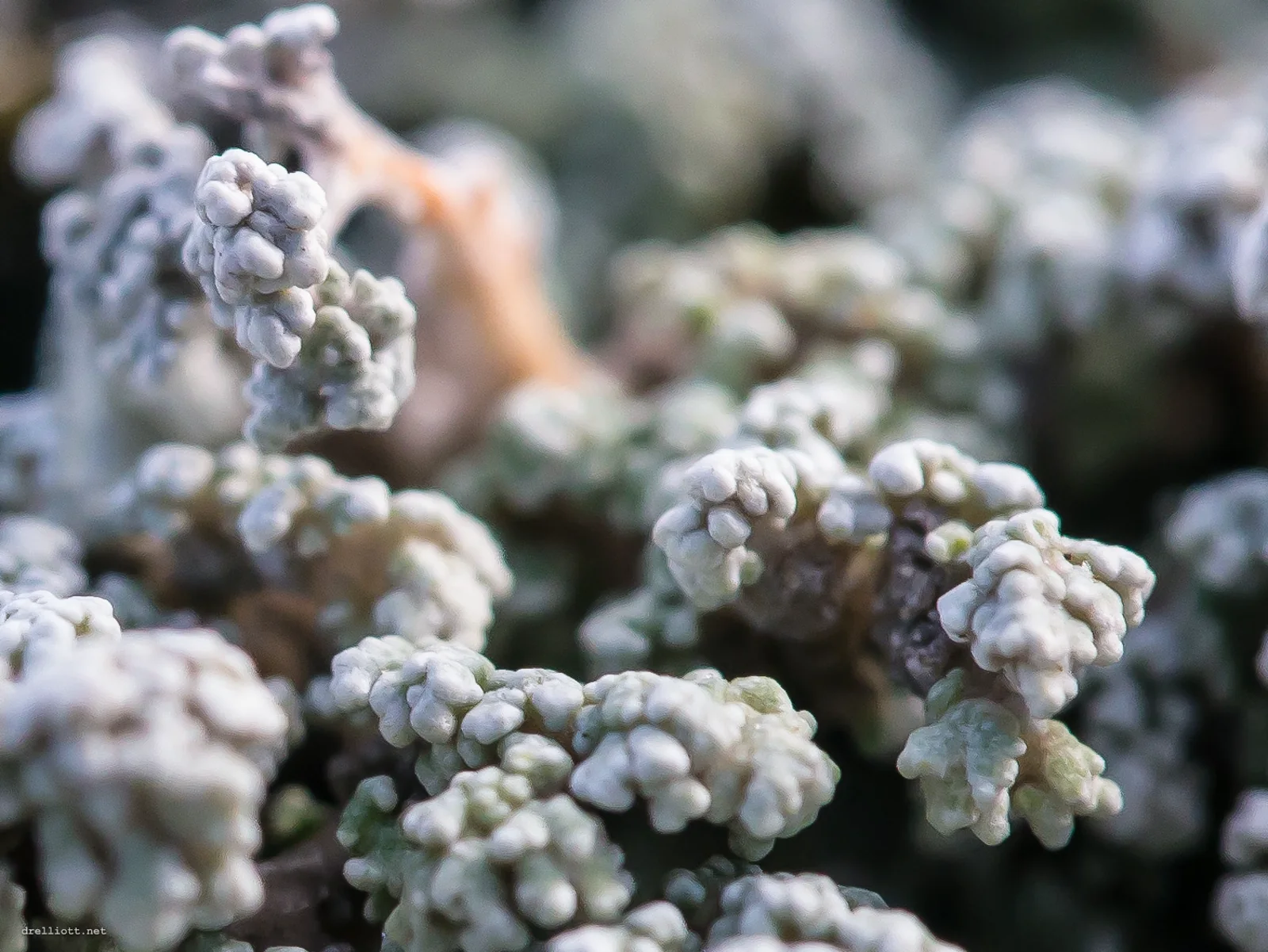
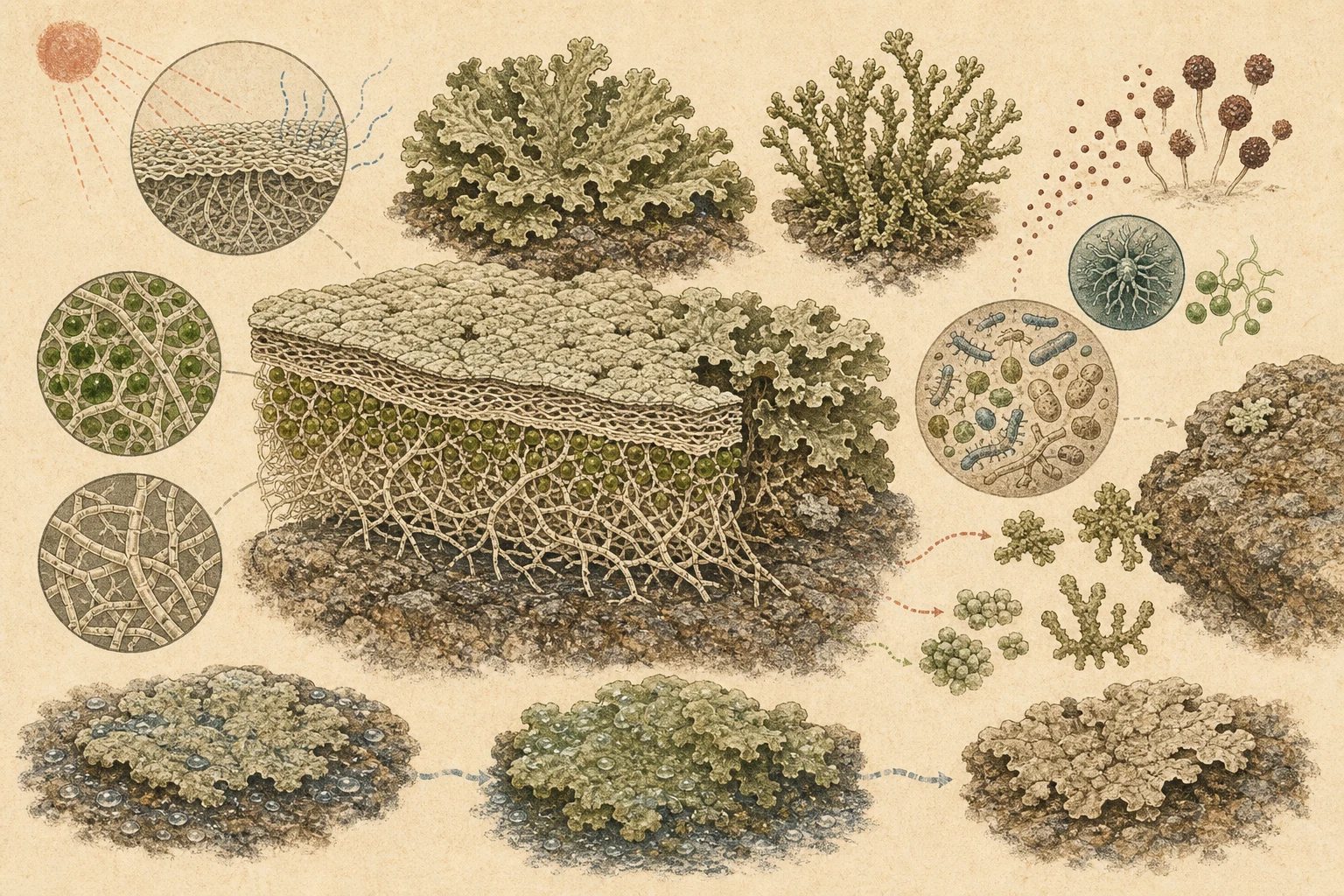
Unlike a free-living mold or mushroom mycelium hidden inside wood or soil, a lichen-forming fungus (the mycobiont) weaves its hyphae into an exposed, light-harvesting body called a thallus—forming tight rock crusts (crustose), lobed leafy sheets (foliose), or branching shrubby tufts and pendulous beards (fruticose). Beneath a protective upper fungal cortex that screens intense ultraviolet light with specialized secondary metabolites, the fungus cradles a layer of photosynthetic cells (the photobiont) and exchanges water and mineral ions for sugar alcohols or glucose. This composite architecture emerges only when compatible partners exchange chemical signals and trigger symbiotic morphogenesis. [1][3]
- The fungal mycobiont builds the visible crustose, foliose, or fruticose thallus and shelters the photosynthetic layer beneath a protective cortex.
- Photosynthetic partners export sugar alcohols (in green algae) or glucose (in cyanobacteria) to fuel fungal growth and stress protection.
- Neither the fungus nor the alga builds a stratified lichen thallus when grown alone in laboratory culture without symbiotic signaling.
Two partners are the beginning, not always the whole
Roughly 85 percent of lichenized fungi partner primarily with unicellular green algae such as Trebouxia or Trentepohlia, around 10 percent partner with nitrogen-fixing cyanobacteria such as Nostoc, and some bipartite or tripartite lichens house green algae in the main thallus while confining cyanobacteria to specialized dark warts called cephalodia. High-throughput sequencing and fluorescence microscopy have further revealed that many lichen thalli host structured bacterial biofilms on their surfaces along with embedded basidiomycete or cystobasidiomycete yeasts in the cortex. Biologists now view lichens as miniature symbiotic ecosystems, while testing which associated microbes are essential functional partners versus resident commensals or parasites. [2][4]
- Green algae are the primary photobiont in most lichens, while cyanobacterial partners also fix atmospheric nitrogen into biologically usable ammonia.
- Tripartite lichens house green algae for carbon fixation alongside specialized pockets (cephalodia) containing nitrogen-fixing cyanobacteria.
- Cortical yeasts and surface bacterial communities regularly inhabit lichen thalli, though their exact roles vary across lineages.
Water controls when lichens are active
Because lichens lack true roots, vascular xylem, and a waxy leaf cuticle with closing stomata, they are poikilohydric: their water content equilibrates directly with rain, fog, dew, and ambient humidity across the entire thallus surface. When morning dew or rain hydrates a dry thallus, respiration and photosynthesis restart within minutes; when sun and wind dry the thallus back down to a brittle state, the partners enter metabolic dormancy protected by sugar alcohols and antioxidant compounds. This ability to survive repeated desiccation lets lichens colonize bare granite boulders, tundra gravel, and outer tree bark, though direct uptake from air and rain also makes many species sensitive to sulfur dioxide and nitrogen air pollution. [1][3]
- Poikilohydric lichens absorb water and dissolved minerals directly across the thallus surface rather than through roots.
- Metabolic activity switches on during rain, fog, or morning dew and pauses safely when the thallus dries out.
- Because lichens absorb atmospheric deposition directly without a protective cuticle, species composition shifts strongly along air-pollution gradients.
Reproduction may separate or carry partners
Lichen reproduction faces a logistical puzzle: how to establish both partners on a new branch or rock face. When the fungal partner forms sexual fruiting bodies—such as cup-like apothecia or flask-shaped perithecia—it ejects microscopic spores that contain only the fungus, which must germinate and locate a compatible free-living or neighboring photobiont before dying. Many lichens bypass that gamble with specialized vegetative propagules: powdery soredia erupting from surface soralia or tiny finger-like outgrowths called isidia that snap off and disperse fungal hyphae already wrapped around living algal cells. By botanical nomenclature rules, the scientific name of a lichen belongs strictly to its fungal partner, and true mosses growing beside it are separate nonvascular plants. [3][4]
- Fungal sexual spores disperse alone and must find a compatible photobiont on bark or rock to establish a new lichen.
- Asexual soredia and isidia package fungal hyphae and algal cells together for ready-made dispersal by wind, rain splash, or animals.
- A lichen's scientific name refers to its fungal mycobiont, and green mosses cushioned alongside it are completely separate land plants.
Related guides
Get Fauna and identify it in the field.
Where this guide comes from
Source-checked editorial guide. Last updated . This guide teaches identification and field skills; it is not a substitute for expert verification when it matters.