Decomposition and nutrient cycling
Animals fragment and consume litter, while fungi, bacteria, and other microbes use enzymes to break complex molecules down. Some carbon enters decomposer biomass or soil and some is respired; nitrogen, phosphorus, and other elements can be immobilized, transformed, released, transported, and taken up again.
Last updated
Dead matter supports a living food web
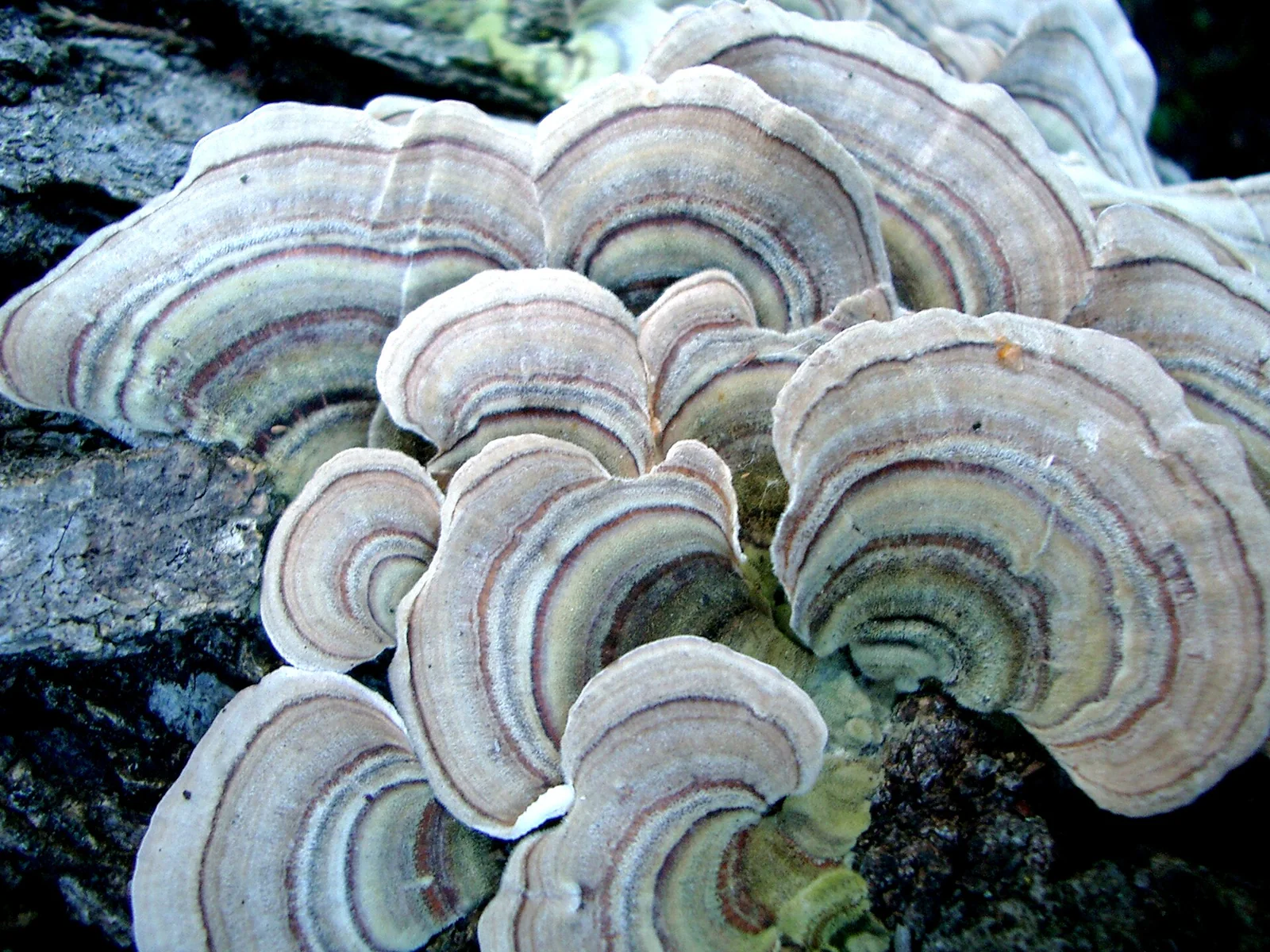
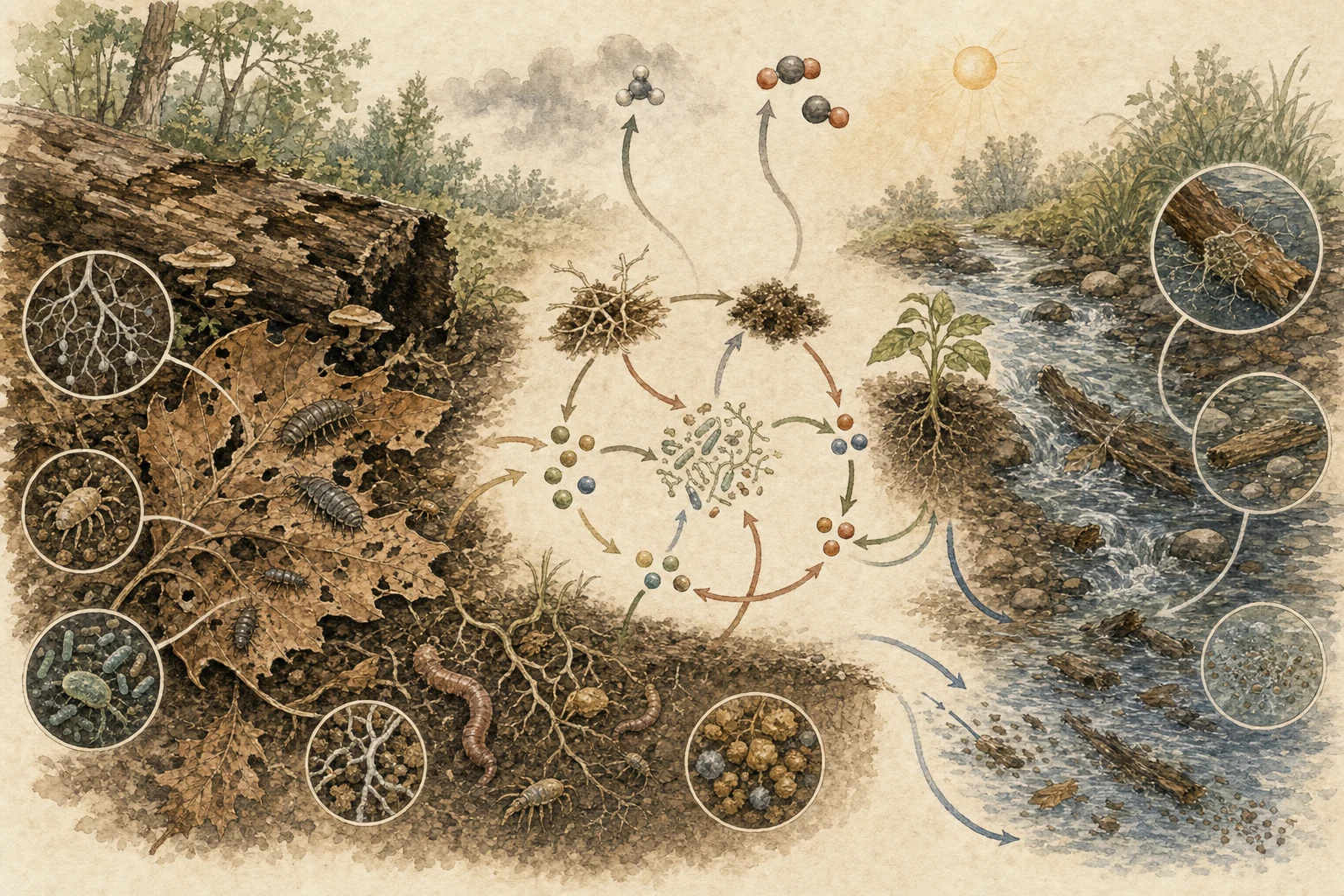
A fallen forest log or autumn leaf pack is processed by an interconnected detrital food web rather than a single generic decomposer. Rainwater first leaches soluble sugars and organic acids, while freeze–thaw cycles and physical abrasion weaken tough tissues. Millipedes, woodlice, earthworms, beetle larvae, and springtails chew and fragment coarse litter, vastly increasing the surface area exposed to microbial colonization. Bracket and crust fungi thread mycelial hyphae deep into lignified wood to secrete extracellular enzymes, and bacteria metabolize the resulting simpler compounds. Predatory mites, centipedes, salamanders, and ground-foraging birds then hunt the detritivores, linking dead organic matter directly to living vertebrate food webs. [1][2][5]
- Physical leaching and invertebrate shredding break coarse litter into fine particles that microbes can colonize efficiently.
- Wood-decay fungi use specialized extracellular enzymes to attack tough lignin and cellulose fibers that most animals cannot digest.
- Detritivores feed predatory arthropods, amphibians, and forest birds, making decaying logs active hubs of the living food web.
Carbon and mineral nutrients take different routes
As decomposers break down dead tissue, carbon and mineral elements follow distinct stoichiometric pathways. Fungi and bacteria incorporate part of the organic carbon into their own cell walls and stable soil organic matter while respiring the rest as carbon dioxide—or, in waterlogged, oxygen-starved wetland soils and sediments, releasing methane through anaerobic microbial pathways. When leaf litter or wood has a high carbon-to-nitrogen or carbon-to-phosphorus ratio, microbes initially scavenge and immobilize dissolved nitrogen and phosphorus from the surrounding soil or water to build their own enzymes, only mineralizing and releasing surplus inorganic nutrients for plant roots once carbon stocks decline. [3][4][6]
- Microbes respire much of litter carbon as carbon dioxide, while anoxic wetland sediments can channel carbon into methane.
- Nutrient-poor wood and leaves cause microbes to immobilize ambient nitrogen and phosphorus before net mineralization begins.
- Matter cycles repeatedly between living tissues, detritus, and mineral pools, whereas energy flows one way and dissipates as heat.
Rate depends on material and environment
How fast dead matter disappears in the field depends on an interaction between substrate chemistry and microclimate. Nitrogen-rich herbaceous leaves, soft fruit, and carrion break down far faster than conifer needles, oak leaves, or heartwood packed with lignin, cutin, and phenolic tannins. Temperature and moisture govern microbial enzyme activity, but neither acts alone: hot desert litter dries out until rain arrives, while cold, waterlogged peatlands and boreal bogs starve aerobic fungi of oxygen, preserving plant tissues for centuries. Even within a single woodland, a sun-baked ridge and a damp, shaded ravine process identical leaf litter at strikingly different speeds. [2][4][5]
- Tissues high in nitrogen and low in lignin decompose rapidly, while woody debris and tannin-rich leaves persist for years.
- Warmth speeds microbial metabolism only when moisture and oxygen are also present in the litter layer.
- Waterlogged, oxygen-poor soils slow aerobic fungal decay dramatically, allowing deep peat and organic muck to accumulate.
Streams move the products downstream
In headwater streams and rivers, autumn leaf fall and fallen branches become mobile fuel that spirals downstream as it breaks down. Dissolved compounds leach rapidly into the current, aquatic hyphomycete fungi and bacterial biofilms coat submerged leaves to soften them—increasing their nitrogen and phosphorus content through microbial immobilization—and shredding invertebrates such as stonefly and caddisfly nymphs tear the conditioned blades into fine particles. Filter-feeding blackfly larvae and net-spinning caddisflies capture those drifting particles farther downstream, while submerged logs trap leaf packs, create slackwater pools, and store organic carbon long before looking visibly decayed. [5][6]
- Submerged leaves become more nutritious for stream insects after aquatic fungi and bacteria colonize and soften the tissue.
- Shredding stoneflies and caddisflies turn whole leaves into fine drifting particles that feed downstream filter-feeders.
- Fallen logs in streams act as both slow-release carbon reservoirs and physical dams that retain leaf packs.
Related guides
Get Fauna and identify it in the field.
Where this guide comes from
Source-checked editorial guide. Last updated . This guide teaches identification and field skills; it is not a substitute for expert verification when it matters.
- UK Centre for Ecology & Hydrology ↗
- Proceedings of the National Academy of Sciences of the United States of America — Substrate and climate determine terrestrial litter decomposition ↗
- Ecological Monographs — Stoichiometric controls on carbon, nitrogen, and phosphorus dynamics in decomposing litter ↗
- Annals of botany — Methane emission from natural wetlands: interplay between emergent macrophytes and soil microbial processes. A mini-review ↗
- TheScientificWorldJournal — From litterfall to breakdown in streams: a review ↗
- Freshwater Science — Immobilization and mineralization of nitrogen and phosphorus during leaf decomposition ↗