Ecological succession explained
After bare substrate forms or an established community is disturbed, organisms colonize, persist, replace one another, or coexist. Soil, seed banks, dead wood, nearby source populations, herbivores, fire severity, and chance can send similar sites along different trajectories rather than one predetermined ladder.
Last updated
Primary and secondary are starting conditions
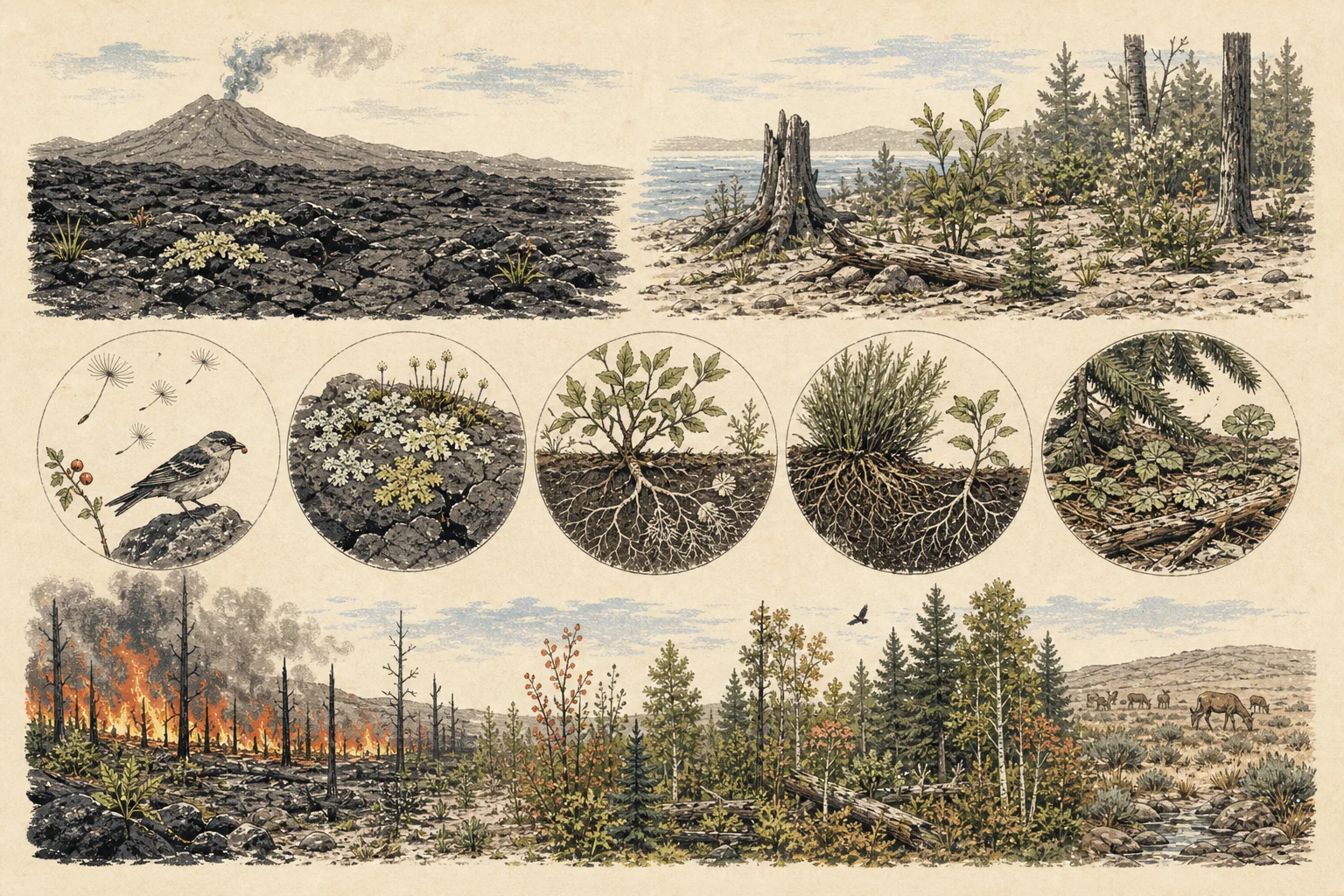
Ecologists divide succession by what remains when community assembly begins. Primary succession unfolds on freshly exposed mineral substrates—cooled volcanic lava, glacial till left by retreating ice, or newly formed sand dunes—where developed soil, seed banks, and living tissues are virtually absent. Secondary succession begins after a windstorm, wildfire, flood, or agricultural clearing alters an existing community while leaving behind soil structure, buried seeds, root crowns, mycorrhizal fungi, and decaying wood. In practice, these categories form a gradient: a single large disturbance often leaves heavily scoured patches of nearly bare mineral earth right beside lightly disturbed pockets rich in biological legacies. [1][2]
- Primary succession starts on raw mineral surfaces like fresh lava or glacial outwash that lack soil and living remnants.
- Secondary succession builds on surviving biological legacies such as intact soil, buried seed banks, resprouting roots, and snags.
- Single disturbances vary across space, creating a patchwork of primary-like and secondary starting conditions within one landscape.
Arrival and interaction shape each trajectory
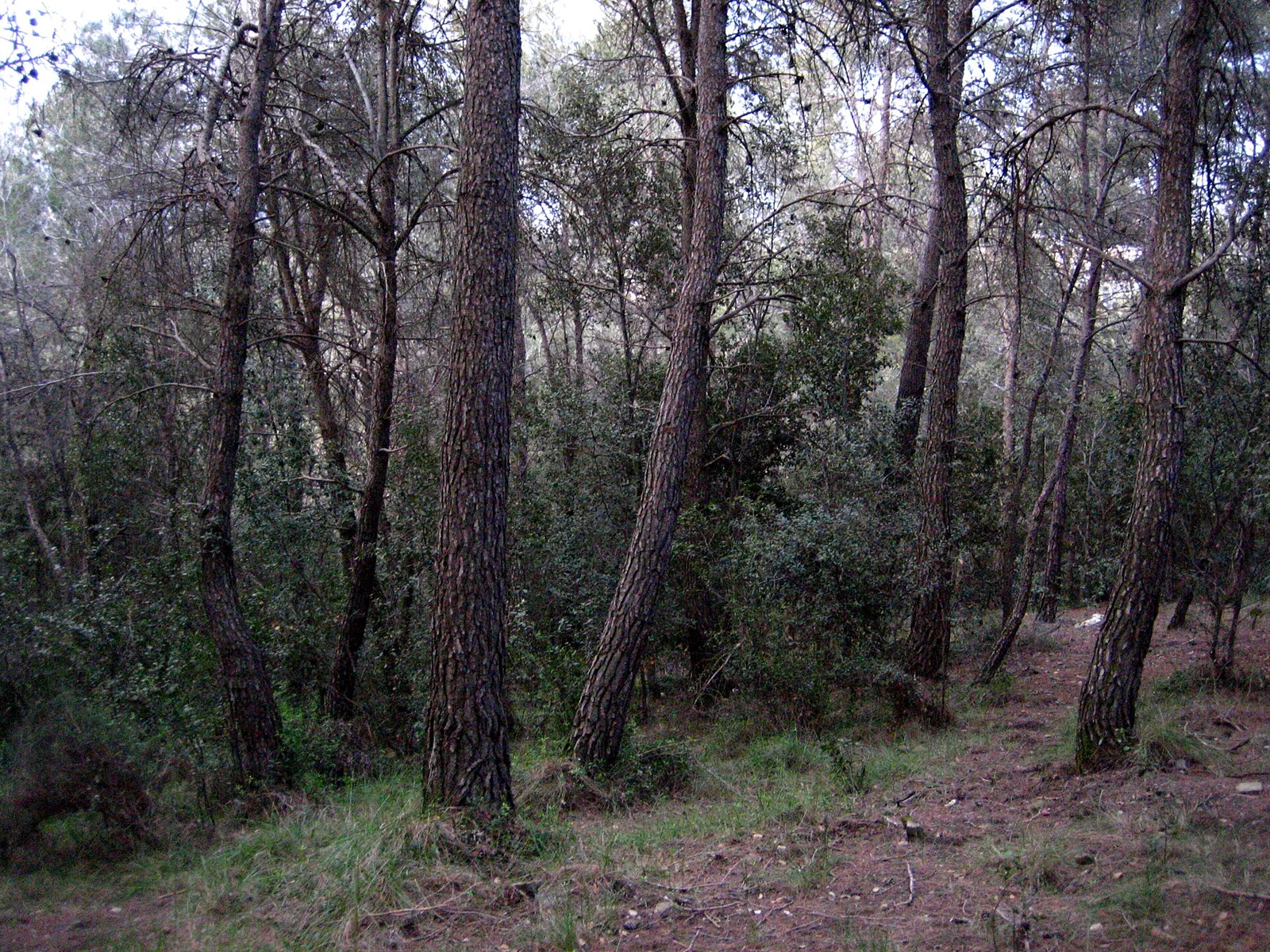
How a disturbed site changes depends on which propagules arrive first and how early colonists alter conditions for species that follow. Wind-dispersed herbs, nitrogen-fixing shrubs, or fast-growing pines may facilitate later arrivals by stabilizing loose sediment, adding organic litter, and casting shade—as when young shade-tolerant holm oaks establish beneath mature Aleppo pines in regenerating Mediterranean woodland. Elsewhere, early colonists inhibit newcomers by monopolizing light, soil moisture, or space until disease, browsing, or senescence opens gaps. Because priority effects give early arrivals a lasting edge, two adjacent clearings with identical climate and bedrock can assemble into markedly different communities. [1][4]
- Early colonists can facilitate later species by building soil and shade, or inhibit them by monopolizing light and root space.
- Priority effects mean that the order in which seeds, spores, and animals arrive can steer community composition for decades.
- Young shade-tolerant trees growing beneath a pioneer pine canopy illustrate species turnover unfolding in real time.
Fire does not always start the clock at zero
Wildfire rarely wipes a landscape clean; its ecological effect depends on fire intensity, burn severity, season, fuel continuity, and evolutionary adaptations of the local flora and fauna. Across western North American parks such as Yellowstone and Bryce Canyon, burns leave heterogeneous mosaics of unburned refugia, lightly scorched understory, and stand-replacing crown fire. Lodgepole pines release seeds from heat-opened serotinous cones, aspen and chaparral shrubs resprout vigorously from insulated underground tissues, and char-standing snags provide immediate foraging and nesting habitat for woodpeckers and cavity-nesting birds. Treating every burned slope as a reset to bare ground overlooks the surviving legacies that drive rapid post-fire recovery. [2][3][4]
- Fire-adapted plants recover quickly through heat-triggered serotinous cones, smoke-stimulated seed banks, or insulated underground roots.
- Even large wildfires burn unevenly, leaving unburned islands and standing dead wood that seed and shelter the next community.
- Post-fire landscapes in places like Yellowstone form complex habitat mosaics rather than uniform biological deserts.
There is rarely one final community
Early twentieth-century ecology often portrayed succession as a predictable march through fixed stages ending in a single, self-replacing climax forest determined solely by regional climate. Long-term plot monitoring, paleoecological pollen cores, and disturbance histories instead show multiple pathways and ongoing change. Chronic ungulate browsing, bark beetle outbreaks, severe drought, invasive grasses that alter fire frequency, or shifting climate baselines can arrest, divert, or reverse community development. Rather than assuming an old-growth canopy is the inevitable endpoint of every open meadow or shrubland, field ecologists reconstruct site history, soil conditions, and disturbance regimes to understand why a patch looks the way it does today. [1][3]
- Modern ecology replaces the idea of a single inevitable climax community with multiple contingent pathways shaped by disturbance and history.
- Repeated fire, heavy herbivory, invasive plants, or drought can maintain grasslands, shrublands, or open woodlands indefinitely.
- Reading a regenerating landscape requires checking soil, dead wood, tree age classes, and browsing pressure rather than assuming a fixed stage.
Related guides
Get Fauna and identify it in the field.
Where this guide comes from
Source-checked editorial guide. Last updated . This guide teaches identification and field skills; it is not a substitute for expert verification when it matters.