How mycorrhizal fungi partner with roots
Fungal hyphae explore soil pores beyond the immediate root surface and transfer phosphorus, nitrogen, and other resources across specialized interfaces. Plants provide photosynthetically fixed carbon. The balance depends on soil fertility, water, host and fungal identity, competitors, and other stresses, so the outcome ranges from strongly beneficial to costly.
Last updated
Fungi extend the soil interface
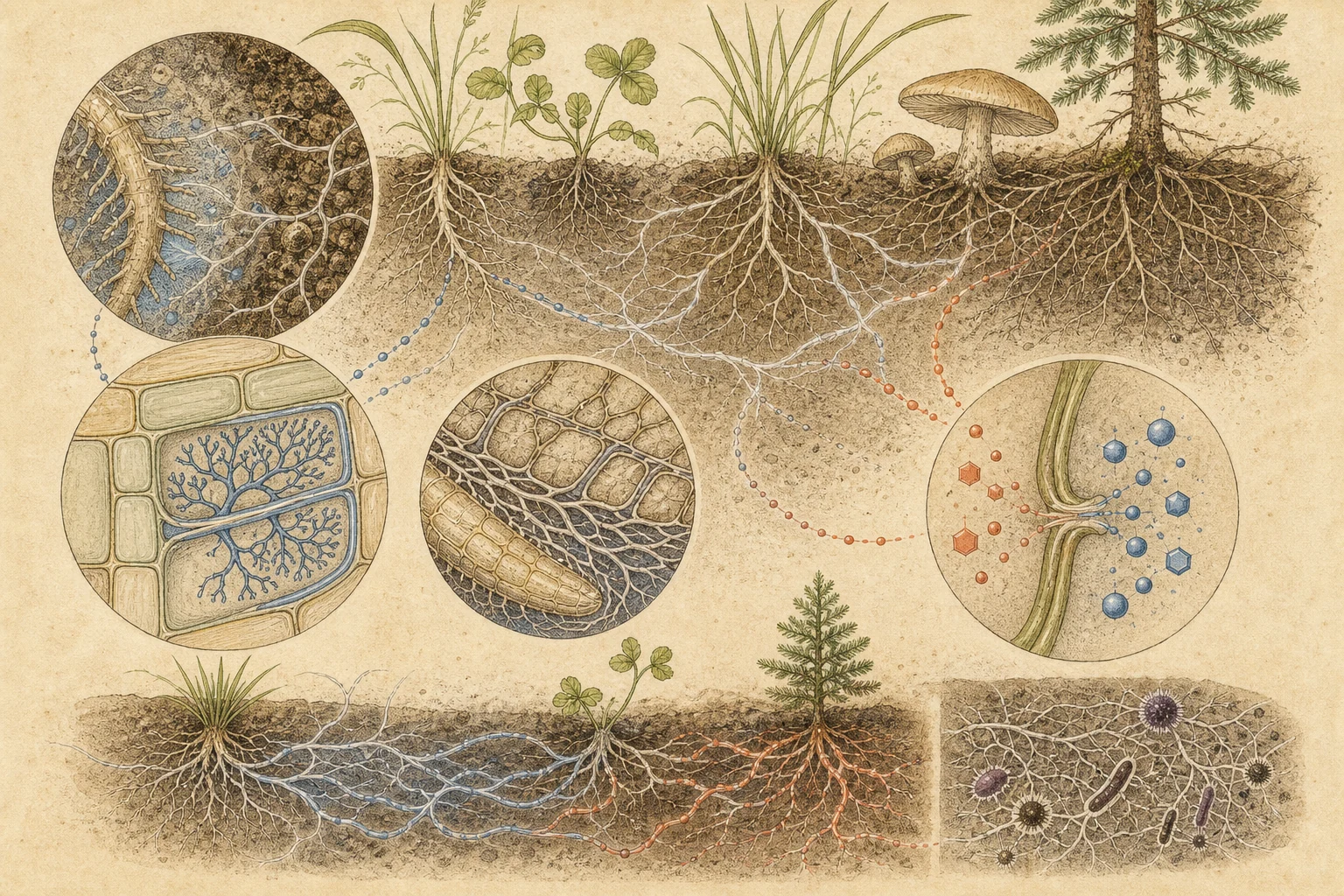
Because phosphate and several micronutrients bind tightly to soil particles and diffuse slowly through porewater, an actively absorbing plant root quickly creates a narrow depletion zone around itself. Mycorrhizal fungi bridge that gap by sending threadlike extraradical hyphae far beyond the reach of root hairs and into microscopic soil pores only a few micrometers wide. Those hyphae scavenge inorganic phosphorus, nitrogen, zinc, and water from a vastly larger soil volume and translocate them back to the root. Rather than acting as passive physical extensions of the plant, however, the fungi are independent heterotrophic organisms with their own metabolic respiratory costs and mineral demands. [1][2]
- Fine fungal hyphae reach beyond the root's nutrient-depletion zone and penetrate microscopic soil pores inaccessible to root hairs.
- Mycorrhizal transport is especially important for poorly mobile soil nutrients like inorganic phosphate.
- Fungal hyphae are living organisms with their own carbon and nutrient needs, not passive root pipes.
Exchange occurs across specialized structures
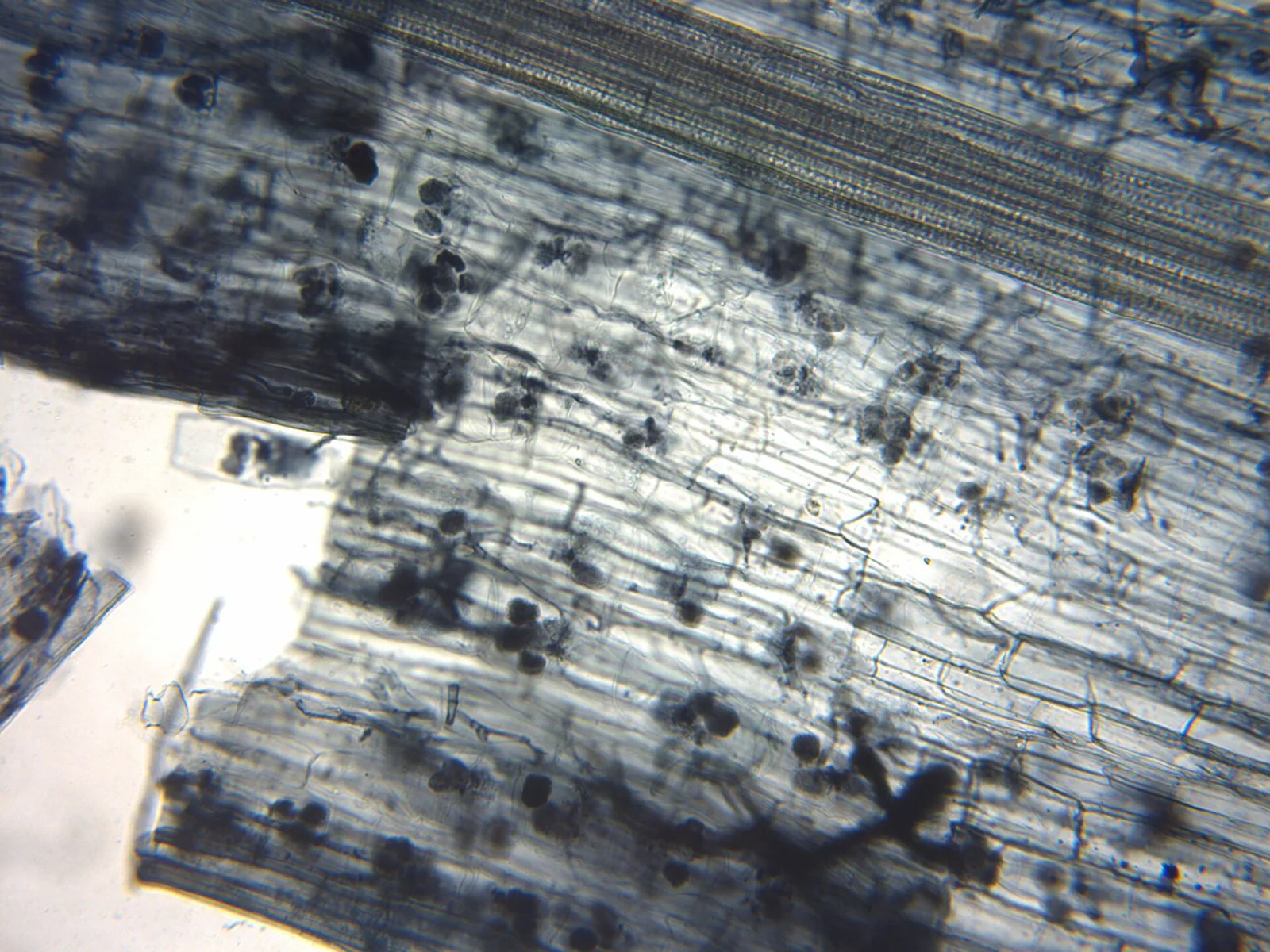
The two most widespread mycorrhizal guilds build contrasting anatomical interfaces inside plant roots. Arbuscular mycorrhizal fungi (phylum Glomeromycota), which partner with the majority of herbaceous plants, grasses, crops, and many tropical trees, penetrate root cortical cell walls to form finely branched tree-like arbuscules; a specialized plant-derived periarbuscular membrane wraps every branch so fungal and host cytoplasms never mix directly. Ectomycorrhizal fungi—including many familiar forest mushrooms such as amanitas, boletes, and chanterelles partnering with pines, oaks, birches, and eucalypts—remain outside host cells, wrapping root tips in a dense fungal mantle and weaving an intercellular Hartig net between epidermal and cortical cells. [2][3]
- Arbuscular mycorrhizal fungi form tree-like arbuscules inside root cortical cells, surrounded by a specialized plant membrane.
- Ectomycorrhizal fungi sheath fine tree root tips in a fungal mantle and exchange nutrients between cells via a Hartig net.
- Some plant families, such as mustards (Brassicaceae) and sedges, routinely grow without forming mycorrhizal partnerships.
Both partners regulate the trade
Across the symbiotic interface, host plants export photosynthetically fixed carbon—as hexose sugars and fatty acids—into the apoplastic exchange space, while the fungus transfers phosphate and ammonium or amino acids driven by proton-gradient transporters. Laboratory root-organ and split-root experiments show that both partners can adjust resource allocation: plants often direct more carbon to root sectors colonized by fungi delivering more phosphorus, and fungal hyphae can hoard polyphosphate or shift delivery toward higher-carbon hosts. Even so, this exchange is governed by local physiological source–sink rules and membrane transport kinetics rather than conscious negotiation, and multiple fungal species competing on one root system vary widely in how much benefit they return. [1][4]
- Plants supply sugars and lipids fixed by photosynthesis in exchange for phosphorus and nitrogen delivered by fungal transporters.
- Physiological feedback allows hosts and fungi to shift resource allocation among colonized root sectors according to nutrient supply.
- Different fungal strains colonizing the same root system can range from high-performing mutualists to low-benefit carbon drains.
A network is not automatically a benefit or a message
Because a single mycorrhizal mycelium can colonize the roots of multiple neighboring plants, fungal hyphae can form common mycorrhizal networks in forest and grassland soils. Tracer studies confirm that carbon, nitrogen, water, and defense-related signaling molecules can move through shared hyphae under specific conditions, and that fungal colonization primes systemic plant immune defenses against root pathogens and foliar herbivores. However, field evidence does not support popular metaphors of a benevolent ‘wood wide web’ in which mother trees intentionally send warnings or charity to seedlings: network transfers are often tiny, driven by fungal sink strength, and can even amplify competition or spread allelochemicals. [3][4]
- Shared fungal mycelia can link neighboring plant roots, and colonization often primes host jasmonate defenses against pests and pathogens.
- In heavily fertilized soils, supporting mycorrhizal fungi with plant carbon can cost more than the extra nutrients are worth.
- Movement of carbon or defense signals through fungal networks reflects fungal physiology and source–sink gradients, not intentional tree altruism.
Related guides
Get Fauna and identify it in the field.
Where this guide comes from
Source-checked editorial guide. Last updated . This guide teaches identification and field skills; it is not a substitute for expert verification when it matters.
- Plant signaling & behavior — The role of carbon in fungal nutrient uptake and transport: implications for resource exchange in the arbuscular mycorrhizal symbiosis ↗
- BioMed research international — Soil fungal resources in annual cropping systems and their potential for management ↗
- F1000Research — Understanding transport processes in lichen, Azolla-cyanobacteria, ectomycorrhiza, endomycorrhiza, and rhizobia-legume symbiotic interactions ↗
- The ISME journal — Community assembly of root-colonizing arbuscular mycorrhizal fungi: beyond carbon and into defence? ↗