How predator–prey cycles work
More prey can support more predators; increased predation can then slow prey growth, after which predators may decline as food becomes scarce. That feedback can oscillate, yet real ecosystems add time lags, alternative foods, plant defenses, climate, disease, and movement, so no single curve fits every pair.
Last updated
Delayed feedback can make abundance oscillate
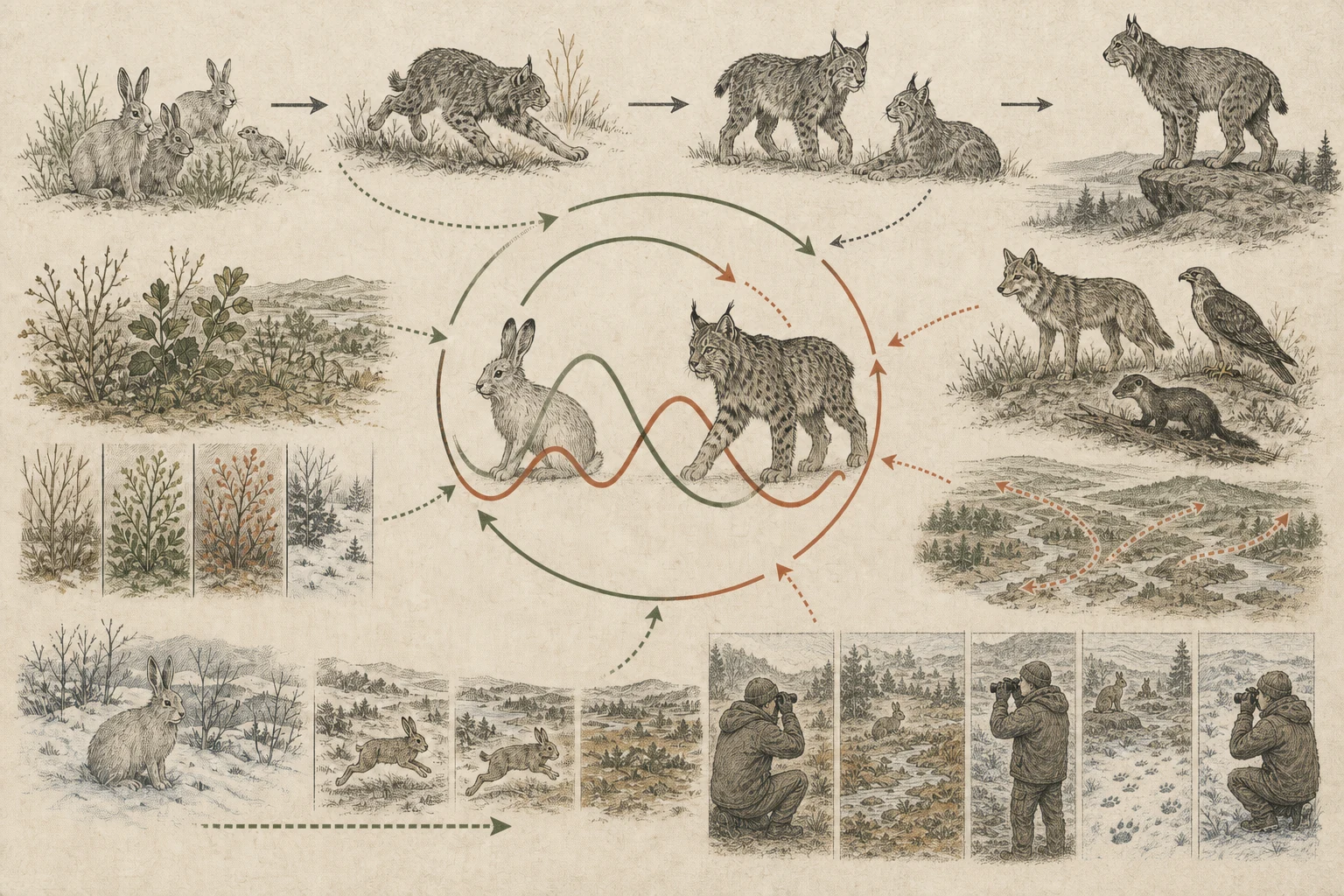
When prey populations surge across a landscape, specialist predators encounter meals more frequently, keep more young alive, and recruit larger cohorts into the breeding population. Because gestation, juvenile maturation, and territory establishment take time, predator numbers peak after prey abundance has already begun to turn. Heavy hunting pressure and chronic predation risk then push prey survival and reproduction downward, eventually leaving too few prey to sustain the expanded predator population. As predator survival and litter sizes drop, prey gain breathing room to rebound. This delayed negative feedback drives recurring oscillations whose period and amplitude depend on generation times and local habitat structure. [1][2]
- Predator numbers typically lag behind prey peaks because reproduction, maturation, and recruitment require time.
- Both direct killing and physiological stress from predator encounters can depress prey reproduction during the decline phase.
- Cycle length and amplitude reflect the life histories of the interacting species rather than a fixed universal schedule.
The classic equations are a teaching model
The classic Lotka–Volterra predator–prey equations generate smooth, out-of-phase oscillations by stripping an ecosystem down to four strict assumptions: prey grow exponentially when predators are absent, predators starve exponentially without that single prey, encounters happen at random like colliding gas molecules, and prey biomass converts into new predators at a fixed rate in a closed arena. Those simplifications make the logic of consumer–resource feedback transparent, but wild populations face winter forage limits, age structure, spatial refuges, seasonal breeding, satiation, and multi-species food webs. Field ecologists treat Lotka–Volterra curves as a baseline hypothesis to test against messy demographic records rather than a literal portrait of nature. [1][4]
- Basic Lotka–Volterra models assume random encounters, no carrying capacity for prey, and no alternative food for predators.
- Real predators become satiated and spend time handling prey, which caps how fast consumption rises when prey are abundant.
- Habitat refuges, seasonal weather, and migration modify or dampen the smooth waves predicted by simple equations.
Famous cycles have more than two actors
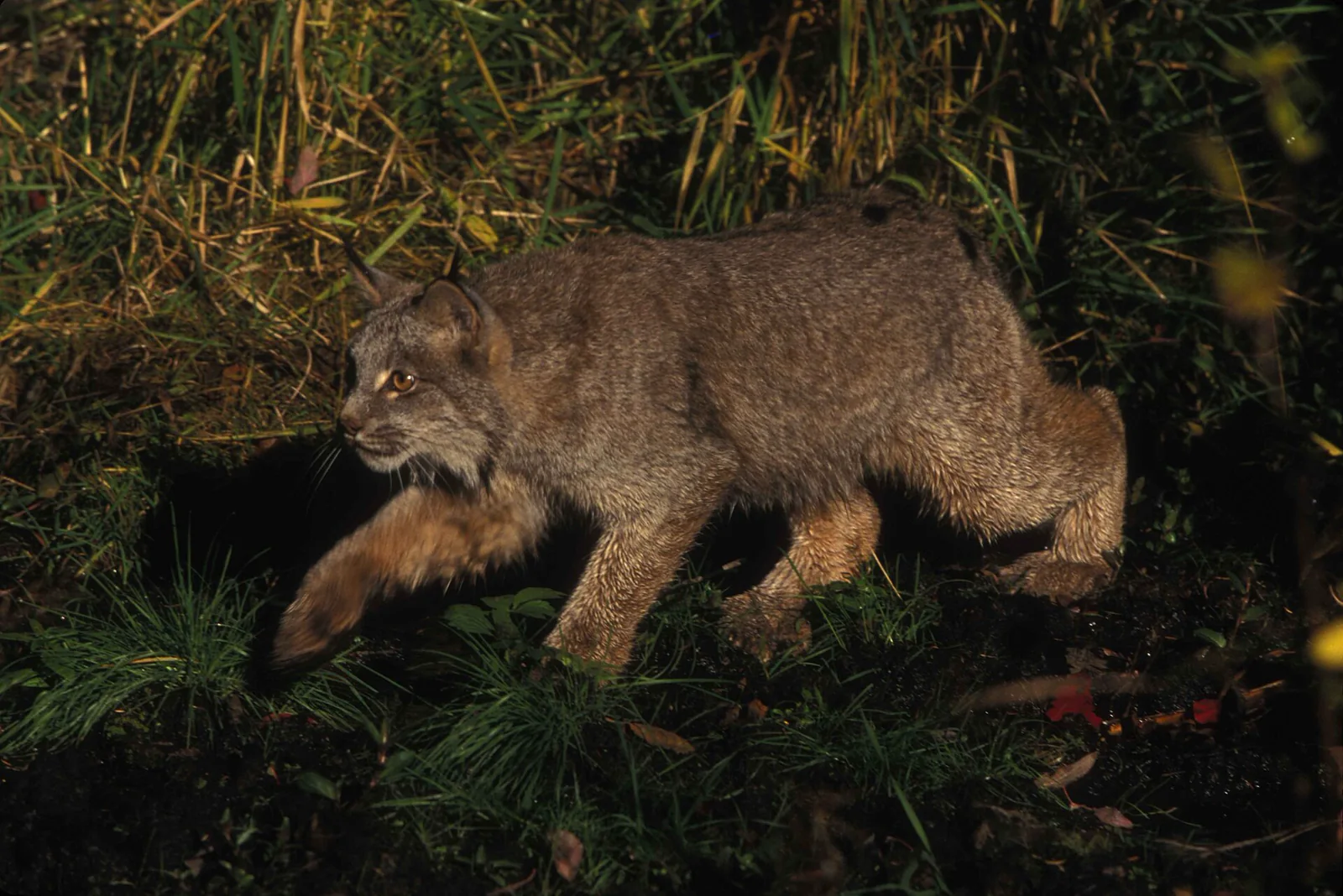
Boreal snowshoe hare and Canada lynx records are often taught as a tidy two-species clock, yet decades of field experiments in northern Canada show a wider web at work. Winter browse depletion, toxic plant defenses in regenerating twigs, maternal stress hormones, and a guild of other predators—including great horned owls, goshawks, and coyotes—all shape the roughly ten-year hare cycle, while regional dispersal spreads waves of lynx survival across the boreal forest. In Fennoscandia, voles fluctuate on a three-to-five-year rhythm driven strongly by specialist small mustelids such as least weasels and stoats, whose delayed numerical response keeps predation heavy even as vole densities crash. [2][3][5]
- Boreal snowshoe hare cycles involve winter browse quality, stress physiology, and multiple avian and mammalian predators alongside Canada lynx.
- Across Finland and northern Europe, specialist least weasels and stoats track vole populations with a delay that deepens the crash phase.
- Generalist predators that switch to alternative prey tend to stabilize prey numbers, whereas tight specialists promote sharper oscillations.
Cycles must be separated from noisy change
Distinguishing a genuine population cycle from irregular weather-driven booms and busts requires multi-decade time series spanning several complete oscillations, standardized survey effort, and models that test competing explanations. A two- or three-year count can easily mistake a local post-fire pulse, a hard winter die-off, or regional immigration for part of a repeating wave. To prove that consumer–resource feedback drives a rhythm, field researchers combine abundance indices with radio-telemetry survival rates, diet analyses, reproductive output, and experimental food supplementation or predator exclosures, separating local births and deaths from movement across the surrounding landscape. [3][4]
- Confirming a true cycle takes standardized monitoring across multiple full periods rather than a few years of fluctuating counts.
- Sudden drops or spikes in local sightings often reflect dispersal or weather events rather than predator-driven mortality.
- Field experiments that manipulate food supply or exclude predators help isolate consumer–resource feedback from climate noise.
Related guides
Get Fauna and identify it in the field.
Where this guide comes from
Source-checked editorial guide. Last updated . This guide teaches identification and field skills; it is not a substitute for expert verification when it matters.
- Proceedings of the National Academy of Sciences of the United States of America — Evidence for a survival-driven traveling wave in a keystone boreal predator population ↗
- PeerJ — Mammalian cycles: internally defined periods and interaction-driven amplitudes ↗
- Proceedings. Biological sciences — Of lemmings and snowshoe hares: the ecology of northern Canada ↗
- Proceedings of the National Academy of Sciences of the United States of America — Population regulation in snowshoe hare and Canadian lynx: asymmetric food web configurations between hare and lynx ↗
- Proceedings. Biological sciences — Predator-vole interactions in Northern Europe: the role of small mustelids revised ↗