Metapopulations and wildlife corridors
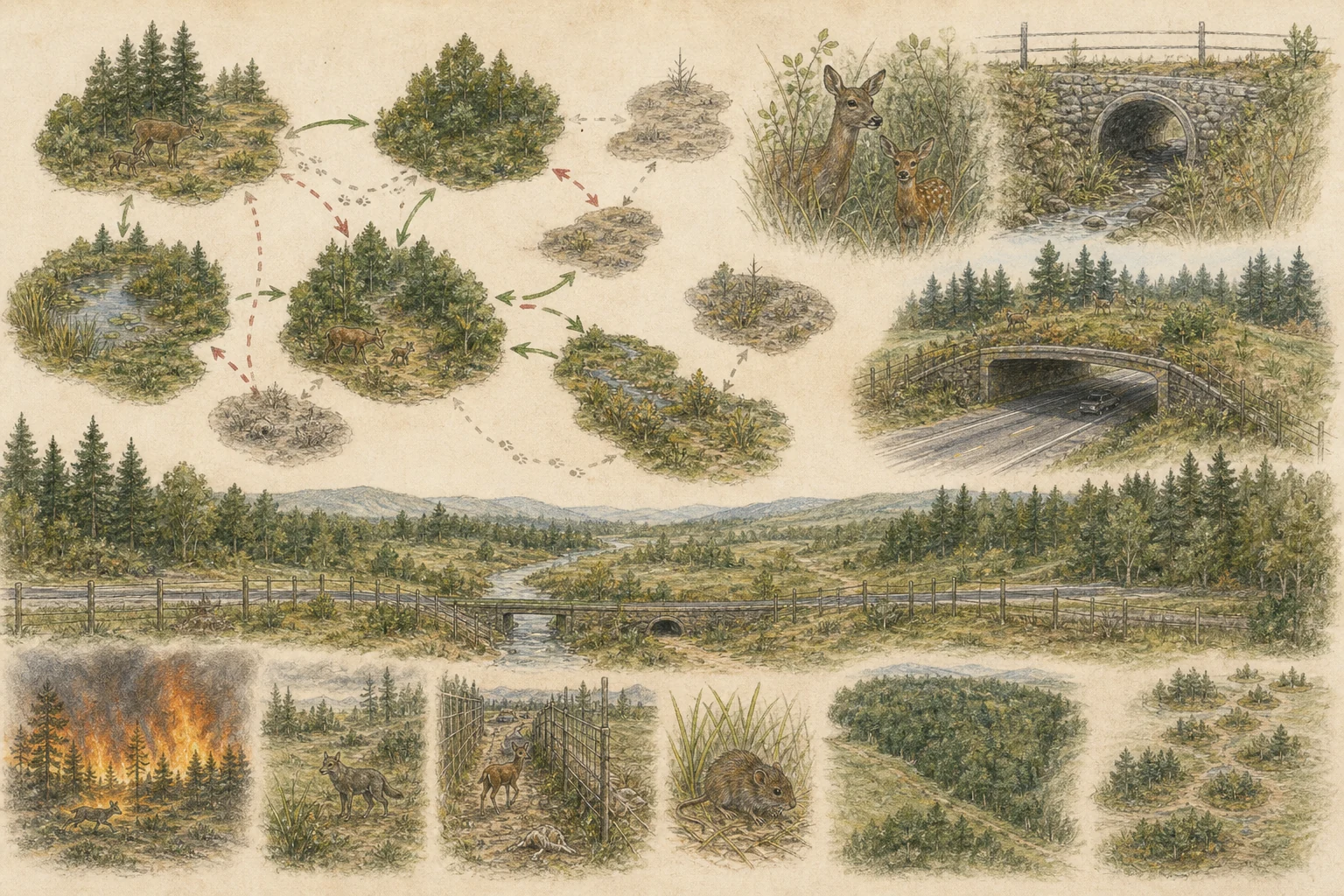
In a metapopulation, organisms occupy a set of habitat patches connected enough for dispersal but separate enough that local dynamics differ. Movement can recolonize empty patches and rescue declining ones. Corridors and crossings may improve connectivity, but their value is a measured outcome, not a property of any green strip on a map.
Last updated
Patches are connected but not interchangeable
Classic metapopulation theory views a regional population as a network of discrete habitat patches—such as meadow openings for butterflies, seasonal ponds for amphibians, or mountain basins for bighorn sheep—where local populations occasionally wink out and dispersing individuals later recolonize empty sites. Spatially realistic models expand that picture to account for patch area, habitat quality, boundary permeability, and directional wind or stream currents. The metapopulation framework applies best when local patches have somewhat independent births and deaths yet exchange enough individuals to affect regional persistence. A single continuous forest population or a seasonal migratory flyway where the entire population shifts between breeding and wintering grounds follows different demographic rules. [1][2]
- True metapopulations combine partly independent local patch dynamics with occasional dispersal between patches.
- Large, high-quality patches often act as steady sources of dispersers, while tiny patches experience frequent local turnover.
- Seasonal migration between breeding and wintering ranges is a regular round-trip cycle, not patch extinction and recolonization.
Movement can rescue a regional population
When dispersers cross the landscape and enter an occupied patch, they can top up dwindling numbers before a local population vanishes—a demographic rescue effect—or bring new alleles that counter inbreeding depression in isolated groups. If a harsh winter, drought, or disease outbreak wipes out a patch completely, immigrants from neighboring populations can re-establish breeding there once conditions recover. Because of this, landscape connectivity is defined by actual organismal movement, survival, and gene flow rather than human map geometry. A four-lane divided highway or a cleared agricultural strip that a hawk crosses effortlessly can completely block terrestrial salamanders, forest beetles, or small understory mammals. [1][3]
- Dispersing individuals can rescue small declining populations demographically and restore genetic diversity before local extinction occurs.
- Empty but suitable habitat patches are not proof of degraded habitat; they may simply await recolonization from nearby occupied patches.
- Functional connectivity depends on the movement behavior and gap tolerance of a specific organism rather than visual proximity on a map.
A corridor must match its users
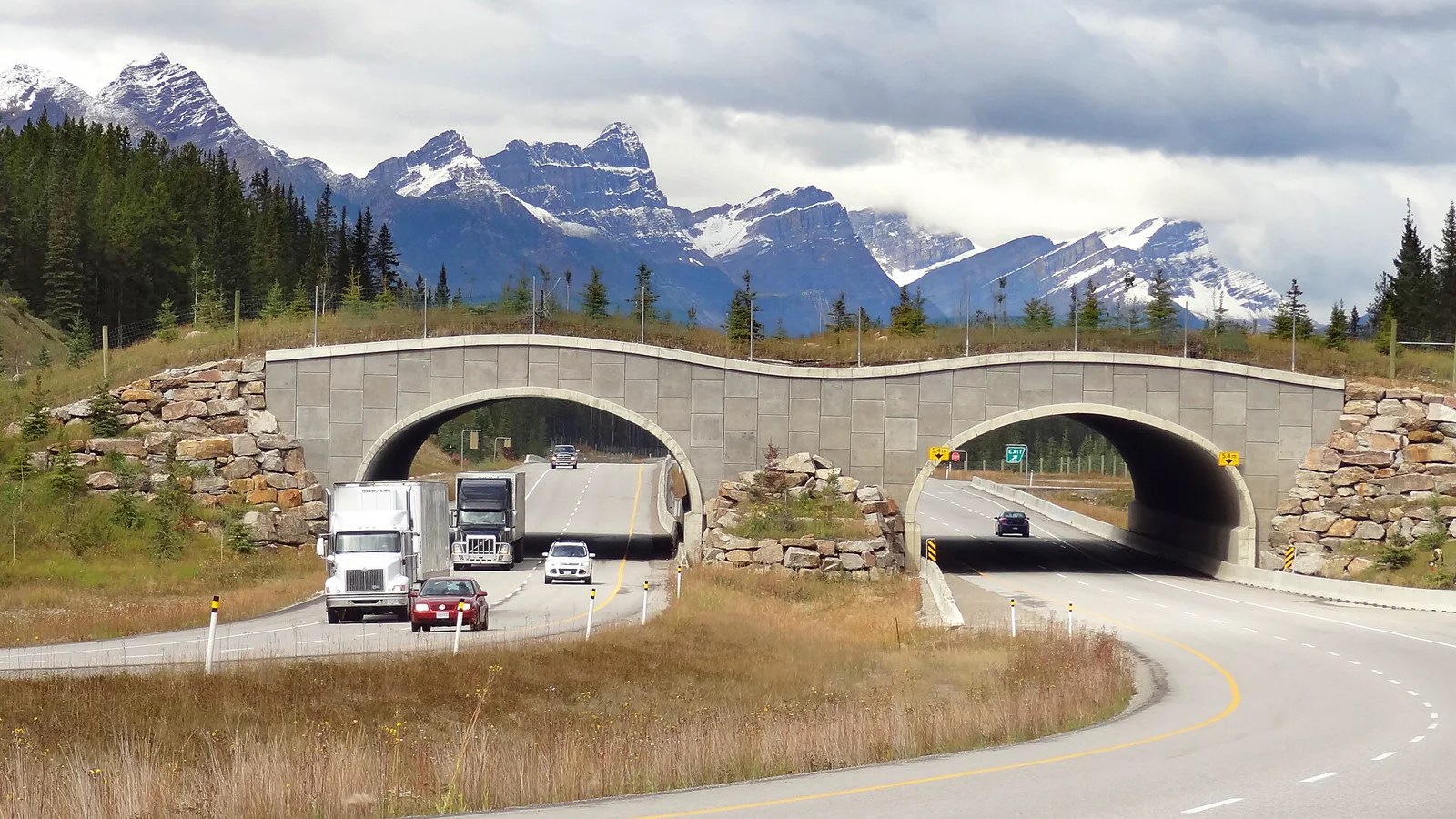
Riparian woodland strips, hedgerows, underpass culverts, and broad vegetated wildlife overpasses—such as those spanning the divided Trans-Canada Highway in Banff National Park—are built to lower movement resistance between core habitats. Whether animals actually use a structure depends on species-specific details: grizzlies, elk, and wolves often favor wide, quiet overpasses with natural sightlines, whereas black bears and cougars also travel through narrower underpasses, and amphibians require damp substrate and shaded cover. Guide fencing is usually essential to keep animals off the pavement and funnel them toward crossings. Even when trail cameras record frequent tracks, proving conservation success requires showing reduced roadkill, successful breeding dispersal, and maintained gene flow across the barrier. [2][3][4]
- Effective crossings pair species-appropriate structure—width, substrate, cover, and light—with wing fencing that guides wildlife off roads.
- Different species prefer different crossing types, from open vegetated overpasses for ungulates to sheltered culverts for smaller mammals.
- Camera-trap photos confirm passage, but genetic sampling and survival studies are needed to prove long-term population benefit.
Connectivity has tradeoffs and alternatives
Linking habitat patches is not an automatic conservation win in every landscape. Narrow or poorly sited corridors can act as edge-dominated funnels that expose dispersing prey to ambush predators, human poaching, or road edges, and physical linkages can sometimes accelerate the spread of wildfire, invasive plants, or wildlife pathogens between formerly isolated reserves. In some landscapes, enlarging existing core reserves, improving matrix quality across working ranches and forests, or maintaining a chain of wetland stepping stones achieves more for regional persistence than buying a single thin strip of land. Managers weigh these tradeoffs against explicit target species, movement data, and future climate shifts before committing resources. [2][4]
- Corridors can occasionally facilitate the spread of contagious diseases, invasive species, or wildfire between habitat patches.
- Narrow strips dominated by edge habitat can concentrate predators or human disturbances, turning a linkage into a mortality sink.
- Stepping-stone habitats, matrix restoration, or expanding core reserves can sometimes outperform a single continuous corridor.
Related guides
Get Fauna and identify it in the field.
Where this guide comes from
Source-checked editorial guide. Last updated . This guide teaches identification and field skills; it is not a substitute for expert verification when it matters.