Density dependence explained
Competition, disease, predators, mate finding, cooperative defense, and habitat modification can make demographic rates depend on density. Negative effects tend to stabilize abundance, while positive effects at low density can hinder recovery. The response may be delayed and can differ among ages, habitats, seasons, and spatial scales.
Last updated
Measure rates per individual
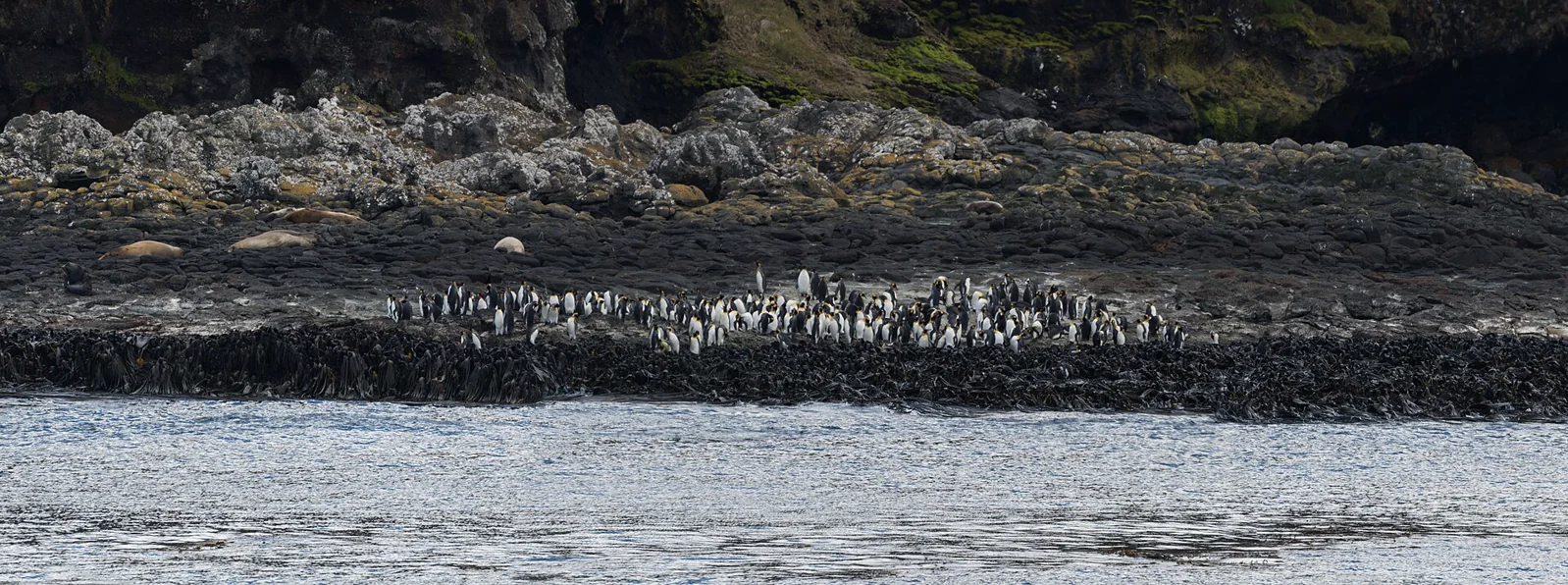
A growing population often produces more total offspring simply because more breeding adults are present, so testing for density dependence requires tracking per-capita rates—such as surviving young per female, individual body mass gain, or annual survival probability—against population density. Choosing a biologically meaningful area denominator is equally important. Tens of thousands of king penguins packed shoulder-to-shoulder on a Crozet Islands beach experience intense local crowding at nesting territories and nearshore foraging zones even though the surrounding Southern Ocean is vast. Total population size, broad geographic range, and local ecological density experienced by interacting individuals measure very different aspects of crowding. [1][2]
- Density dependence is evaluated using per-capita survival, growth, or reproduction rather than total offspring produced.
- Ecological density measures individuals per unit of actually used habitat—such as nesting ledges or winter yards—not total map area.
- High local crowding at a breeding colony can coexist with sparse distribution across a species' wider foraging range.
Negative feedback can regulate abundance
When population density climbs, per-capita performance often drops through negative density dependence: individuals compete harder for prime territories and winter forage, parasites and respiratory pathogens spread more easily between neighbors, juveniles are forced into marginal cover, and predators focus their hunting on the abundant prey. Because this negative feedback pushes growth rates down when a population is high and relaxes when numbers fall, it acts as a stabilizing brake that keeps long-term abundance within bounds. Even so, regulation rarely produces a flat line in the field; time lags in food recovery or age structure can interact with environmental noise to amplify fluctuations. [1][3]
- Negative density dependence lowers per-capita birth or survival rates as crowding intensifies competition, disease, or predation.
- Stabilizing feedback keeps populations from growing without bound, even when year-to-year counts fluctuate widely.
- Delayed density dependence—where this year's survival reflects last year's grazing or parasite load—can drive multi-year oscillations.
Low density can carry its own costs
At the opposite extreme, some populations suffer lower per-capita survival or reproduction when numbers drop too low—a positive density-dependent pattern known as an Allee effect. Broadcast-spawning marine invertebrates like abalone and sea urchins need neighbors close enough for eggs and sperm to meet in the current; wind- or insect-pollinated plants in small patches may receive too little pollen; and colonial seabirds, schooling fish, or pack-hunting mammals can lose antipredator vigilance, social thermoregulation, or foraging efficiency when groups shrink. Strong Allee effects create a critical density threshold below which a sparse population struggles to recover even if habitat and food remain abundant. [2][4]
- Allee effects occur when per-capita survival or reproduction declines at very low population densities.
- Difficulty finding mates, reduced fertilization in broadcast spawners, and weaker group defense against predators can all drive Allee effects.
- Not every small or endangered population experiences an Allee effect; each mechanism must be tested demographically.
Other variation can hide the signal
In real landscapes, density-dependent feedbacks operate alongside powerful density-independent forces such as spring blizzards, summer droughts, coastal storms, and human harvest. Those environmental jolts can mask underlying regulation in short time series, while census counting errors can create statistical illusions of negative density dependence where none exists. Conversely, a single snapshot of a densely packed penguin colony, bat cave, or ungulate winter yard shows behavioral aggregation, not whether crowding is currently depressing or boosting vital rates. Ecologists combine long-term mark–recapture studies, age-structured models, and multi-scale habitat measurements to separate true density feedback from weather and sampling noise. [3][4]
- Weather extremes, harvest, and immigration alter survival regardless of density and can obscure density-dependent signals in short records.
- Sampling and counting errors in annual surveys can generate false statistical signatures of negative density dependence.
- Long-term tracking of marked individuals across high- and low-density years provides the strongest test of demographic feedback.
Related guides
Get Fauna and identify it in the field.
Where this guide comes from
Source-checked editorial guide. Last updated . This guide teaches identification and field skills; it is not a substitute for expert verification when it matters.
- Scientific reports — Weak evidence of density dependent population regulation when using the ability of two simple density dependent models to predict population size ↗
- Nature Education — Population growth and density dependence ↗
- PeerJ — Density regulation amplifies environmentally induced population fluctuations ↗
- Nature Education — Allee effects and population dynamics ↗