Animal dispersal vs migration
Classify movement by its role in the life cycle, not mileage: ask where the animal started, whether it returns or alternates areas, whether reproduction follows relocation, and how the pattern repeats across time or generations.
Last updated
Dispersal links one breeding place to another
When a subadult red fox leaves its parents' denning territory to establish a home range two valleys away, or a fledgling songbird settles in a new woodlot the following spring, the process is natal dispersal; when an adult shifts breeding sites between years, it is breeding dispersal. Biologists break dispersal into three linked stages—departure from the old patch, transit across intervening matrix habitat, and settlement at a new site—driven by local crowding, kin competition, inbreeding avoidance, or habitat turnover. A dispersing spider ballooning across a meadow or a salamander moving a few hundred meters can be just as ecologically consequential for gene flow and colonization as a wolf crossing state lines. [1][2]
- Distinguish natal dispersal (birth site to first breeding site) from breeding dispersal (movement between successive adult breeding sites).
- Focus on reproductive settlement and gene flow rather than raw kilometers, since dispersal can span meters in snails or hundreds of kilometers in carnivores.
- Think of dispersal in three stages—departure, transfer across the landscape, and settlement—each shaped by different risks and cues.
Migration links recurring seasonal areas
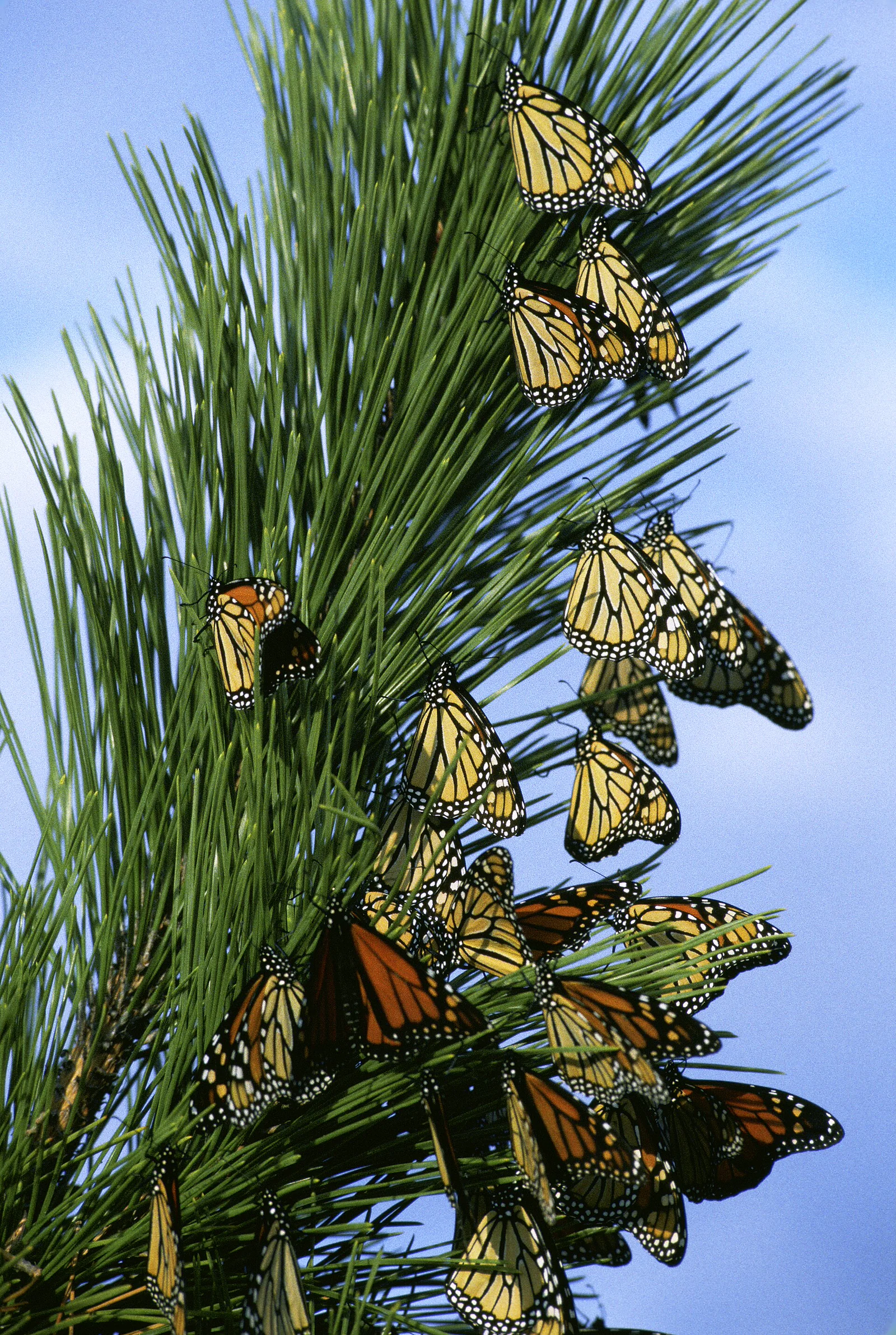
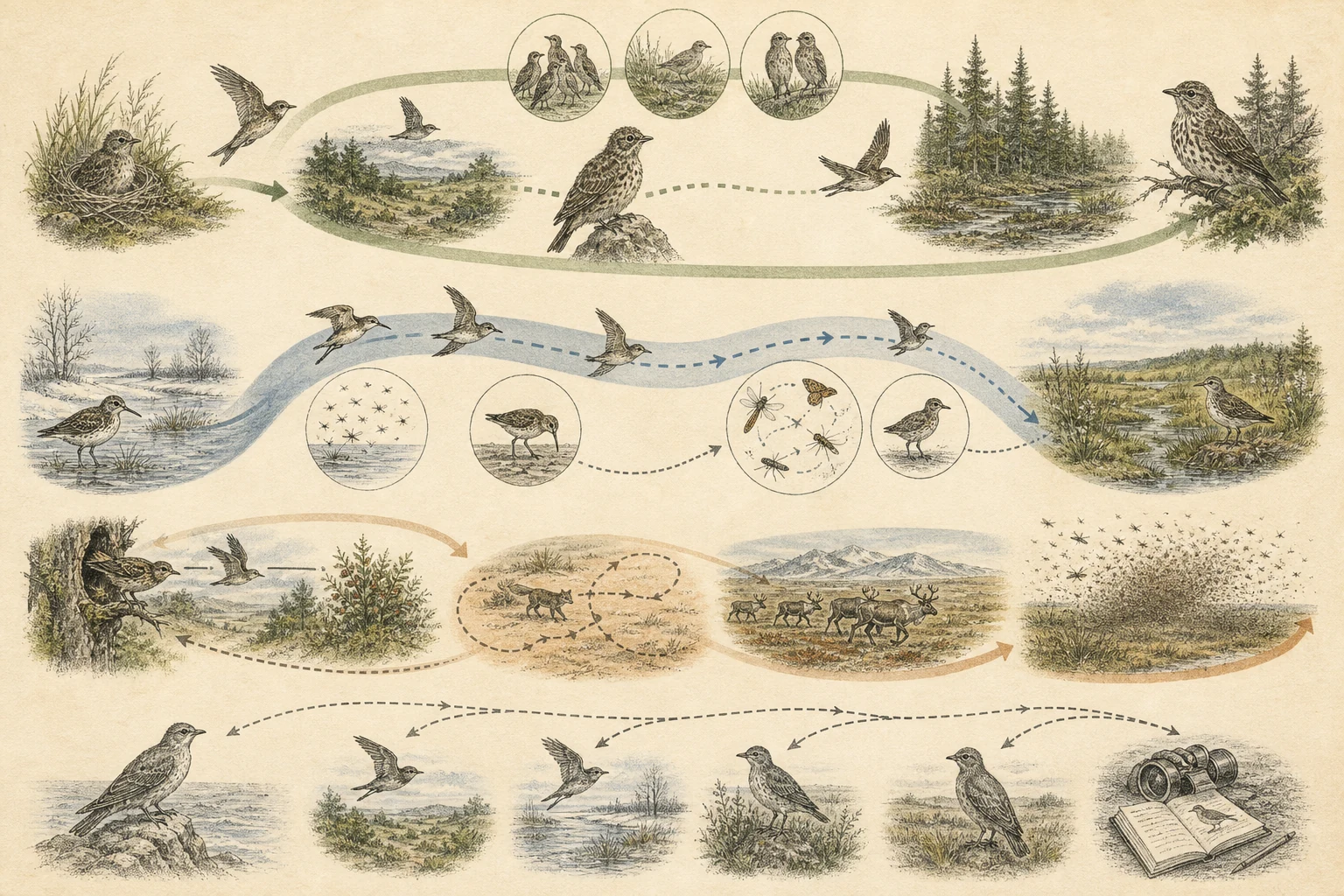
Unlike dispersal's relocation to a new breeding home, migration is a persistent, directed movement that shuttles animals between discrete seasonal ranges—such as breeding grounds, molting lakes, and wintering habitats—while temporarily suppressing ordinary responses to local food or shelter along the route. In Arctic terns, humpback whales, and caribou, the same individual repeats the round trip year after year. In monarch butterflies and painted ladies, however, the full seasonal circuit spans multiple successive generations, and in partial migrants only a fraction of the local population departs. What unites these patterns as migration is predictable, recurring alternation between functional seasonal habitats. [2][3]
- Look for sustained, directional travel between distinct seasonal ranges accompanied by physiological preparation such as fat deposition.
- Remember that insect migration often completes its seasonal round trip across multiple generations rather than within one adult lifespan.
- Account for partial migration, where some individuals in a population migrate while neighbors of the same species remain year-round.
Routine ranging belongs in a third box
Not every long track on a map is dispersal or migration. Within the movement-ecology framework, daily foraging commutes—such as starlings flying twenty kilometers from a winter communal roost to agricultural fields and returning at dusk, or bats commuting between a maternity cave and riverine feeding beats—are station-keeping home-range movements because the animal keeps returning to the same focal center. Exploratory pre-dispersal forays may test surrounding patches before returning home, whereas nomadic movements track shifting rain or seed pulses across years without fixed seasonal endpoints. Keeping station-keeping commutes, nomadism, dispersal, and migration conceptually distinct prevents misreading daily traffic. [3][4]
- Classify daily roost-to-feeding flights and territorial boundary patrols as station-keeping home-range movements, not migration.
- Recognize exploratory forays, where young animals make temporary outward loops before returning to their natal range.
- Separate predictable seasonal migration from nomadism, in which animals track erratic resource pulses without fixed annual destinations.
One sighting rarely reveals the process
Spotting a juvenile heron north of its breeding marsh in August, a lynx in an unfamiliar county, or a vagrant warbler on a coastal headland does not by itself tell you which movement process brought it there. The same animal could be making a post-fledging exploratory foray, dispersing to a new breeding site, migrating along a seasonal corridor, or blown off course by a storm front. Determining the true ecological category requires sequential evidence across time—individual bands, radio or satellite telemetry, stable isotopes, genetic parentage, or multi-year population monitoring. In field notes, describe the animal's age class, travel bearing, behavior, and date without overclaiming its destination. [1][4]
- Log age class, plumage or molt state, flight direction, and stopover behavior when you encounter an animal outside its usual habitat.
- Avoid labeling a single late-summer juvenile wandering upslope or northward as true migration without population context.
- Look for band codes, neck collars, or fin tags that allow researchers to link your single sighting to a known origin and fate.
Related guides
Get Fauna and identify it in the field.
Where this guide comes from
Source-checked editorial guide. Last updated . This guide teaches identification and field skills; it is not a substitute for expert verification when it matters.
- Philosophical transactions of the Royal Society of London. Series B, Biological sciences — Evolutionary ecology of dispersal in biodiverse spatially structured systems: what is old and what is new? ↗
- Movement ecology — Integrating movement ecology with biodiversity research - exploring new avenues to address spatiotemporal biodiversity dynamics ↗
- Conservation physiology — Conservation physiology of animal migration ↗
- Proceedings of the National Academy of Sciences of the United States of America — A movement ecology paradigm for unifying organismal movement research ↗