Abundance vs. occupancy
Abundance asks how many individuals occur in a defined area or population; occupancy asks what proportion of defined sites are occupied or used. Neither is the raw count alone when individuals or occupied sites can be missed during sampling.
Last updated
Ask two different questions
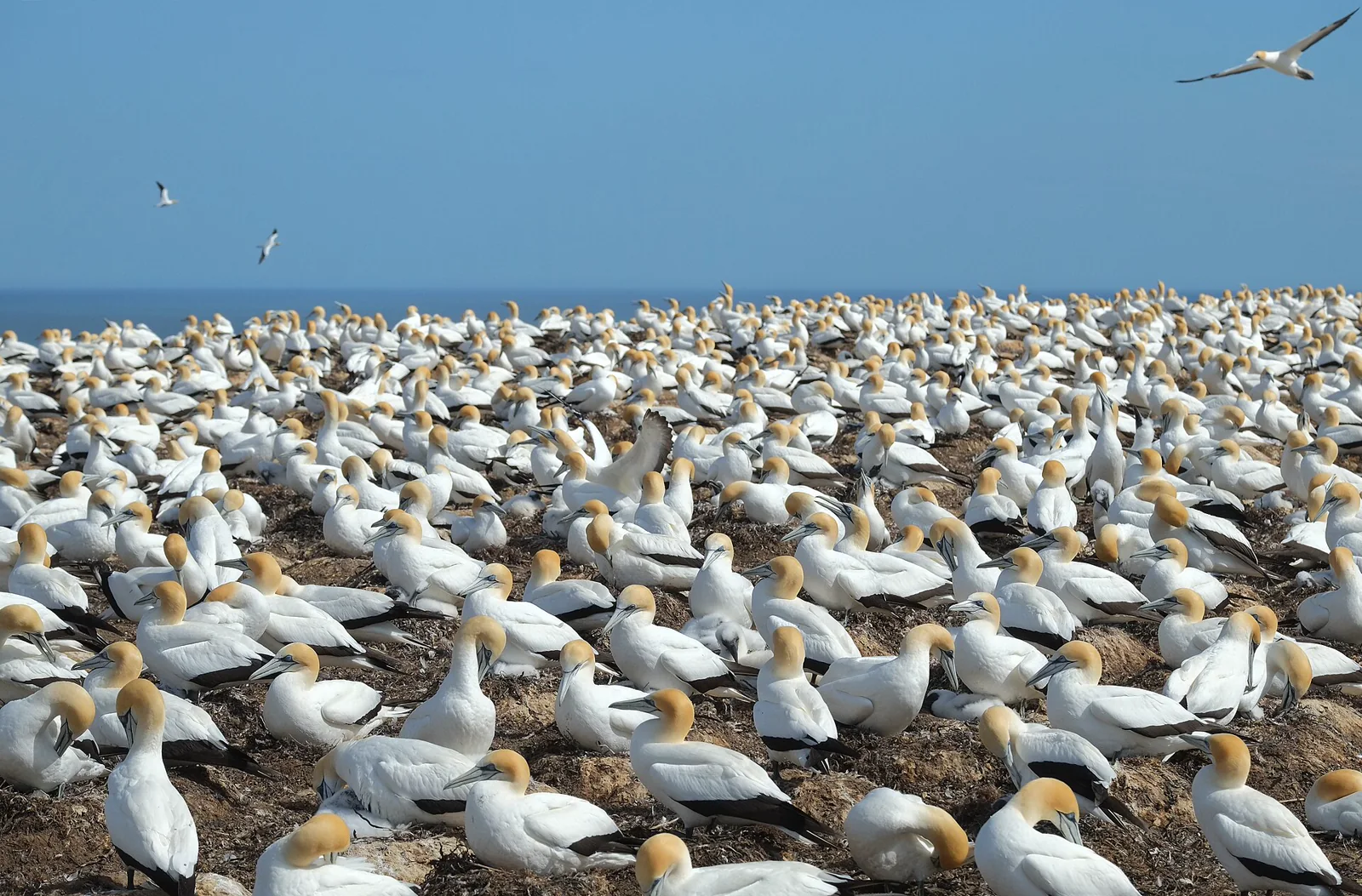
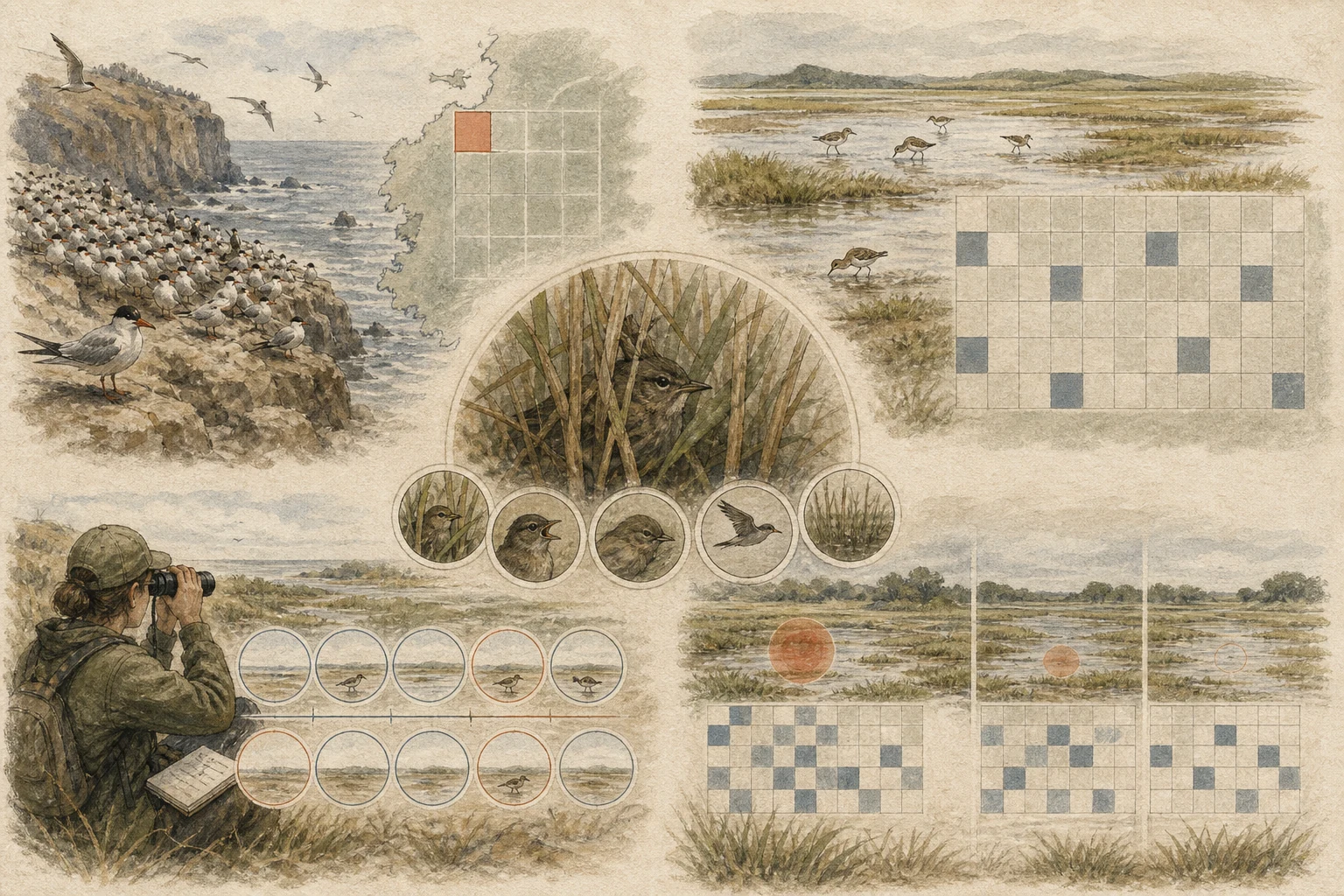
When naturalists ask how a species is faring across a landscape, 'how many individuals are there?' and 'how many places does the species use?' are two fundamentally different questions. Abundance measures the total number or density of individuals in a site or population, whereas occupancy measures the proportion of defined spatial units—such as vernal pools, forest plots, or 1-kilometer grid cells—where the species is present. Colonial seabirds like gannets or cliff swallows can have huge local abundance at a handful of headlands while showing very low regional occupancy, whereas a territorial owl or winter wren may occupy nearly every woodland patch at low density. [1][2][5]
- Abundance asks how many individuals live in a defined area; occupancy asks what fraction of sampled sites contain at least one individual.
- Colonial breeders (gannets, herons, bats) often show high local abundance paired with low landscape occupancy.
- Territorial predators and dispersed woodland plants often show high site occupancy paired with low local density.
Separate state from observation
In real field surveys, neither abundance nor occupancy equals your raw checklist tally because detection is almost never perfect. A hiding bittern in cattails, a calling treefrog on a chilly night, or a cryptic orchid in tall grass is frequently present at a site yet missed during a single walk. Biologists therefore separate the true ecological state (whether the site is occupied, or how many individuals are present) from the observation process (detection probability). By making repeated visits to the same sites within a short season, occupancy models estimate how often present species go undetected and correct the naive proportion of positive sites. [1][3][4]
- A raw count of zero on one visit means 'not detected during this survey,' not proof that the site is unoccupied.
- Detection probability varies with weather, time of day, seasonal singing or flowering state, ambient noise, and observer skill.
- Field check: record wind, temperature, cloud cover, and time of day on every visit—those conditions strongly drive detectability.
Match effort to the estimate
Because counting every individual takes far more field time than checking whether at least one individual is present, monitoring programs match their survey design to the question that matters most. Estimating occupancy across a refuge requires visiting many clearly bounded sites multiple times during a 'closed' seasonal window when the species is neither colonizing new patches nor abandoning occupied ones. Estimating true abundance or density requires additional effort—such as recording exact distances to detected birds, double-observer counts, or mark-resight methods—to account for individuals hidden inside the plot. Keeping your plot radius, search duration, and route constant makes your field series usable. [1][4][5]
- Repeat visits to defined sites within a single breeding or flowering window allow researchers to separate occupancy from detectability.
- Changing the spatial grain of your sampling unit (a 10-meter pond margin versus a 10-kilometer grid square) changes the occupancy fraction.
- Keep search duration, area boundary, and method fixed across visits rather than lingering longer only when wildlife is active.
Interpret trends at the same scale
Tracking both abundance and occupancy over time reveals conservation patterns that either metric alone can miss. A widespread songbird or amphibian can lose half of its individuals inside every woodlot—a steep drop in abundance—while still keeping at least one surviving pair in most woodlots, leaving coarse-scale occupancy almost unchanged until local populations finally wink out. Conversely, a recovering wetland bird may colonize new marshes across a county (rising occupancy) before local flock sizes build up. When reviewing local checklists or survey reports, always compare identical spatial scales, seasons, and effort, and keep zero-detection visits in your log. [2][3][4][5]
- Common trap: assuming stable presence-absence maps mean a common species is not declining in local abundance.
- Abundance often drops inside occupied patches long before whole sites drop to zero and show up as range contraction.
- Preserve complete checklists and zero-detection visits in your notebook—trends cannot be evaluated from highlight sightings alone.
Related guides
Get Fauna and identify it in the field.
Where this guide comes from
Source-checked editorial guide. Last updated . This guide teaches identification and field skills; it is not a substitute for expert verification when it matters.
- U.S. Geological Survey — Occupancy models to study wildlife ↗
- U.S. Geological Survey — Estimating abundance from presence-absence data ↗
- U.S. Geological Survey — Multispecies occupancy modeling ↗
- U.S. Geological Survey — Integrating count and detection-nondetection data ↗
- U.S. Geological Survey — Dynamic occupancy models and survey design ↗