Island biogeography explained
The classic model proposes that immigration tends to add species and local extinction removes them, with island isolation affecting arrival and area affecting persistence. It predicts tendencies and turnover around a dynamic richness, not an exact permanent species list for every island or habitat fragment.
Last updated
The equilibrium is dynamic
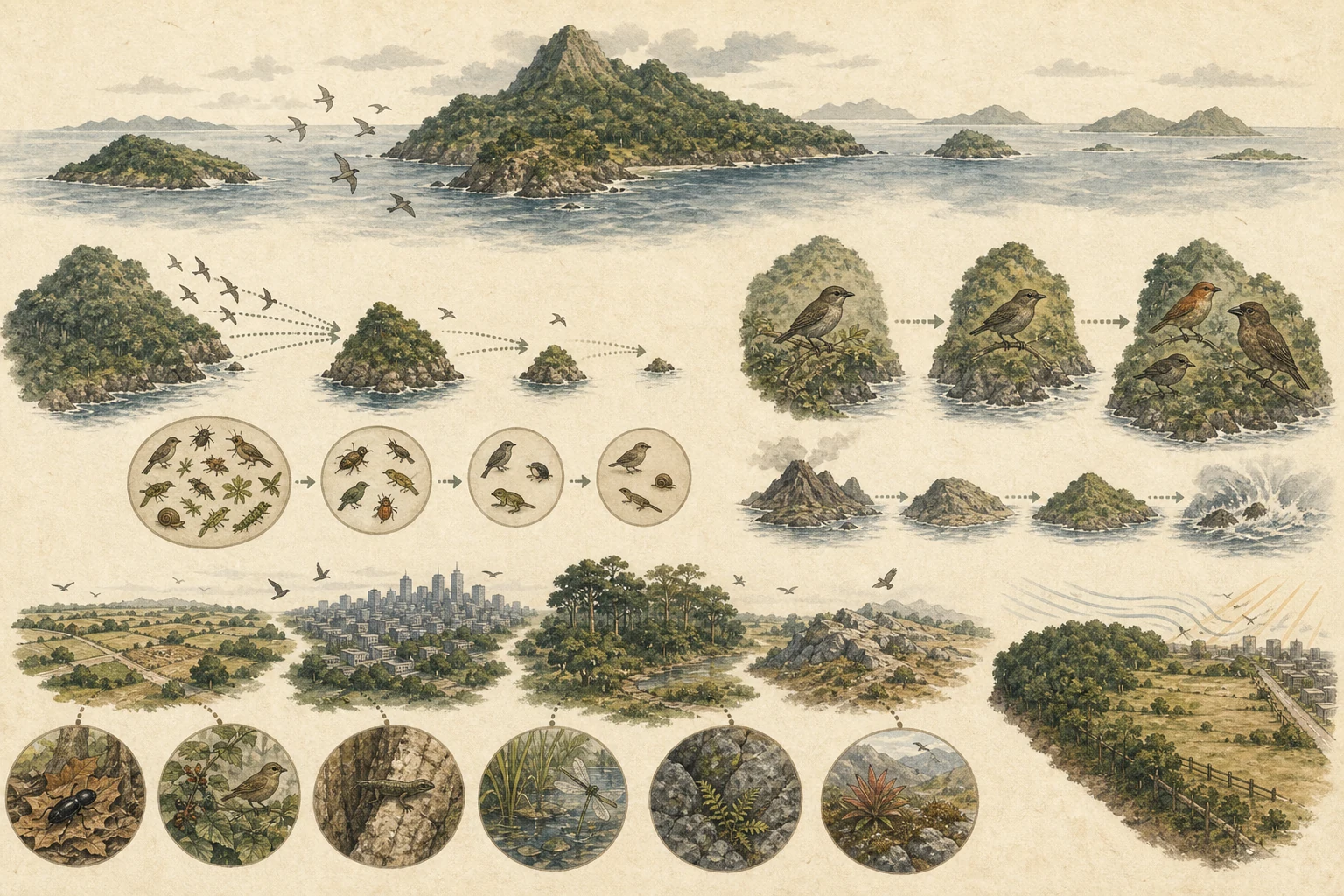
MacArthur and Wilson's classic equilibrium model treats an island's species count as a moving balance between two opposing rates: immigration of new species from a mainland source pool and local extinction of established populations on the island. As more of the regional pool colonizes an island, fewer unrepresented species remain to arrive, so the immigration rate declines. Meanwhile, adding more species means more populations sharing limited space and resources, raising the overall rate of local extinction. Where those two curves intersect lies an expected species richness, yet species composition continues to turn over as new arrivals replace populations that wink out. [1][2]
- Equilibrium richness describes a stable neighborhood of species count while individual species continue to arrive and go locally extinct.
- Immigration rates fall as an island accumulates most of the easy-to-disperse species from the mainland source pool.
- Local extinction rates climb as more species pack into finite island area with smaller average population sizes.
Area and isolation change the odds
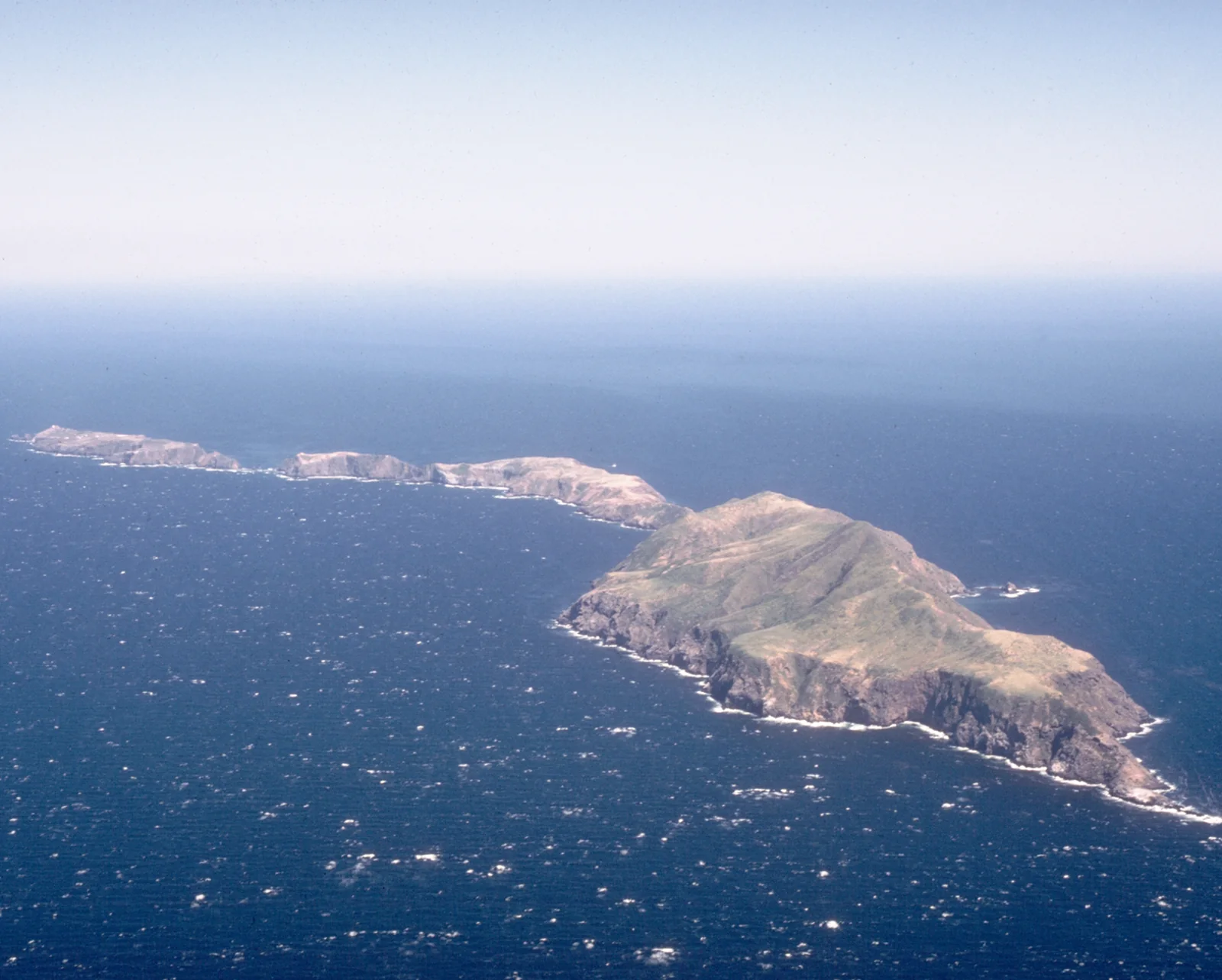
Island size and distance from a mainland shift the balance of colonization and persistence in predictable ways, visible on narrow offshore ridges like Anacapa Island in the Channel Islands as well as vast archipelagos. Larger islands usually support bigger populations that buffer against demographic accidents and storms, while also containing more microhabitats—from coastal bluffs to sheltered canyons. Closer islands intercept more windblown seeds, flying birds, and bats than remote oceanic specks. Still, these species–area and distance patterns are statistical tendencies: a small, topographically complex island can hold more species than a larger flat sandbar, and dispersal ability differs sharply between seabirds, ballooning spiders, and terrestrial amphibians. [1][3]
- Larger islands reduce local extinction risk by supporting bigger populations and offering a wider variety of habitats.
- Islands closer to a mainland source receive a steadier stream of immigrants, raising both richness and species turnover.
- Dispersal traits filter who arrives: strong fliers and windborne spores cross open water that blocks non-volant mammals and amphibians.
Evolution enters on longer timescales
On remote oceanic islands where immigration is exceedingly rare, evolutionary diversification within the island can add species faster than outside colonization. Over millions of years, a handful of founding lineages may diverge across elevation zones and islands, generating rich endemic clades while older islands gradually erode, subside, and lose habitat area. Extended biogeographic models incorporate in situ speciation alongside immigration and extinction, linking ecological island theory to geological island life cycles. Even so, storms, sea-level swings, and human-assisted introductions continually reshape island biotas, meaning present-day species lists reflect deep evolutionary history layered beneath recent ecological change. [1][2]
- On very isolated archipelagos, in situ speciation from a few founders can become a major source of new species.
- Volcanic islands grow, erode, and subside over geological time, changing their area, elevation, and carrying capacity for lineages.
- Human transport of rats, cats, weeds, and pathogens has bypassed natural isolation filters and driven rapid island extinctions.
Habitat fragments are island-like, not identical
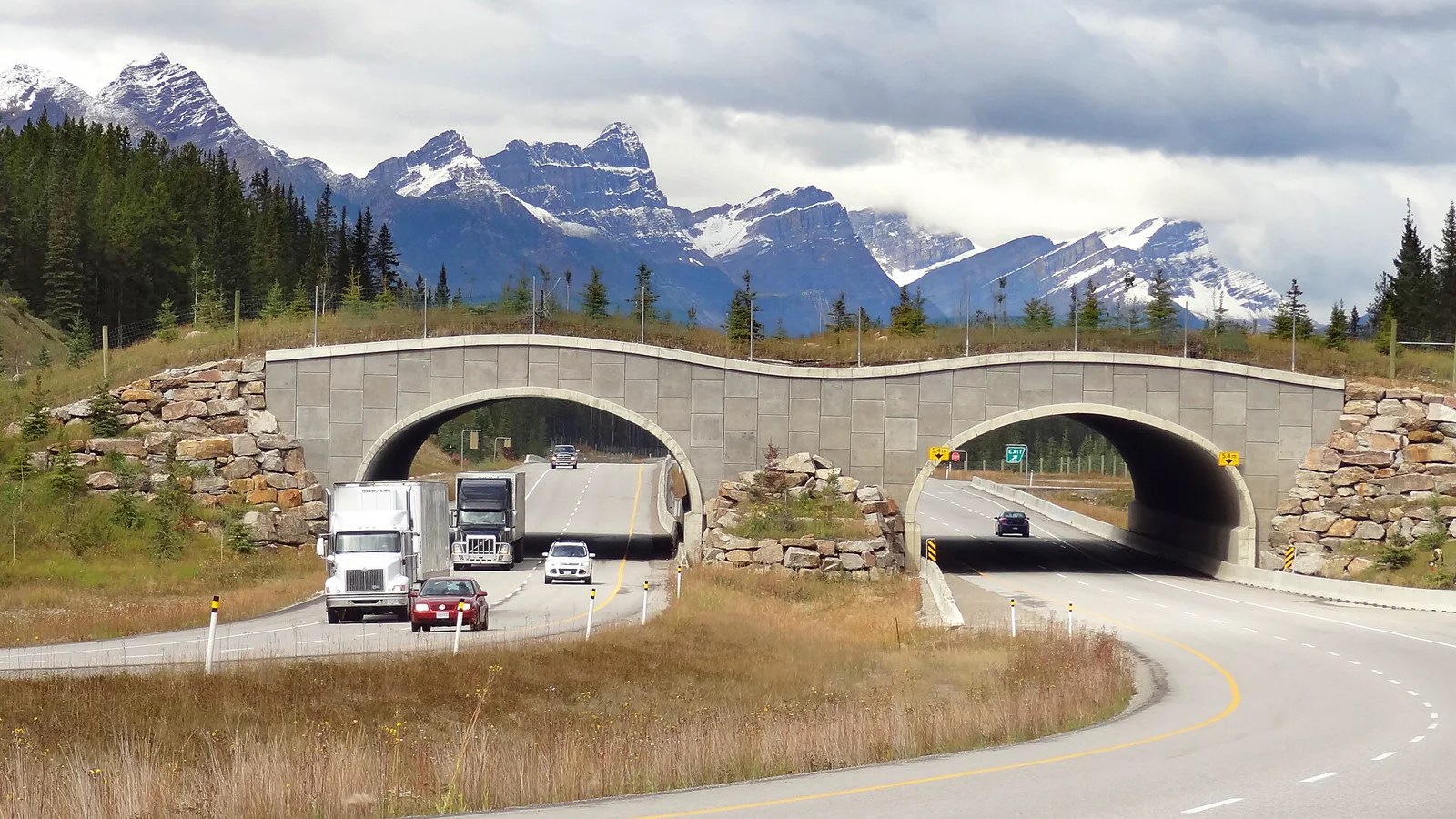
Conservation biologists often apply island biogeography to forest remnants, prairie patches, kettle ponds, and sky-island mountaintops surrounded by human land use or contrasting vegetation. Larger and better-connected habitat patches generally retain more area-sensitive species, yet a surrounding matrix of pasture, suburbs, or timber plantations is rarely as uniform or hostile as open ocean. Matrix habitats let some generalists move, forage, or breed between patches while exposing patch edges to wind, heat, invasive weeds, and nest predators. Treating a terrestrial reserve as a sealed oceanic island without checking matrix permeability, edge effects, and local habitat quality can mislead management. [3][4]
- Unlike open ocean, the land matrix around a forest or wetland fragment allows some species to cross while filtering out specialists.
- Fragment edges experience altered light, wind, moisture, and predator activity that penetrate deep into small habitat patches.
- Effective reserve design combines patch area and connectivity with habitat quality and management of the surrounding landscape.
Related guides
Get Fauna and identify it in the field.
Where this guide comes from
Source-checked editorial guide. Last updated . This guide teaches identification and field skills; it is not a substitute for expert verification when it matters.
- Ecology and evolution — A niche-based theory of island biogeography ↗
- Proceedings of the National Academy of Sciences of the United States of America — Immigration and extinction probabilities for individual species: relation to incidence functions and species colonization curves ↗
- The Quarterly review of biology — The reticulating phylogeny of island biogeography theory ↗
- UK Centre for Ecology & Hydrology — Biodiversity ↗