How termite mounds regulate temperature
A termite mound is part wall, part porous exchange surface, and part ventilation network. Its effects depend on species, architecture, weather, soil, colony metabolism, and whether the nest lies inside or beneath the visible structure.
Last updated
Buffer rapid outside swings
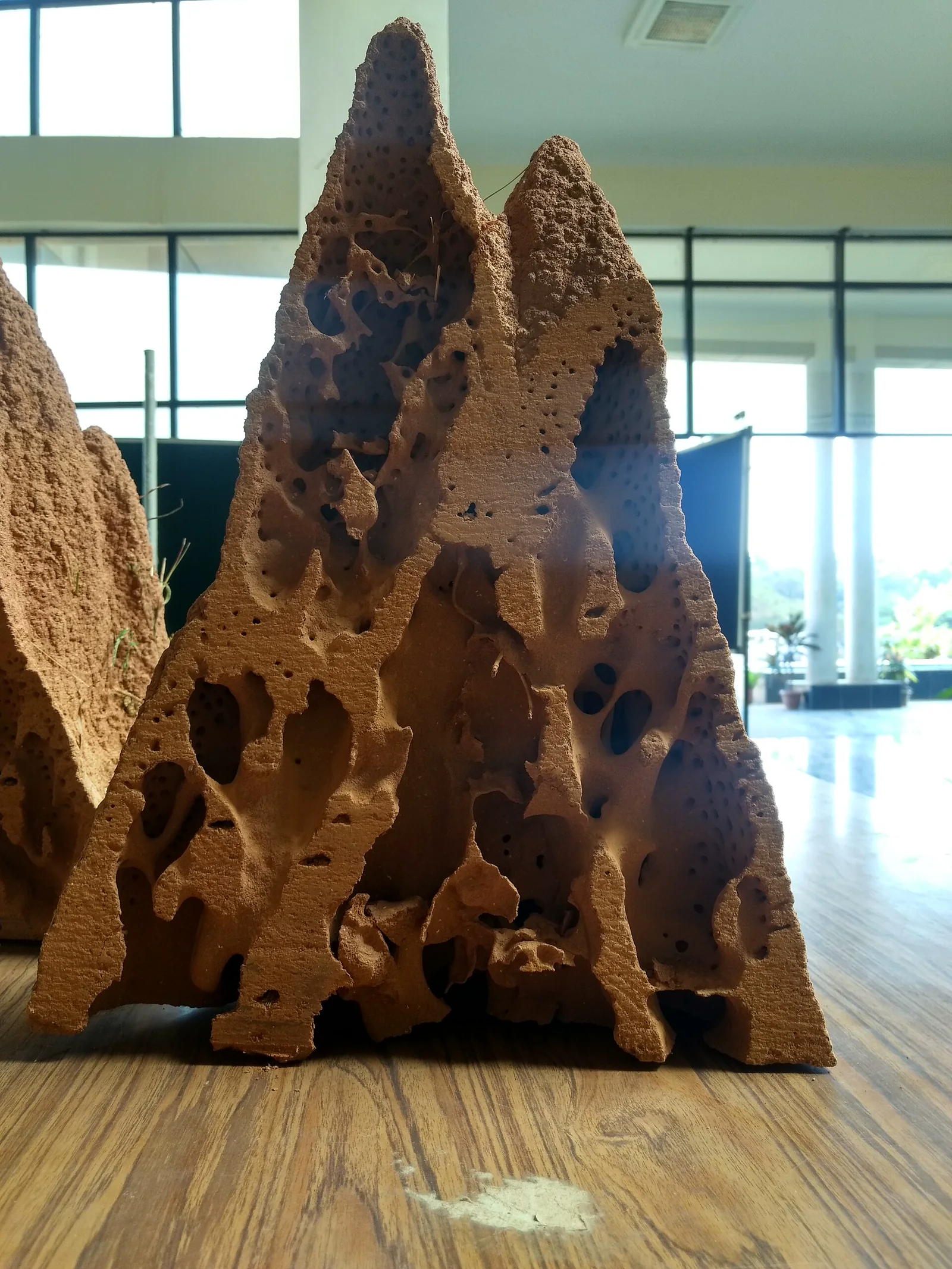
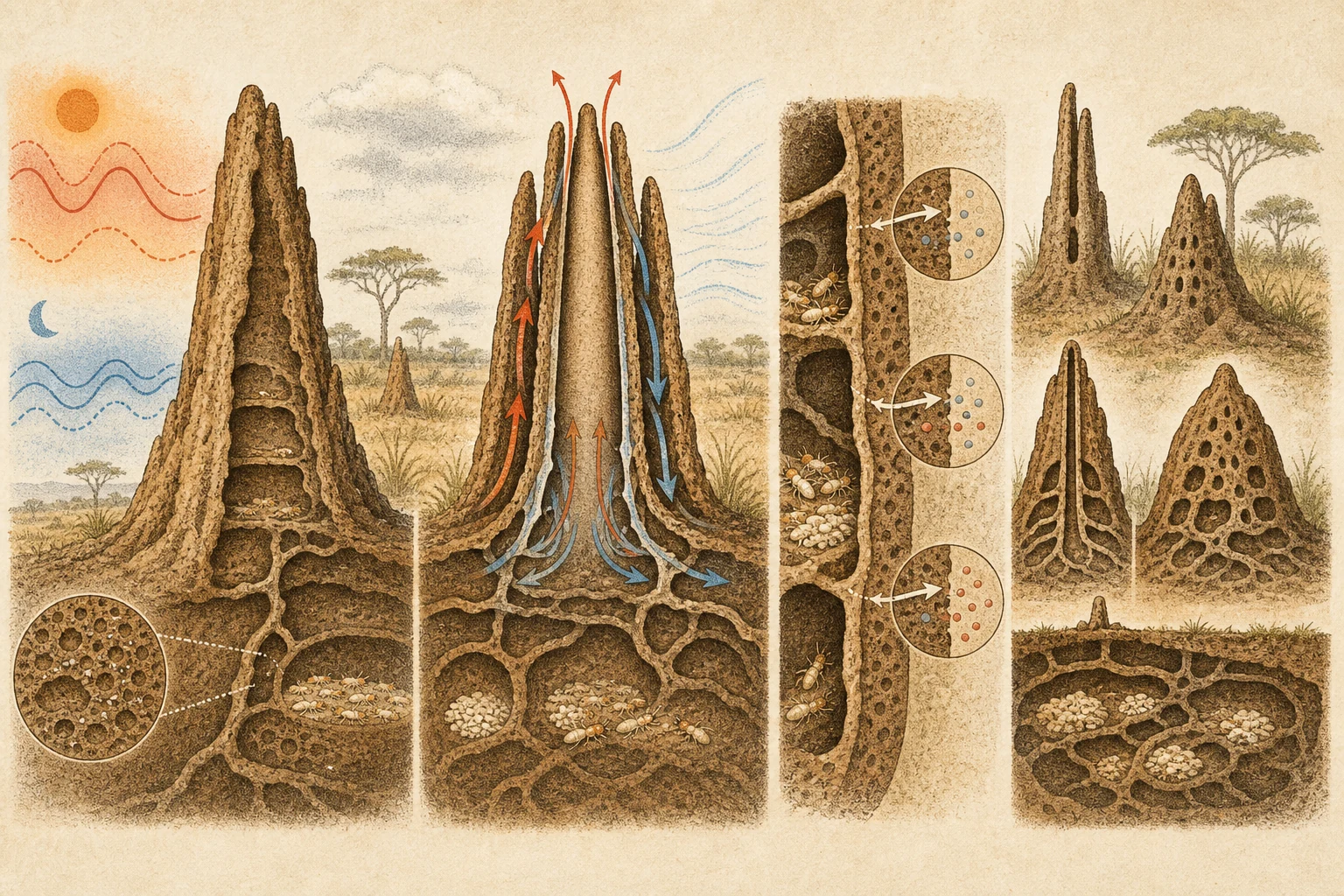
Across African savannas, Indian forests, and Australian floodplains, the towering clay spire visible above ground is often the colony's respiratory chimney and thermal shield rather than the brood chamber itself. In many Macrotermes and Odontotermes species, the queen, developing larvae, and delicate Termitomyces fungus combs sit in a subterranean or basal vault surrounded by tons of damp soil and dense, cemented earthen walls. Because deep soil and thick clay walls have high heat capacity and low thermal conductivity, fierce midday solar heating and chilly night air are damped and delayed before they reach the subterranean nursery. [1][3]
- Thick cemented soil walls and deep underground nest placement damp rapid daytime and nighttime temperature swings
- In many fungus-growing termites, the visible mound spire sits above a subterranean nursery and fungus garden
- Canopy shade, wall thickness, and soil moisture strongly influence internal nest temperature profiles
Turn daily heating into airflow
For decades, textbooks depicted termite mounds as simple thermosiphon chimneys driven continuously upward by metabolic heat from the nest, or as wind-catcher towers powered solely by steady external breezes. Direct thermistor airflow probes inside Indian Odontotermes obesus mounds revealed a very different daily engine: solar-powered diurnal oscillation. During the day, sunlight warms the thin-walled outer buttresses (flutes) much faster than the shaded central chimney, causing warm air to rise up the flutes and cool air to sink down the core; at night, the flutes cool below core temperature and the entire convective loop reverses direction. [1][4]
- In fluted Odontotermes mounds, daytime sun heats outer peripheral channels faster than the insulated central chimney
- Buoyant airflow rises in outer flutes and sinks in the center by day, then reverses direction after sunset
- External wind across surface ridges and openings adds transient pressure-driven flushing to the daily thermal cycle
Exchange gases through walls and tunnels
A mature colony containing millions of termites alongside respiring fungus combs can generate liters of carbon dioxide and substantial water vapor every hour, yet many mounds have no open holes to the outside world. X-ray microtomography of mound walls shows an intricate hierarchy of interconnected micropores and larger drainage channels spun from soil grains cemented with worker saliva. Convective loops driven by daily heating carry stale, CO2-rich air from the deep nest up into the thin-walled surface conduits, where oxygen and carbon dioxide exchange across the porous clay skin by molecular diffusion without exposing the brood to dry wind or marauding ants. [1][2][3][4]
- Closed mounds act as external lungs, bringing nest air close to porous outer walls for diffusive gas exchange
- Microscopic pores let oxygen and carbon dioxide diffuse across the wall while keeping predatory ants out
- Larger interconnected pores allow rainwater to drain quickly during storms so wet clay does not suffocate the nest
Build for one colony and climate
Termite mounds are not static stone monuments; worker termites continually excavate, plug, and plaster earthen conduits in response to local air currents, humidity gradients, and seasonal rain. Comparative field studies of Macrotermes species in West Africa show that savanna and forest mounds adopt markedly different turret heights, wall thicknesses, and internal channel networks, and that the resulting internal temperatures correlate with which specific Termitomyces fungal symbiont a colony cultivates. Rather than locking the interior at one invariant thermostat reading, mound architecture keeps seasonal and daily fluctuations within the narrower range tolerated by both termites and their crop. [1][2][3]
- Savanna and forest mounds of the same termite genus differ in wall thickness, ridge density, and turret height
- Internal nest temperatures still vary by several degrees across seasons rather than holding a single constant number
- Fresh, dark, wet soil patches on a mound's exterior show active worker remodeling after rain or surface damage
Related guides
Get Fauna and identify it in the field.
Where this guide comes from
Source-checked editorial guide. Last updated . This guide teaches identification and field skills; it is not a substitute for expert verification when it matters.
- Journal of the Royal Society, Interface — Termite mound architecture and climate control: a review of X-ray tomography and flow field simulation approaches ↗
- Proceedings of the National Academy of Sciences of the United States of America — Morphogenesis of termite mounds ↗
- PeerJ — Termite mound architecture regulates nest temperature and correlates with species identities of symbiotic fungi ↗
- Proceedings of the National Academy of Sciences of the United States of America — Termite mounds harness diurnal temperature oscillations for ventilation ↗