Reading a grassland
Grasslands range from short, sparse, dry systems to tall, dense, wet ones. Their value to a given organism depends on plant composition and structure, patch size, season, and management—not simply the absence of trees.
Last updated
Describe the open habitat precisely
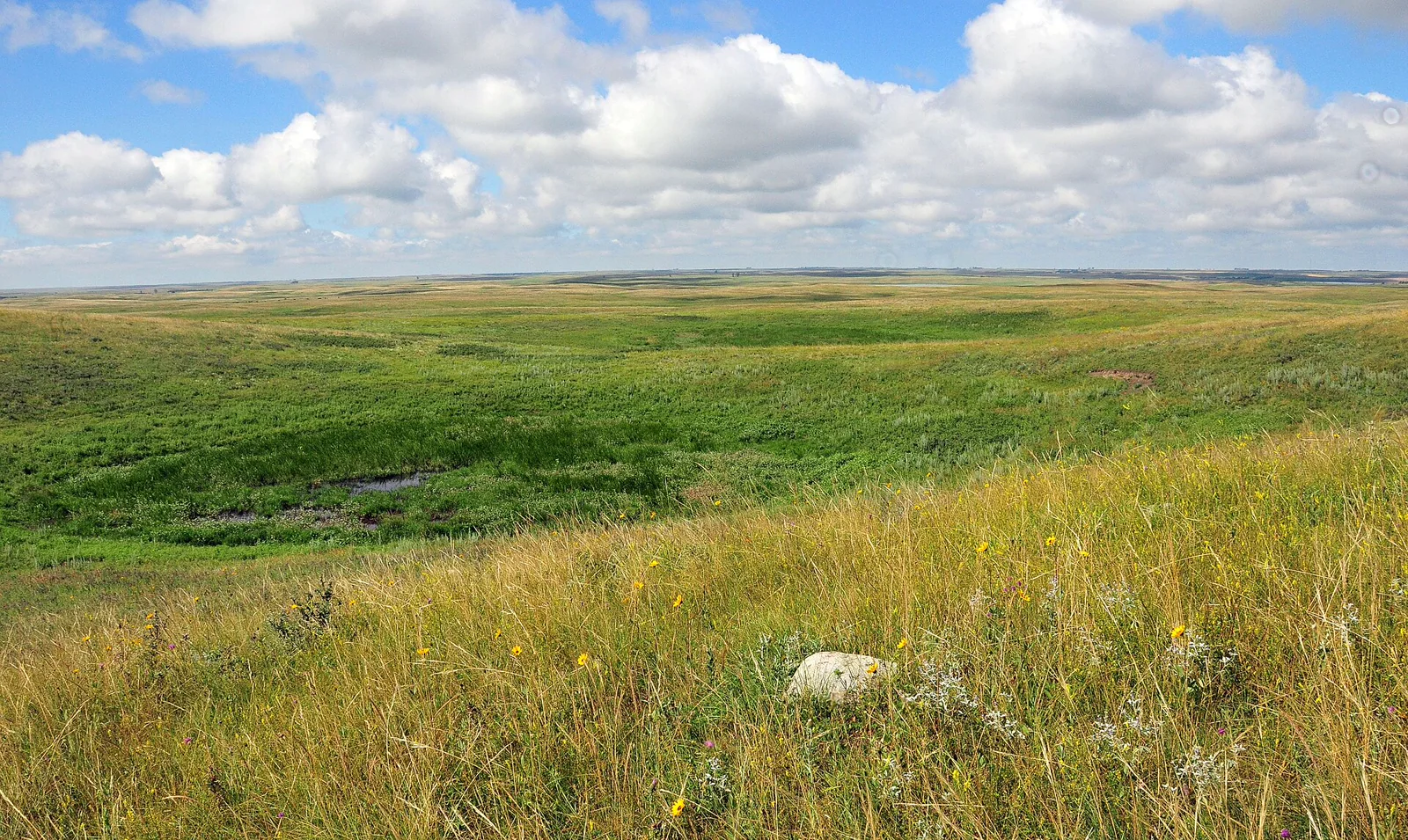
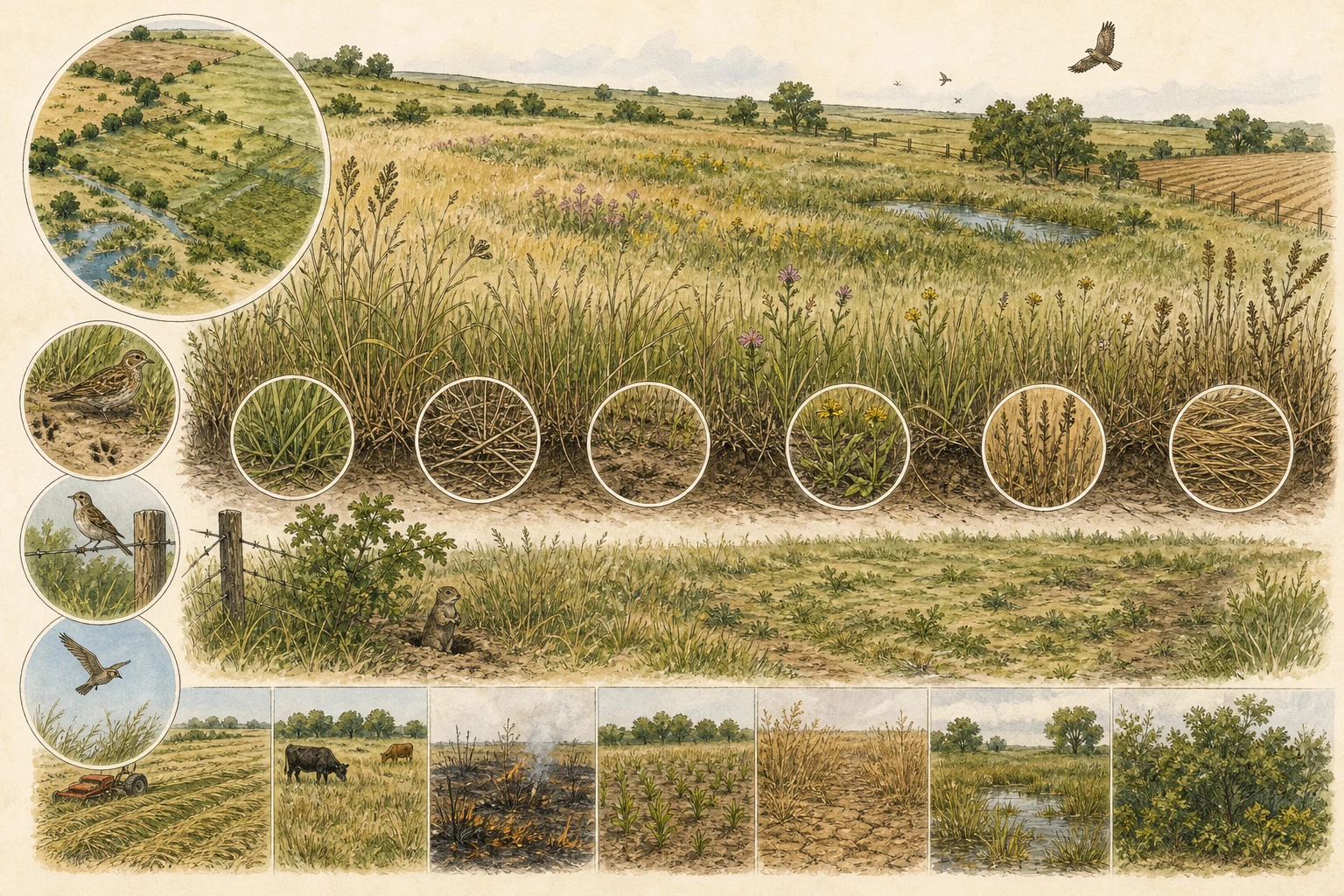
Begin by identifying what actually dominates the open sward: native bunchgrasses or sod-forming grasses, sedges in damp depressions, broad-leaved flowering forbs, planted agricultural forage, bare mineral ground, or a mosaic of several cover types. Estimate the size and shape of the opening, then note scattered shrubs, lone trees, fence lines, prairie pothole basins, rock outcrops, and surrounding land uses. Because grass-dominated habitats vary dramatically across rainfall gradients and management regimes, start with concrete structural notes rather than assuming every treeless opening functions as native prairie. [1][2][3]
- Separate a frequently mown lawn from taller, structurally varied vegetation.
- Note whether woody plants are absent, sparse, clustered, or expanding.
- Photograph across the patch as well as down into the plant layer.
Read structure at ground and stem level
Compare short sparse patches against tall dense stands, standing dead stems from the previous growing season, woven thatch litter on the soil surface, bare mineral pockets, blooming forbs, ripening seed heads, and moist swales. Centimeter-scale differences in sward architecture partition grassland wildlife: some ground birds and burrowing insects need bare soil for walking and nesting, whereas meadowlarks, bobolinks, and voles rely on deep thatch and overhead grass arches for concealment. Native bunchgrasses and warm-season grasses also provide larval host foliage, pollen, and winter bumblebee queen refuge alongside showy wildflowers. [1][3][4]
- Estimate patchiness instead of reducing the site to one average height.
- Record litter depth visually without pulling apart nests or ground cover.
- Treat plant identity and habitat structure as related but separate observations.
Watch each vertical zone
Scan the ground margin for mammal runways and tracks, grass stems and flower heads for orthopterans, bees, and perched songbirds, wooden fence posts or stiff forb stalks for territorial singers and raptors, and the open sky for aerial insectivores and skylarking display flights. Repeat your scan from a stationary trail viewpoint because birds and mammals hidden in knee-high grass often pop up onto a stalk for only a few seconds. Remember too that roadside fence lines concentrate edge-tolerant birds, whereas area-sensitive grassland obligates often stay far out in treeless interior blocks. [1][2][3][5]
- Keep equal timed scans for ground, vegetation, and sky.
- Use binoculars rather than entering dense cover during nesting periods.
- Record whether an animal was feeding, crossing, singing, or only flying over.
Put disturbance and season in the notes
Grazing, haying, mowing, prescribed or wild fire, reseeding, prolonged drought, spring ponding, and woody shrub encroachment continually reshape grassland structure, sometimes within a single week. Record visible management clues and their approximate recency, but avoid judging ecological health from a single snapshot right after a burn or cut. Walking the same permitted perimeter route across spring green-up, midsummer bloom, autumn seed set, and winter dormancy makes shifts in thatch depth, seed availability, temporary water, and raptor or songbird use far clearer. [1][2][3][5]
- Note recent cutting, hoof impact, burn evidence, vehicles, and foot traffic separately.
- Keep route length, duration, time, and weather with every wildlife list.
- Follow closures and do not approach ground nests to confirm occupancy.
Related guides
Get Fauna and identify it in the field.
Where this guide comes from
Source-checked editorial guide. Last updated . This guide teaches identification and field skills; it is not a substitute for expert verification when it matters.
- U.S. Geological Survey — America’s Grasslands, Great Plains, and Pothole Prairies ↗
- National Park Service — Grassland Habitat at Gateway ↗
- U.S. Geological Survey — Grassland birds: threats and management strategies ↗
- USDA Natural Resources Conservation Service — Pollinators Need Native Grasses Too ↗
- National Park Service — Seven Ways to Safely Watch Wildlife ↗