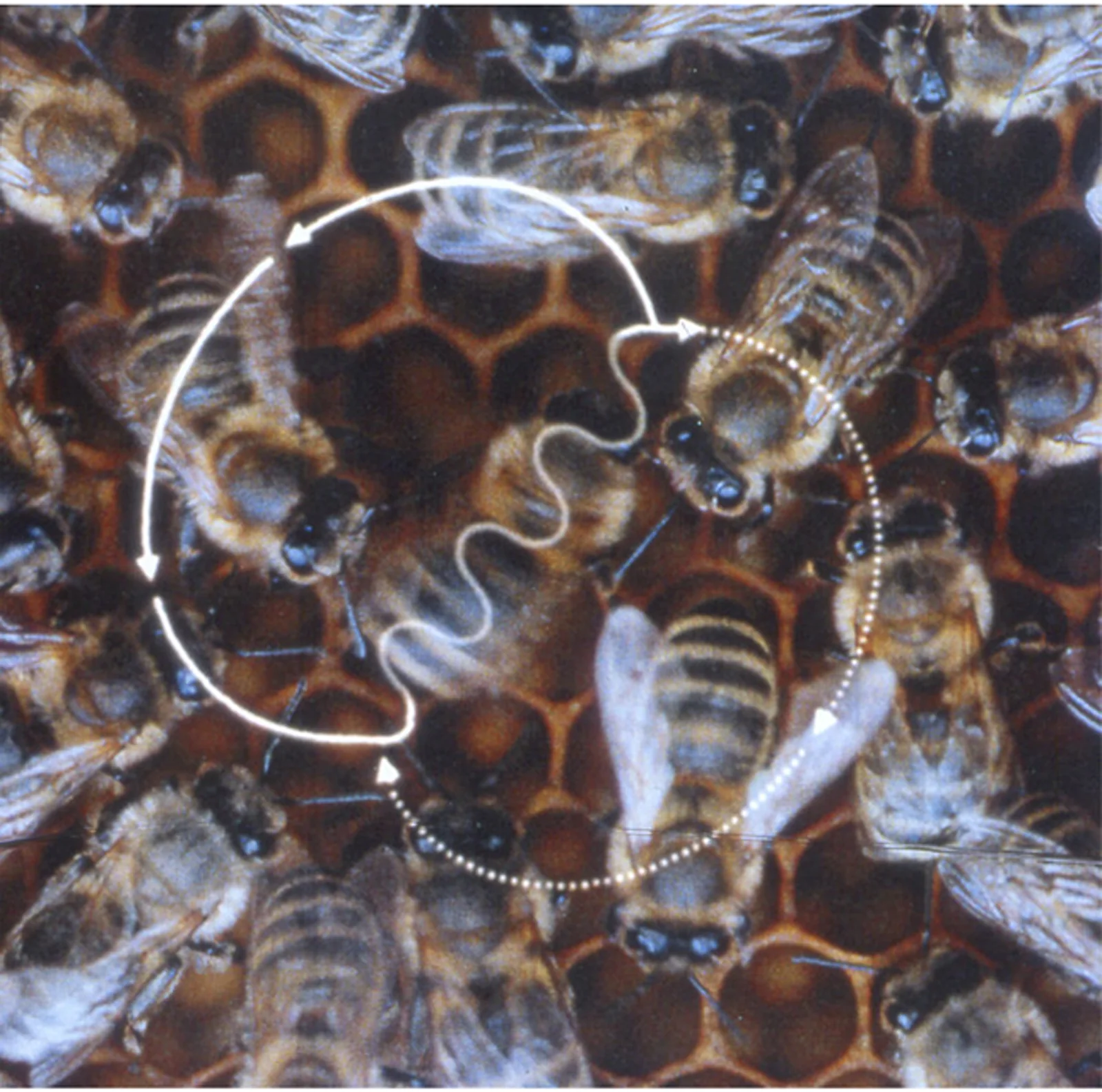
How ants navigate
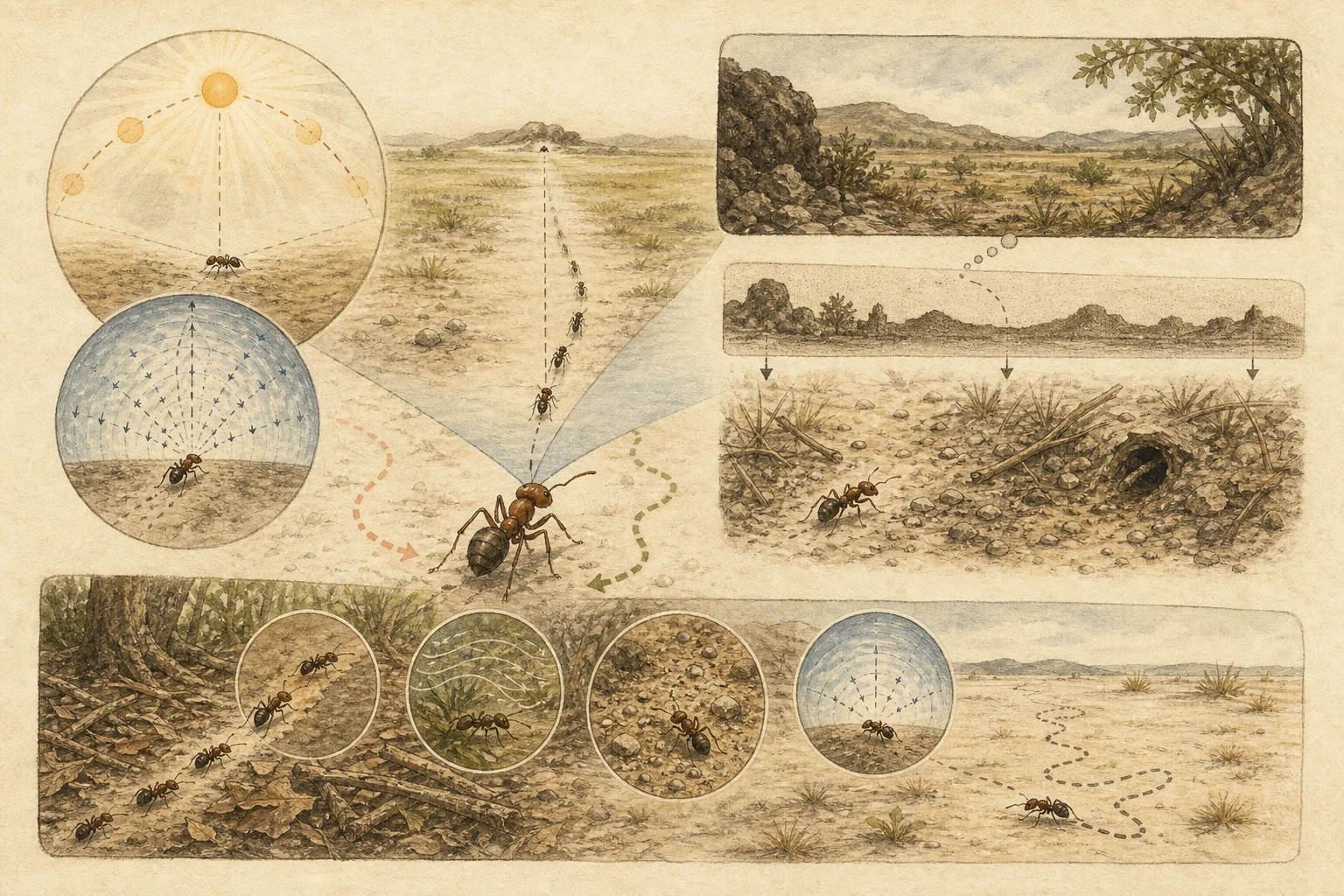
An ant rarely relies on one map. Depending on species and habitat, it can integrate its outbound turns, read sky cues, learn a visual panorama, follow odors, and switch to a looping search when those estimates disagree.
Last updated
Update a vector while walking
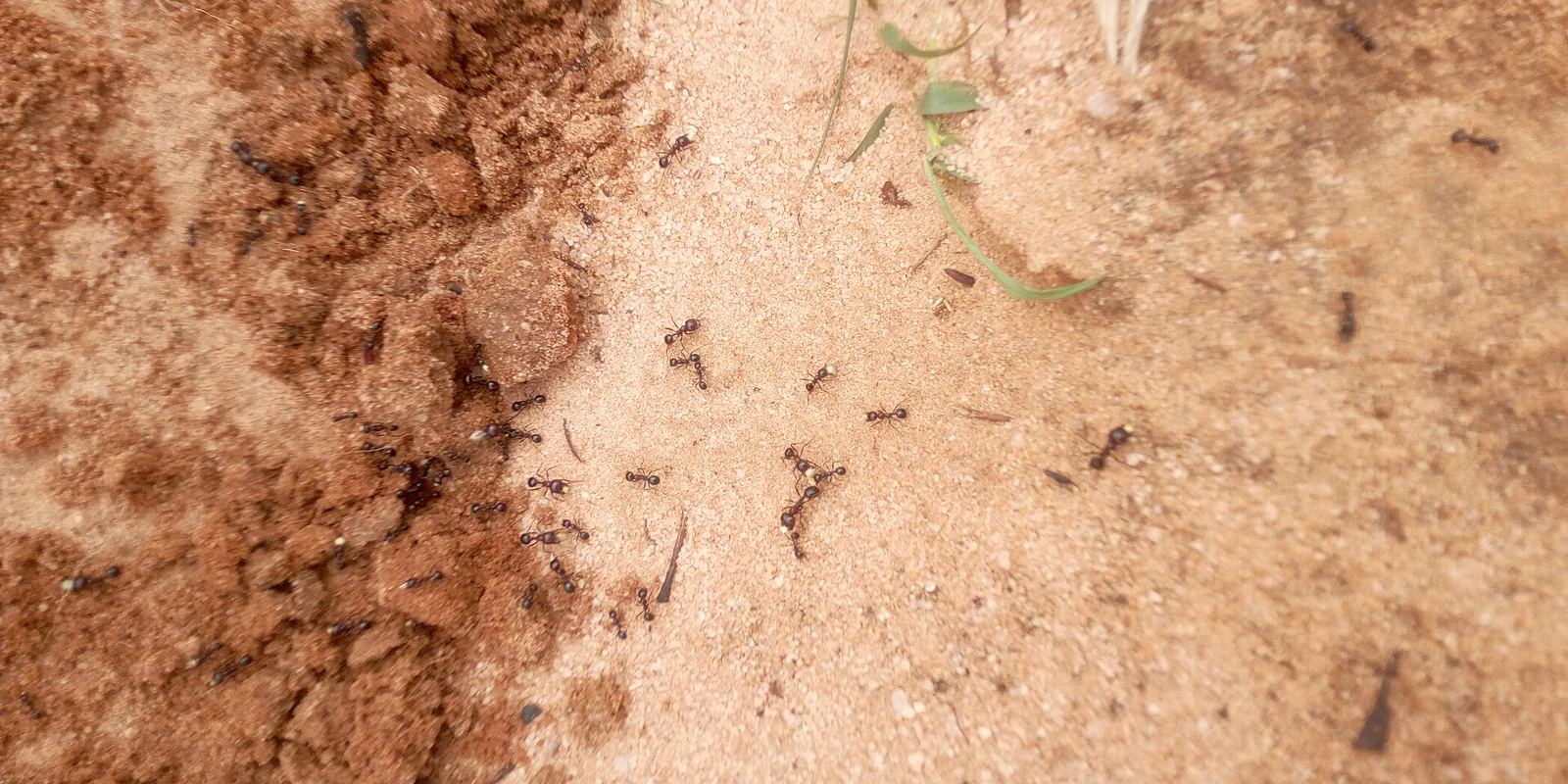
Watch a Saharan desert ant (Cataglyphis fortis) scavenging across a sun-baked salt pan: she wanders outward in a twisting, hundred-meter search for heat-stricken insects, yet the instant she seizes a prize she pivots and sprints homeward in an almost straight line. Rather than memorizing every outward turn or following a chemical trail that would evaporate on hot sand, her central-complex neural circuits perform continuous path integration—combining each outbound segment's compass bearing and distance into a single running home vector. If researchers pick her up at the feeder and release her on an unfamiliar flat, she runs that exact vector distance and angle before breaking into search loops. [1][2][4]
- Path integration continuously updates a single straight-line direction and distance vector back to the nest
- Outbound foraging paths often twist widely while homeward runs holding food follow a direct bearing
- Reentering the nest or completing a homeward run resets the internal path integrator to zero for the next trip
Read direction and distance cues
To build an accurate vector, an ant needs both a compass and an odometer. Specialized ommatidia along the dorsal rim of the compound eye detect the pattern of ultraviolet polarized skylight overhead, allowing an ant to read solar compass direction even when the sun itself is hidden behind clouds, while an internal circadian clock compensates for solar drift across the day. Distance is measured primarily by a proprioceptive pedometer that counts strides and integrates leg stride length: in classic experiments where Cataglyphis ants returned on pig-bristle stilts or shortened legs, stilted ants overshot the nest entrance while short-legged ants stopped and searched too early. [1][2]
- Dorsal-rim ommatidia read ultraviolet sky polarization patterns to maintain a time-compensated solar compass
- A stride-integrating pedometer estimates walking distance, supplemented in some species by ground optic flow
- Experimentally lengthening or shortening a desert ant's legs shifts her estimated homeward distance proportionally
Learn scenes and familiar routes
When ants live among tussock grass, desert shrubs, or forest trees—such as Australian red honey ants (Melophorus bagoti) or wood ants (Formica)—they pair their path-integration vector with learned visual memories of the surrounding skyline and local landmarks. Before venturing far, naive foragers perform choreographed learning walks and pirouettes around the inconspicuous nest hole, turning back repeatedly to record panoramic snapshots of bushes, rocks, and canopy gaps around the entrance. On subsequent trips, a returning ant compares her live retinal view against those stored skyline templates to steer around obstacles and follow habitual one-way corridors home. [3][4]
- Naive foragers perform looping learning walks and body pirouettes to memorize the skyline around their nest
- Stored panoramic views let ants steer along familiar shrub corridors even when their path integrator is zeroed
- When local landmark views and the global sky vector conflict slightly, ants blend both directional estimates
Switch cues and search when wrong
Across the ant family, species weight navigational cues according to what their habitat makes reliable. Leafcutter ants (Atta) and pavement ants lay multi-component pheromone highways that recruit thousands of nestmates to a single tree, while desert and savanna solo hunters rely heavily on sky polarization, wind-borne nest plumes, and ground texture. Whenever cumulative pedometer error or a gust of wind brings a returning ant to the end of her home vector without encountering the nest entrance, she switches immediately into a systematic search—looping outward in expanding petals that repeatedly cross the most probable nest position until visual or olfactory cues lock onto the hole. [1][2][3][4]
- Trail-laying ants rely on chemical highways for mass recruitment, whereas solitary hunters rely on vectors and views
- If the nest is not found when the home vector reaches zero, the ant launches a looping systematic search
- Watching whether disturbed ants scatter individually or rejoin a single line reveals whether they are using trails or visual vectors
Related guides
Get Fauna and identify it in the field.
Where this guide comes from
Source-checked editorial guide. Last updated . This guide teaches identification and field skills; it is not a substitute for expert verification when it matters.