How earthworms shape soil
Earthworms are ecosystem engineers because they move soil while feeding and tunneling. Their channels and casts create new physical structures and microbial hotspots, but the ecological result depends strongly on species and place.
Last updated
Build a network of pores
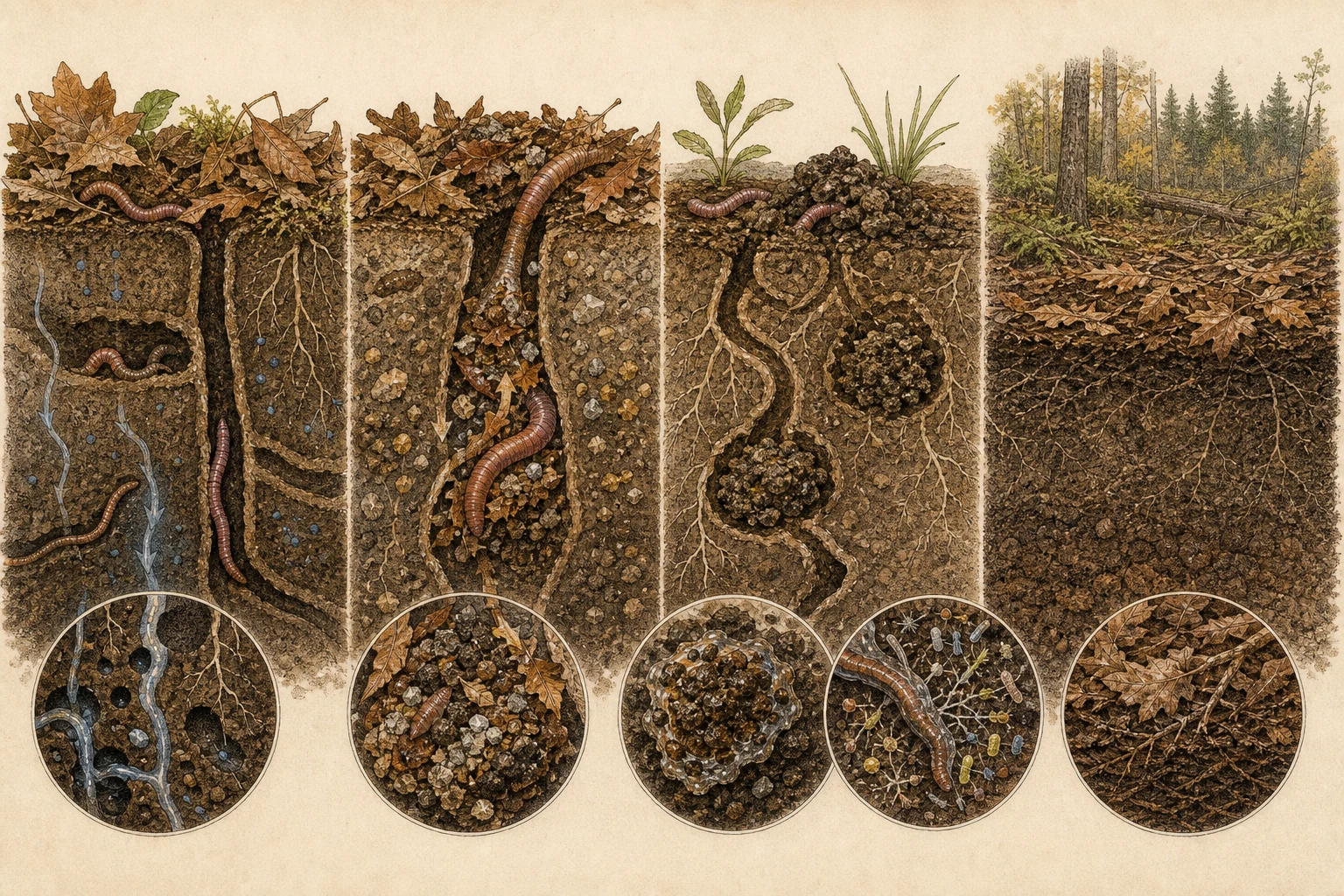
Soil ecologists sort earthworms into three functional guilds whose tunneling habits build very different pore networks. Epigeic litter-dwellers (such as Dendrobaena octaedra) live in decaying surface leaves and scarcely burrow; endogeic topsoil worms (such as Aporrectodea caliginosa) excavate branching, temporary horizontal galleries through the upper mineral root zone and backfill them with casts; and large anecic species (such as the common nightcrawler, Lumbricus terrestris) maintain permanent vertical shafts descending a meter or more into subsoil. Those open macropores aerate heavy clay, give plant roots low-resistance corridors, and create preferential flow pipes that channel stormwater deep underground. [2][4]
- Epigeic worms work surface litter, endogeic worms tunnel horizontally in topsoil, and anecic worms dig deep vertical shafts
- Permanent vertical nightcrawler burrows act as macropores that conduct rainwater, air, and growing roots into subsoil
- Small clusters of leaf stems pulled point-first into a hole—middens—mark the surface entrance of an anecic worm's burrow
Mix litter with mineral soil
As earthworms forage, they drive bioturbation—physically turning over and blending soil horizons that would otherwise stay layered. At night, anecic nightcrawlers reach out of their vertical burrows to pull fallen leaves down into little surface plugs (middens), where microbial decay softens the tissue before ingestion, while endogeic worms swallow mouthfuls of mineral silt, clay, and humified organic matter together. Inside the muscular gizzard, ingested sand grains grind organic fragments fine before the mixture is deposited as casts either in little turrets on the lawn surface or packed along subterranean gallery walls, redistributing carbon and nutrients across depths. [1][2][3]
- Muscular gizzards use swallowed mineral grit to grind leaf fragments and mix them intimately with clay and silt
- Bioturbation blurs sharp boundaries between surface organic litter and underlying mineral soil horizons
- Granular turret-like mounds of dark soil on turf or woodland paths are surface casts deposited around burrow openings
Create aggregates and microbial hotspots
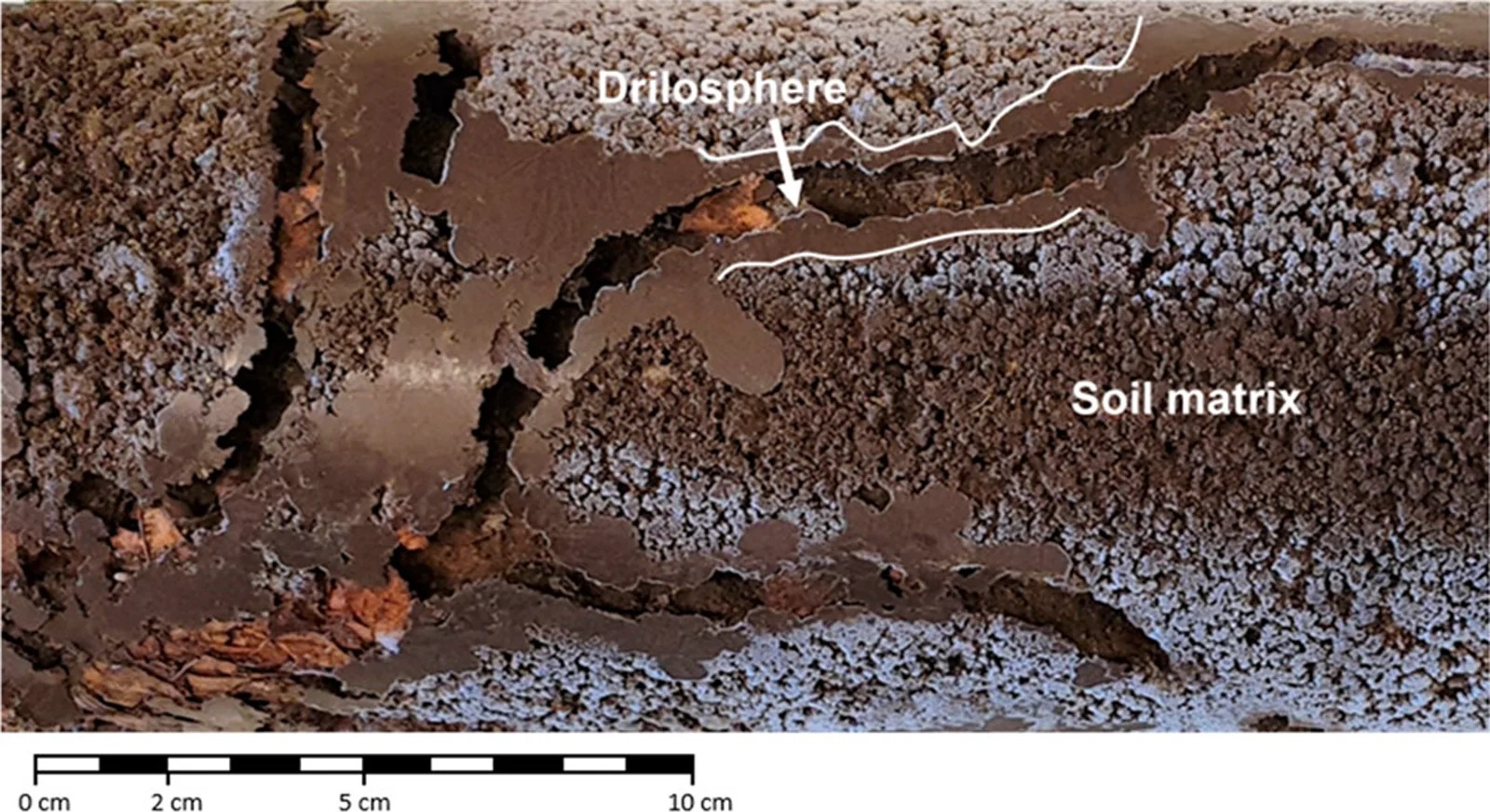
The two-millimeter zone of cast-plastered soil lining an earthworm's burrow—known as the drilosphere—has a markedly different physical and biochemical profile from bulk soil just a centimeter away. As soil passes through the earthworm gut, copious intestinal mucus, neutral pH buffering, and calcium carbonate secreted by calciferous glands awaken dormant soil bacteria and fungi. Enzyme-mapping studies around Lumbricus terrestris and Aporrectodea burrows show that fresh casts and burrow linings become concentrated hotspots of beta-glucosidase, phosphatase, and chitinase activity, while drying mucilage and fungal hyphae cement the compressed cast crumbs into water-stable soil aggregates that resist raindrop erosion. [2][4]
- The drilosphere—burrow walls and casts coated in mucus and gut secretions—concentrates microbial enzyme activity
- Gut passage and drying mucus bind loose mineral silt and organic matter into stable crumb aggregates
- Microbial hotspots along burrow walls fade over weeks after a gallery is abandoned by the worm
Reject the idea that worms are always good
Because Charles Darwin and generations of agronomists praised earthworms for loosening compacted plowland, many observers assume every earthworm benefits every habitat. Yet Pleistocene ice sheets wiped out native earthworms across much of the northern United States and Canada, and the hardwood and boreal forests that regrew over the last ten thousand years evolved around a thick, slow-decaying, spongy forest floor (duff) free of worms. When discarded fishing bait, root balls, or mulch introduce European nightcrawlers (Lumbricus) or Asian jumping worms (Amynthas), the invaders strip away the leaf-litter blanket, expose tree roots, leach nitrogen, and eliminate ground-nesting ovenbirds, salamanders, and native forest wildflowers. [1][3]
- Northern glaciated forests evolved to depend on a thick, spongy duff layer that non-native earthworms rapidly consume
- Invasive jumping worms (Amynthas) turn upper forest soil into loose, dry, coffee-ground-like granular casts
- Never dump leftover fishing worms on forest trails or lakeshores, and inspect plant pots for cocoons before transplanting
Related guides
Get Fauna and identify it in the field.
Where this guide comes from
Source-checked editorial guide. Last updated . This guide teaches identification and field skills; it is not a substitute for expert verification when it matters.
- USDA Climate Hubs — Non-Native Invasive Earthworms in the Midwest and Eastern United States ↗
- Earthworm Society of Britain ↗
- Ecology — Soil chemistry turned upside down: a meta-analysis of invasive earthworm effects on soil chemical properties ↗
- Frontiers in microbiology — Linking Microbial Enzymatic Activities and Functional Diversity of Soil around Earthworm Burrows and Casts ↗