How honeybees communicate with dances
A returning forager converts a flight vector into movement on the comb. Followers sample several noisy runs, odors, and mechanical signals, then leave the hive with a direction and distance estimate rather than an exact set of coordinates.
Last updated
Turn a flight vector onto the comb
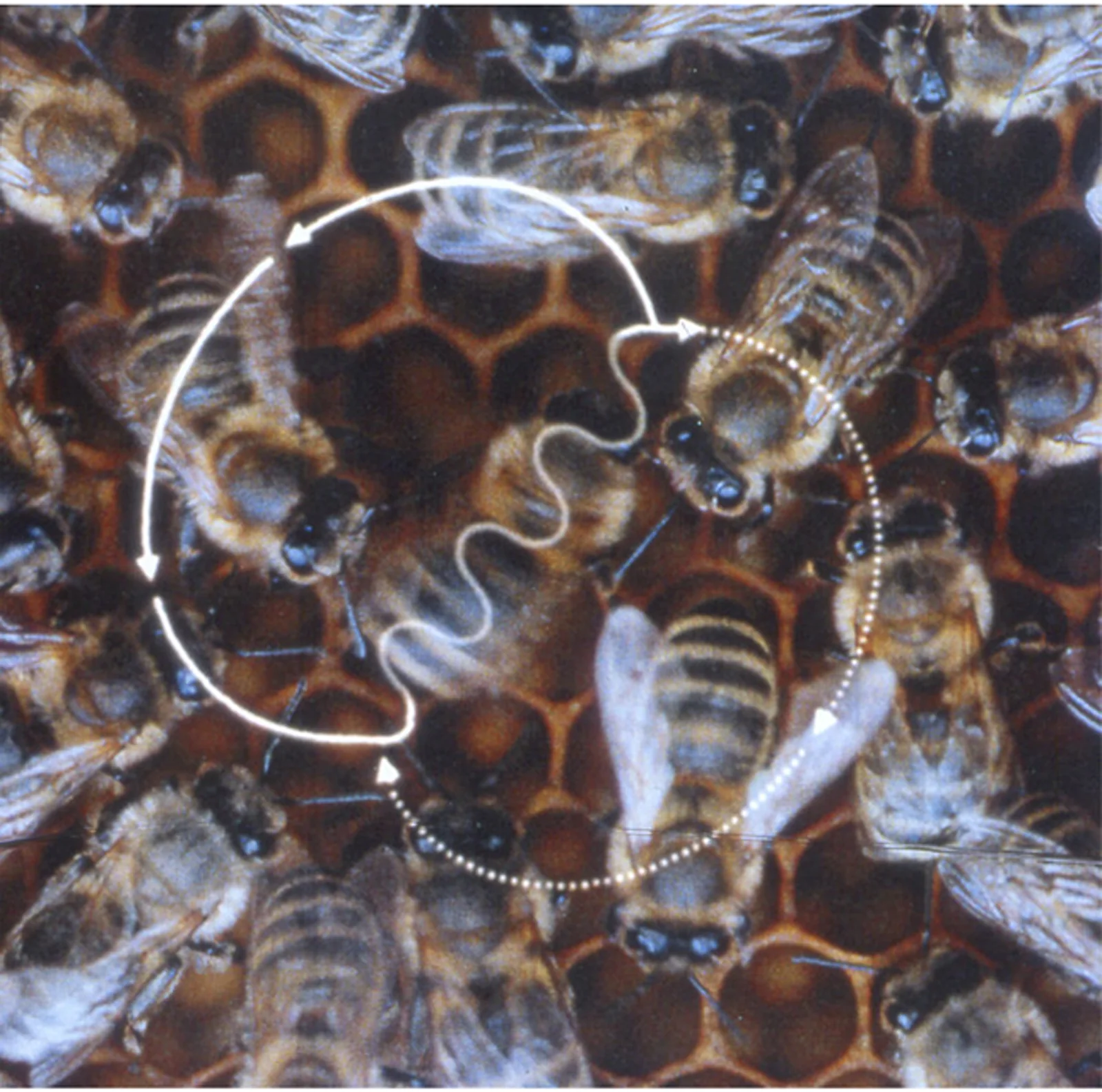
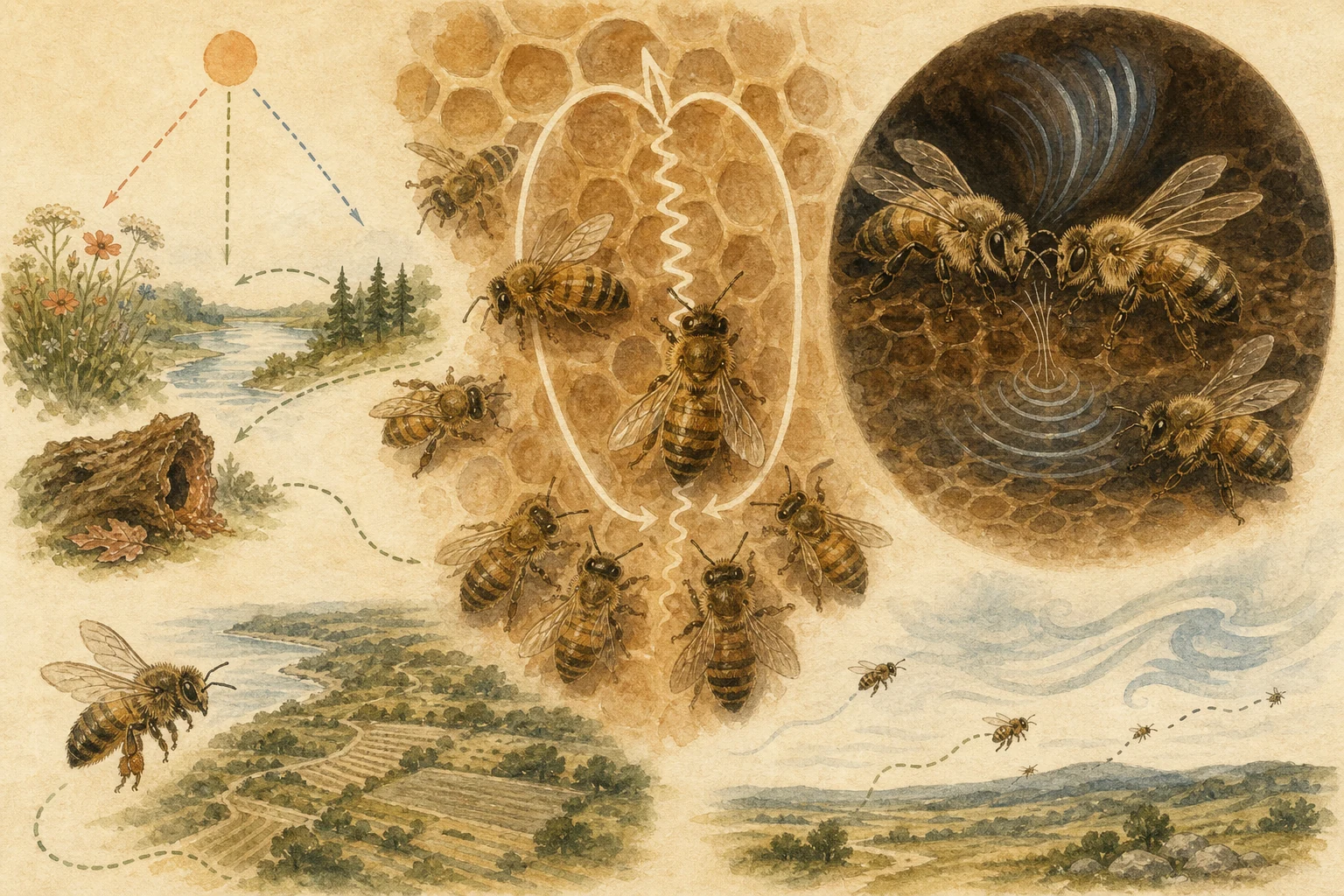
When a western honeybee (Apis mellifera) forager returns from a rich flower patch, water source, or prospective nest cavity, she walks onto the vertical wax comb inside the dark hive and traces a repeating figure-eight pattern. The straight central segment—the waggle run, during which she rapidly shakes her abdomen from side to side at roughly fifteen hertz while buzzing her wings—encodes the outbound compass bearing by translating solar angle into gravity angle. Walking straight up the comb means flying directly toward the sun's current azimuth; a waggle run angled forty degrees to the right of vertical tells followers to fly forty degrees to the right of the sun. [1][2][3]
- On a vertical hive comb, straight upward represents the current horizontal direction of the sun outside
- The angle of the straight waggle run relative to gravity matches the resource's angle relative to the sun
- Looping return runs alternate left and right after each waggle phase to form the classic figure-eight track
Encode distance in elapsed motion
How long the dancer spends waggling during each straight central run communicates how far away the resource lies, but honeybees do not measure distance by mechanical wingbeat effort or elapsed flight time alone. Flying bees through narrow, visually patterned tunnels revealed that their flight odometer is driven by retinal optic flow—how much visual image motion sweeps past their compound eyes between the hive and the feeder. A short flight through a cluttered forest or narrow canyon generates as much optic flow as a much longer flight over featureless water, so waggle-duration calibration is always tied to the visual texture of the local landscape. [1][2][3]
- Waggle-run duration increases proportionally with the perceived flight distance to the advertised flower patch
- Flying honeybees gauge distance primarily by integrating visual optic flow across their compound eyes
- Because individual waggle runs vary slightly, followers average several consecutive circuits before departing
Follow a dancer in darkness
Inside a cavity-nesting western honeybee colony, the dance floor is pitch-dark and crowded with thousands of moving insects, so followers cannot simply watch the dancer from across the comb. Prospective recruits first detect substrate-borne comb vibrations (~250 Hz) and volatile semiochemicals released by the dancer, then crowd closely around her abdomen so their outstretched antennae are brushed and deflected during each waggle pass. At the same time, Johnston's organs in the followers' antennal pedicels detect near-field air-particle oscillations jetting off the dancer's vibrating wings, while brief trophallaxis (mouth-to-mouth nectar sharing) and floral scent clinging to her hairs reveal the flower's taste and aroma. [1][4]
- Comb vibrations and airborne semiochemicals attract unemployed foragers to the active dance floor in the dark
- Followers hold their antennae against the dancer's body and inside her wing-generated air-particle jets
- Floral scents on the dancer's cuticle and shared nectar droplets tell recruits which blossom odor to seek
Use the message as a search lead
A waggle dance delivers an approximate vector—a general neighborhood and floral scent—rather than pinpoint GPS coordinates. After tracking half a dozen waggle runs, a recruit exits the hive entrance into daylight, translates the remembered gravity angle into a solar and polarized-sky compass heading, and flies outward until her own optic-flow odometer matches the dance's duration. Once in the target zone, she switches to upwind casting for the floral odor she smelled on the dancer in the hive—or, if she is an experienced forager whose personal memory points to a known patch of the same flower species, she may fly to her familiar site instead. [1][2][3][4]
- Recruits fly the communicated vector to reach the general neighborhood, then switch to odor-guided local search
- Experienced foragers sometimes use floral scent on a dancer to reactivate memories of their own past foraging sites
- At rich summer flower patches, watching returning bees shows how quickly odor and visual cues guide the final landing
Related guides
Get Fauna and identify it in the field.
Where this guide comes from
Source-checked editorial guide. Last updated . This guide teaches identification and field skills; it is not a substitute for expert verification when it matters.
- Insects — Neuroethology of the Waggle Dance: How Followers Interact with the Waggle Dancer and Detect Spatial Information ↗
- PLoS biology — Dances as windows into insect perception ↗
- PloS one — Automatic detection and decoding of honey bee waggle dances ↗
- PloS one — How do honeybees attract nestmates using waggle dances in dark and noisy hives? ↗