Why butterflies taste with their feet
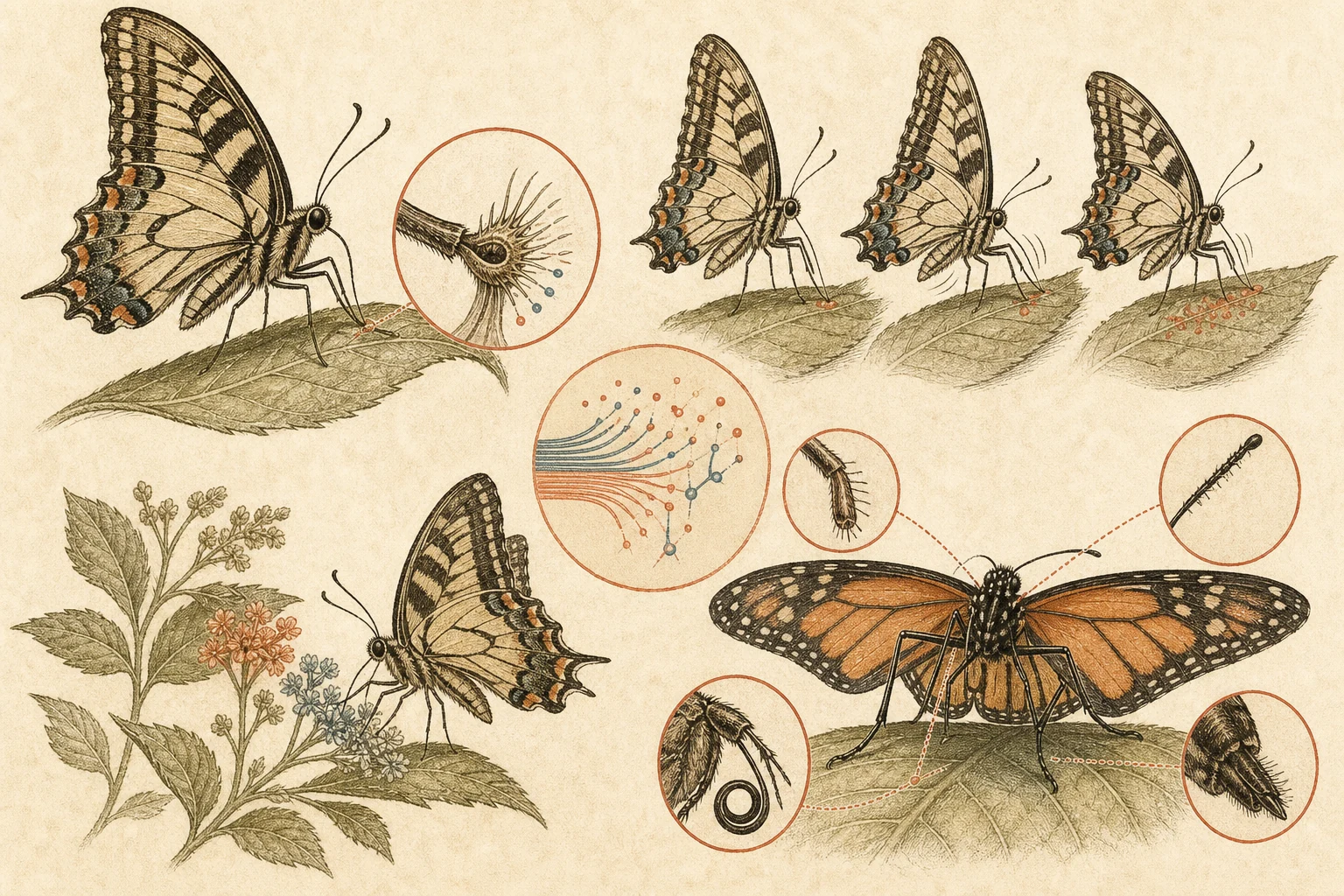
Butterfly feet carry contact chemosensilla: tiny porous hairs whose receptor neurons respond when dissolved molecules touch them. For females, that first taste can determine whether a leaf is a suitable nursery for caterpillars.
Last updated
Put receptors at first contact
Because a butterfly keeps its tubular proboscis coiled under its head while flying, the terminal segments of its legs—the tarsi—are the first body parts to touch a flower petal, damp mud bank, rotting fruit, or prospective host leaf. Clustered on the underside of each tarsus, alongside sharp tarsal claws and spines, sit microscopic hollow hairs called trichoid contact chemosensilla, each tipped with a tiny terminal pore. When the foot touches a moist surface or waxy leaf cuticle, nonvolatile compounds diffuse through that apical pore into the sensillum lymph, where binding proteins and gustatory receptor neurons translate sugars, salts, amino acids, or bitter alkaloids into trains of nerve impulses. [1][4]
- Tarsal contact chemosensilla are microscopic hollow hairs with a single pore at the tip that admits dissolved molecules
- Stepping into nectar or sugary sap triggers a rapid reflex that uncoils the proboscis to feed
- Each sensory hair houses multiple gustatory neurons tuned to distinct chemical classes such as sugars, salts, or deterrents
Drum a leaf to release chemicals
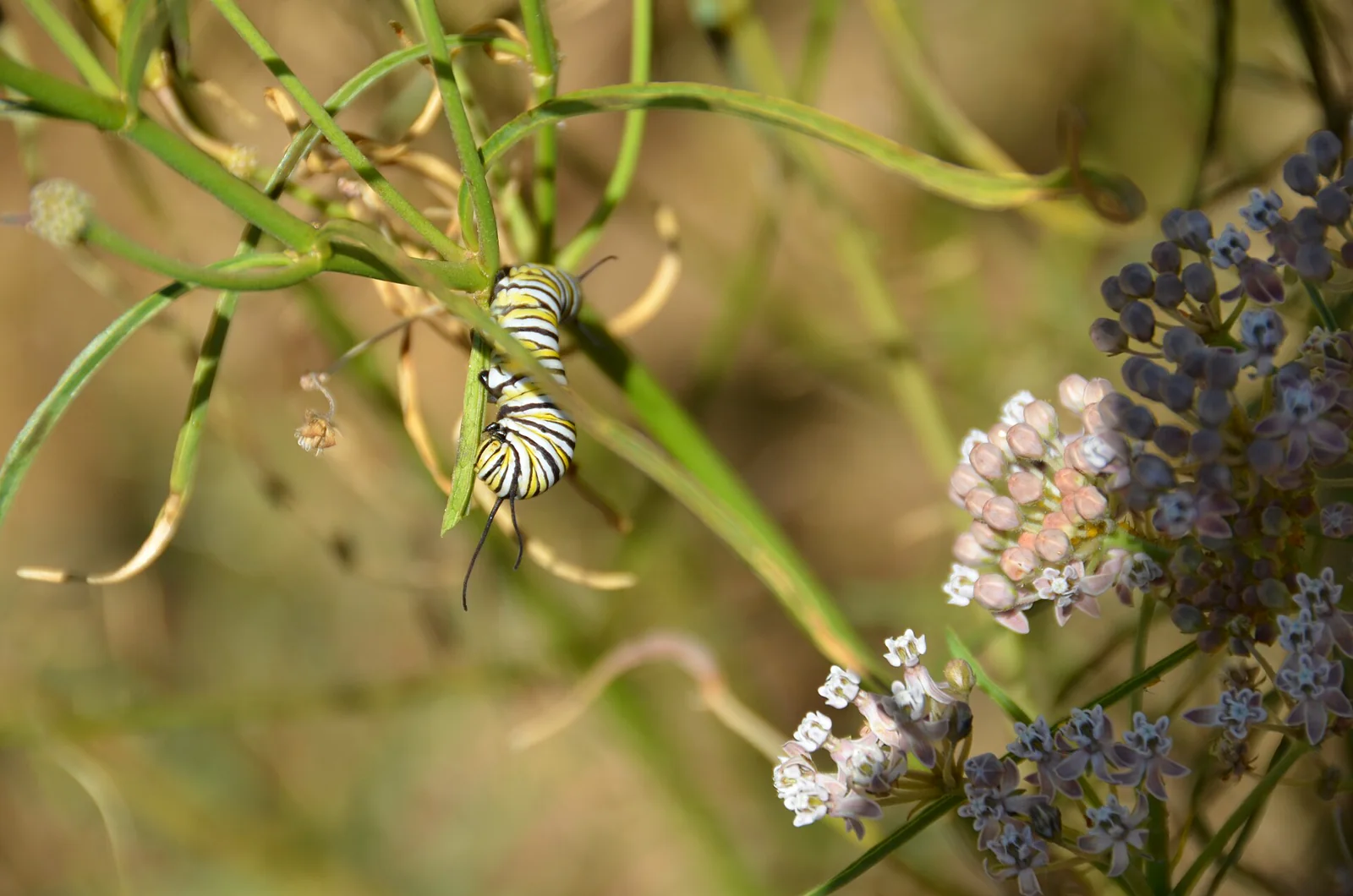
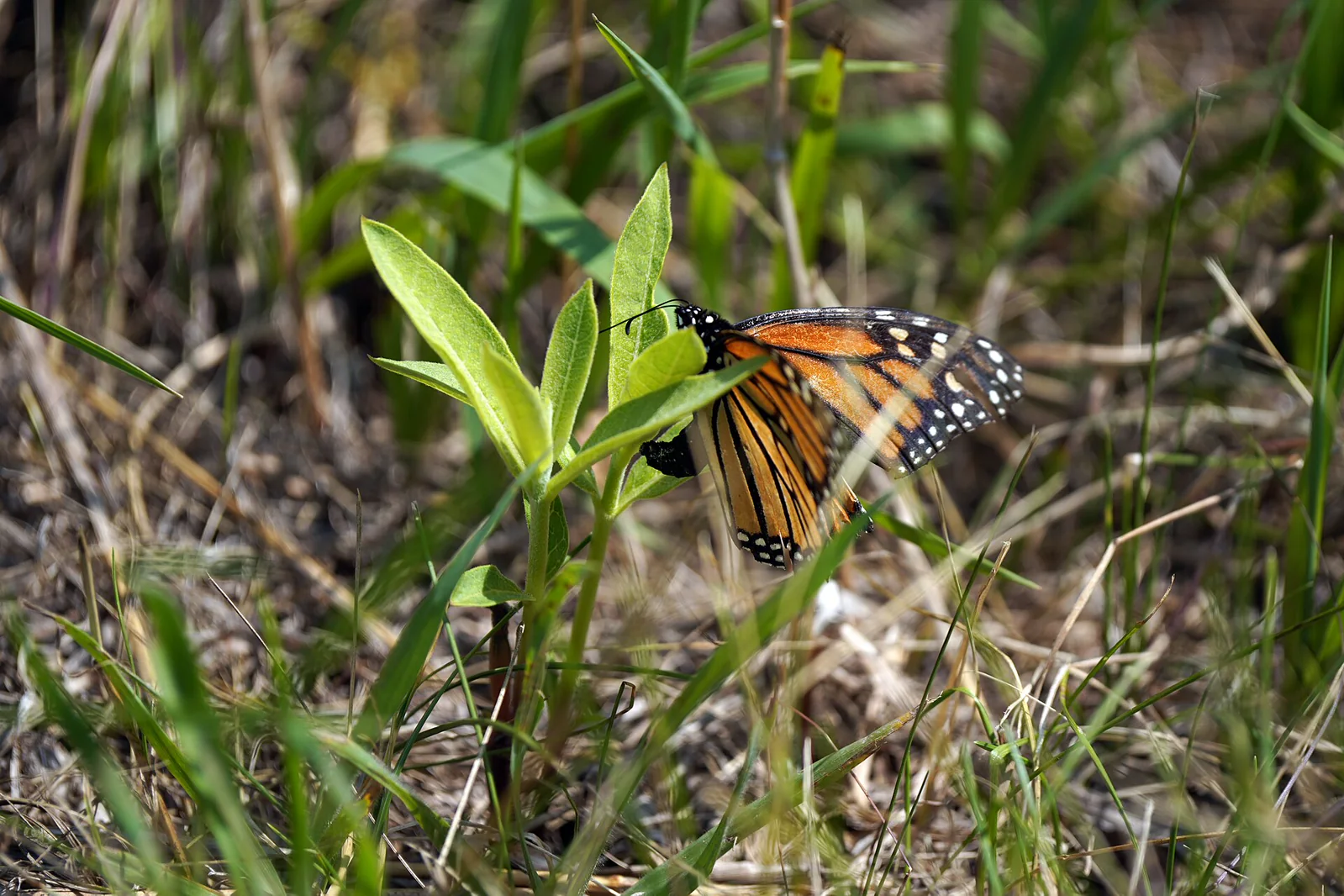
Watch a gravid female monarch (Danaus plexippus), swallowtail (Papilio), or Baltimore checkerspot (Euphydryas phaeton) alight on a green shoot in a meadow: before curling her abdomen to lay an egg, she rapidly taps or drums her front legs against the upper leaf surface. That drumming bout presses her foreleg spines and dense tarsal chemosensilla through the outer epicuticular wax layer, releasing trace water-soluble glycosides and secondary metabolites from the leaf epidermis right where the sensory pores touch. If the chemical profile is wrong, she lifts off within a second or two to test the next stem without wasting a single egg. [2][3]
- Rapid foreleg drumming scrapes leaf surface waxes so nonvolatile plant compounds reach the tarsal taste pores
- Female monarchs touch candidate milkweeds with forelegs, midlegs, and antennae before curving the abdomen to lay
- Brief landings followed by immediate takeoff without abdomen curling show a female rejecting non-host foliage
Recognize a chemical combination
Caterpillars of many butterfly species starve if hatched on the wrong plant family, so females rely on combinatorial chemical codes rather than a single flavor molecule. Electrophysiological recordings from the foreleg sensilla of female Asian swallowtails (Papilio xuthus)—which lay eggs exclusively on citrus and related Rutaceae—show that subsets of gustatory neurons fire selectively to up to ten distinct host compounds, including specific flavonoids, alkaloids, and cyclitols, aided by a specialized oviposition-stimulant binding protein in the sensillum lymph. No individual compound reliably triggers egg laying on its own; only the synergistic firing pattern produced by the natural mixture elicits oviposition. [1][4]
- Female swallowtail foreleg sensilla detect synergistic blends of multiple Rutaceae compounds rather than one cue
- Specialized binding proteins inside the sensory hairs ferry plant stimulants to the gustatory receptor membranes
- Bitter deterrents on toxic non-host plants activate separate neurons that inhibit egg-laying even when stimulants are present
Taste with more than the feet
Saying that butterflies taste with their feet captures a striking field behavior, but tarsal hairs are only one stage of a multi-part chemosensory inspection. In brush-footed butterflies (Nymphalidae) such as monarchs, the forelegs are reduced and tucked against the thorax—yet female monarchs pack dense clusters of contact chemosensilla onto those small, club-like foretarsi while also sampling milkweed leaves with receptors on their walking legs and antennal tips. Once the proboscis uncoils or the abdomen tip touches a stem, additional gustatory sensilla on the proboscis and ovipositor perform a final chemical check on nectar quality or leaf suitability. [1][2][3][4]
- Female brush-footed butterflies use their reduced, tucked forelegs as dedicated chemical-tasting probes during drumming
- Monarch butterflies carry contact taste receptors on their antennae and walking legs as well as their forelegs
- Gustatory sensilla inside the uncoiled proboscis and on the female ovipositor provide a final chemical check
Related guides
Get Fauna and identify it in the field.
Where this guide comes from
Source-checked editorial guide. Last updated . This guide teaches identification and field skills; it is not a substitute for expert verification when it matters.
- Communicative & integrative biology — An oviposition stimulant binding protein in a butterfly: Immunohistochemical localization and electrophysiological responses to plant compounds ↗
- Physiological Entomology — Contact Chemoreception in the Monarch Butterfly ↗
- Journal of chemical ecology — Oviposition cues for a specialist butterfly--plant chemistry and size ↗
- The Journal of neuroscience : the official journal of the Society for Neuroscience — Gustatory sensing mechanism coding for multiple oviposition stimulants in the swallowtail butterfly, Papilio xuthus ↗