How reptiles regulate body temperature
Most reptiles obtain much of their heat from the environment, but that does not make their temperature passive. By moving among thermal patches and changing posture, orientation, and activity time, an animal can make its body warmer or cooler than the surrounding air.
Last updated
Ectothermy is an energy source, not a fixed temperature
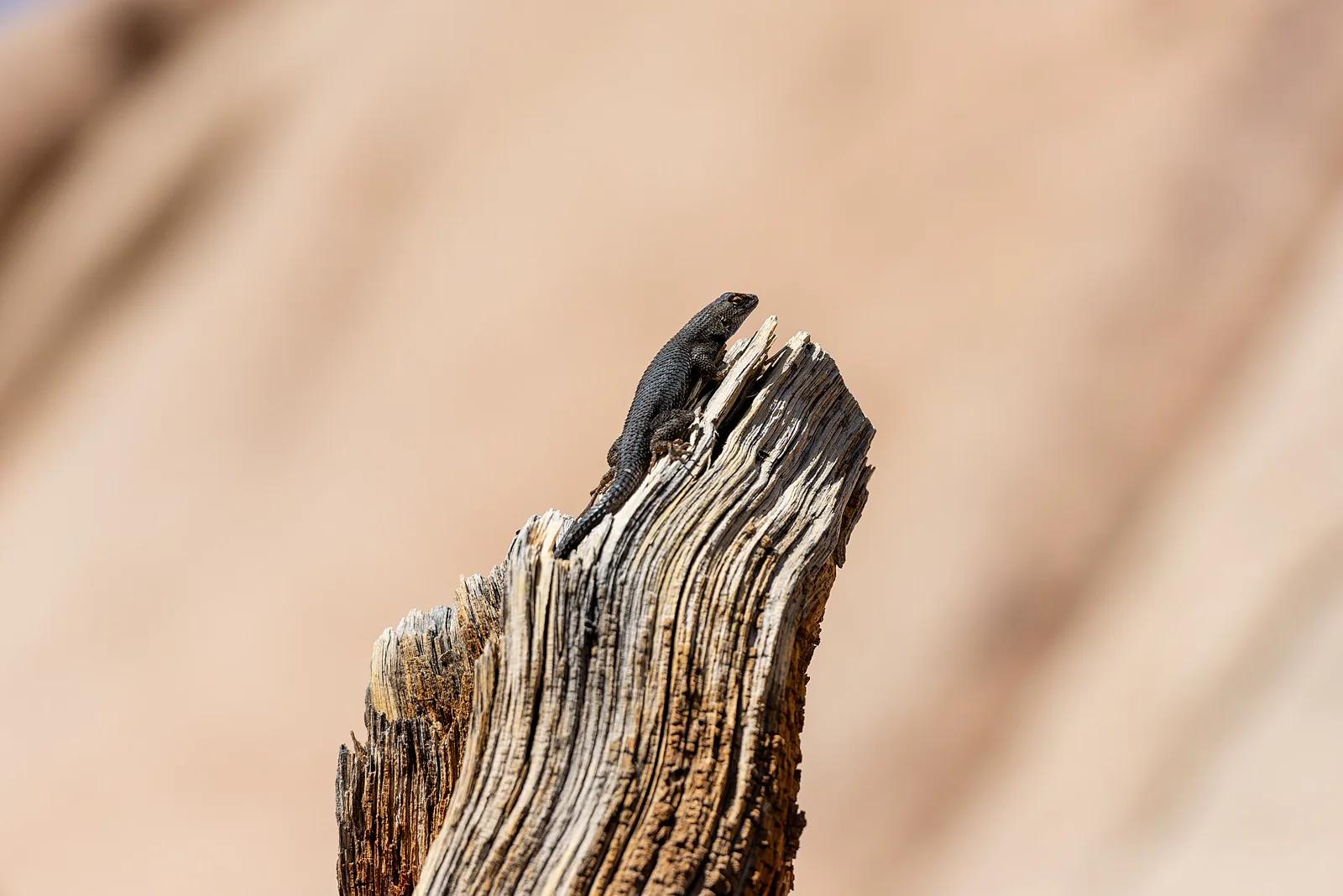
Ectothermic reptiles rely primarily on external heat sources rather than burning food continuously to maintain a high, constant metabolic set point like a mammal or bird. Because direct solar radiation, sun-warmed rock, damp soil, water, wind, and evaporation transfer heat at very different rates, a reptile's core temperature often diverges sharply from shaded air temperature. The everyday label cold-blooded is misleading in the field: an actively basking desert or montane lizard can maintain a body temperature as warm as a rodent's while spending only a fraction of the metabolic energy. [1][6]
- Ectotherms gain heat from solar radiation and warm substrates rather than high resting metabolism
- A basking reptile can hold an internal temperature several degrees warmer than the surrounding air
- Low metabolic overhead lets ectotherms survive long fasts and invest more energy into growth and reproduction
Movement turns a landscape into a thermostat
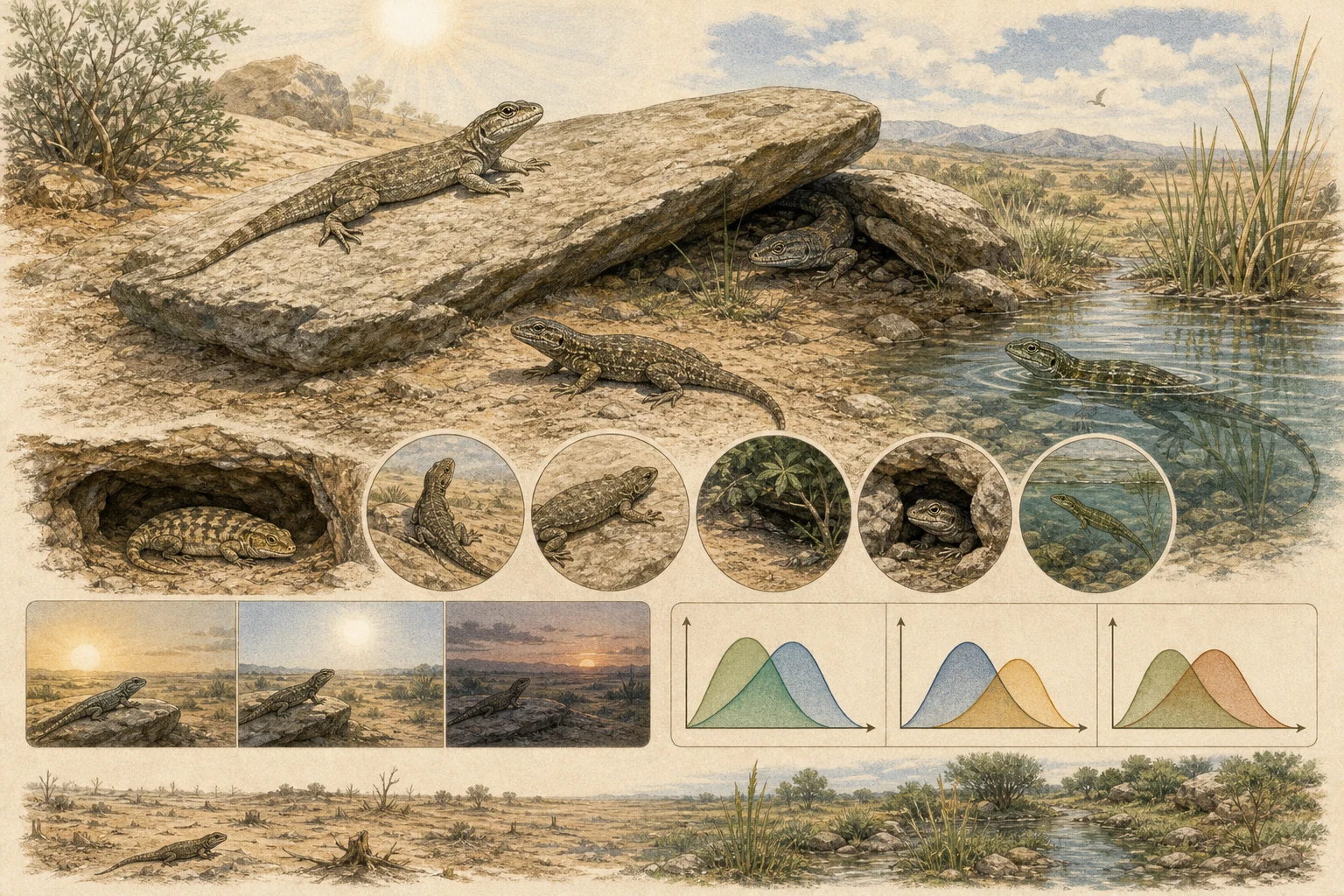
Free-ranging reptiles regulate heat by shuttling across microhabitats and adjusting body geometry. A lizard or snake warms by moving into sunlit patches, pressing its belly flat against heated stone, darkening its skin, or angling its ribs perpendicular to incoming rays; it cools by retreating into shade, burrows, rock crevices, water, or elevated breezes. Field telemetry of giant gartersnakes and Argentine giant tegus shows that target temperatures also shift with sex, gravidity, digestion, and season, with some large species maintaining remarkably stable burrow temperatures even through cool periods. [1][3][4]
- Flattening against warm rock or tilting perpendicular to sunlight accelerates morning heat gain
- Shuttling into shade, burrows, water, or breezy branches prevents overheating once target temperature is reached
- Gravid females and digesting individuals often select warmer microhabitats than resting conspecifics
Temperature changes what the body can do
Sprint speed, strike accuracy, venom and digestive enzyme activity, immune response, and embryonic growth all depend on body temperature, yet they do not share one identical optimum. A thermal performance curve rises gradually from a critical minimum to a peak zone and then drops steeply near the lethal upper limit, leaving a narrow safety margin in hot climates. Open-canopy baskers and deep-forest shade dwellers evolve different thermal tolerances and evolutionary rates of physiological adjustment, so no single preferred temperature applies across all reptile families. [2][3]
- Locomotion, digestion, and embryonic development each follow a curve that drops sharply near upper heat limits
- Tropical forest shade specialists often operate within narrower thermal margins than open-country baskers
- Cold-stiffened reptiles often rely on cryptic stillness or defensive displays when too cool to flee rapidly
Behavior works only when choices remain
Behavioral thermoregulation succeeds only when the habitat supplies a fine-grained mosaic of sunny perches, shaded retreats, and buffered underground refuges within an animal's movement range. Clearing understory shrubs, compacting burrow soil, or draining wetlands can expose reptiles to lethal overheating or cold even when regional mean air temperatures barely shift. Anatomy and vascular physiology also modify heat flow: giant leatherback sea turtles maintain warm swimming muscles in chilly oceans through massive body volume, insulating fat, and counter-current heat exchangers in their flippers. [1][2][4][5]
- Habitat simplification removes the shade patches and burrows reptiles need to buffer extreme midday heat
- Heart-rate changes and peripheral blood shunting let reptiles warm faster in sun than they cool in shade
- Leatherback turtles retain metabolic heat in cold seas using counter-current blood vessels and thick insulation
Reading thermoregulation as behavior
Much of what looks like reptile idleness in the field is active thermal management. Instead of simply ticking a species off a list, observe its posture and substrate contact: a morning lizard pressed flat on dark bark is gathering heat, whereas one standing high on extended toes with its throat raised at noon is shedding it. Record time of day, cloud cover, wind, and whether the animal occupies full sun, filtered edge, or deep cover, and remember that empty rocks at midday usually indicate a shift into underground refuges rather than local absence. [1][3][4]
- Morning surveys along sunlit east-facing rocks and edges often reveal basking snakes and lizards warming up
- High-stilted posture, gaping jaws, or perched elevation off hot sand signal that a reptile is actively cooling
- Midday quiet on hot summer trails reflects animals retreating into burrows or crevices rather than low population density
Related guides
Get Fauna and identify it in the field.
Where this guide comes from
Source-checked editorial guide. Last updated . This guide teaches identification and field skills; it is not a substitute for expert verification when it matters.
- Oxford University Press — Body temperatures and the thermal environment ↗
- Evolution — Basking behavior and heat tolerance in rainforest lizards ↗
- U.S. Geological Survey — Body temperatures of the giant gartersnake ↗
- U.S. Geological Survey — Thermal stability in free-ranging tegus ↗
- Smithsonian Ocean — Counter-current heat exchange in leatherback turtles ↗
- Smithsonian Q?rius — Turtle activity and ectothermy ↗