How sloths host miniature ecosystems
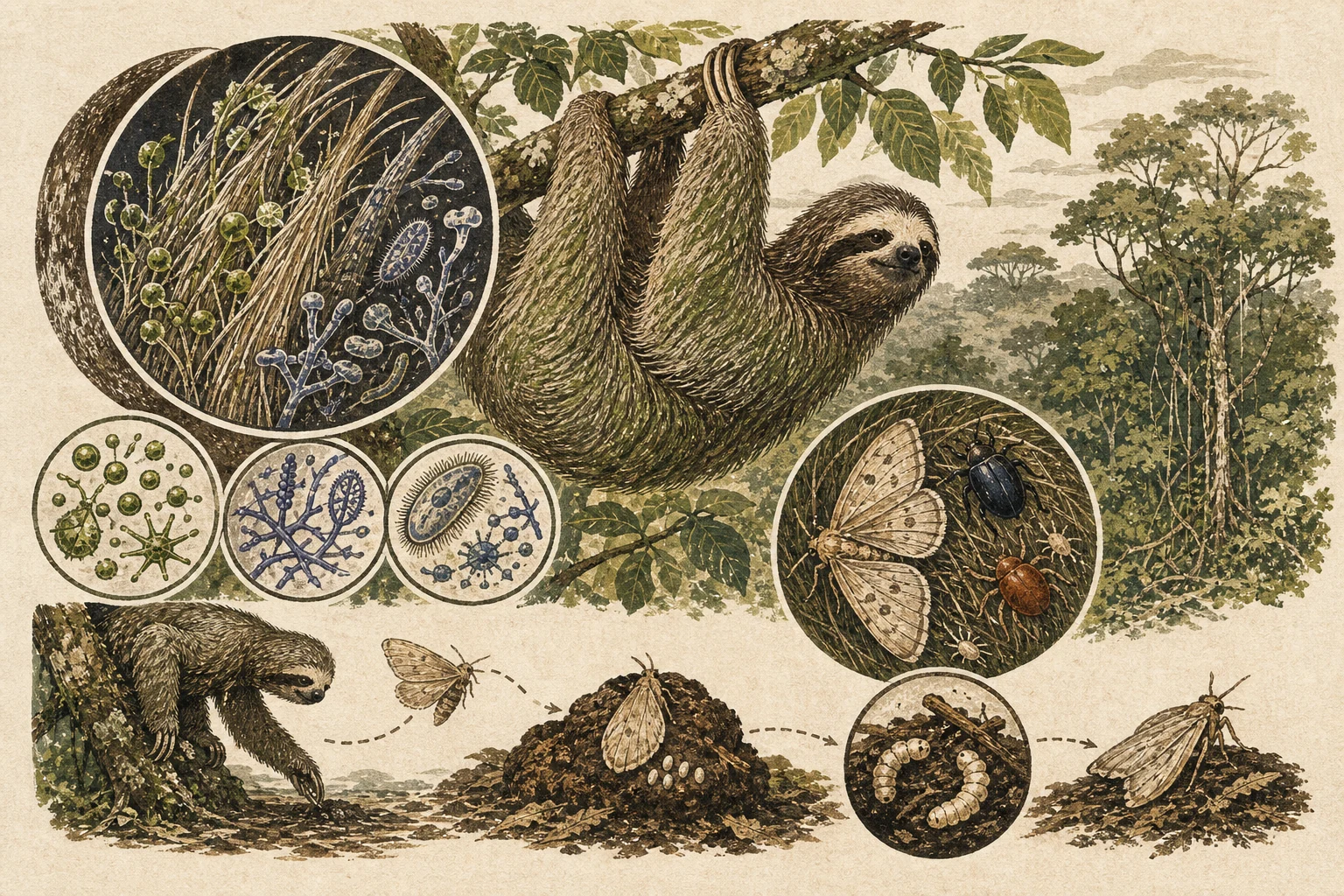
A sloth's outer coat is exposed habitat with water, structure, nutrients, and transport through the forest. Algae and fungi grow among hairs while specialized and incidental arthropods live there, creating interacting trophic levels rather than one simple sloth-algae partnership.
Last updated
Fur becomes an open habitat
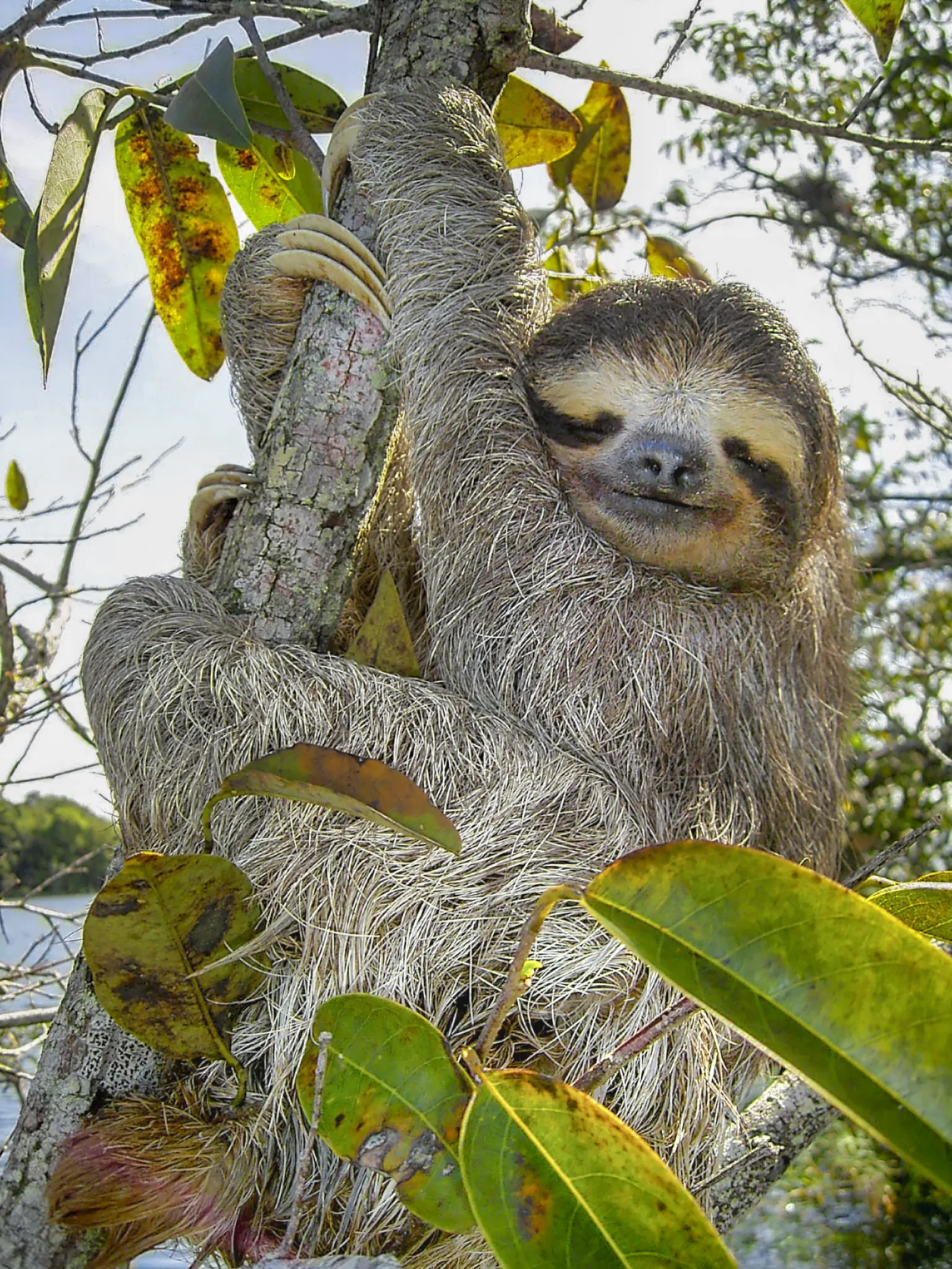
Look closely at a wild brown-throated three-toed sloth (Bradypus variegatus) or Hoffmann's two-toed sloth (Choloepus hoffmanni) resting in a Neotropical rainforest canopy and its outer guard hairs resemble rough, weathered bark more than sleek mammal pelage. In three-toed sloths, transverse cracks and irregular fissures develop along the outer hair cortex as the animal ages, while two-toed sloths carry longitudinal grooves running the length of each guard hair. Those microstructures absorb rainwater like a sponge and shelter a multi-trophic community of green algae, fungi, bacteria, ciliates, pyralid moths, scarab beetles, mites, and ticks moving slowly through humid canopy light. [1][2][5]
- Two-toed sloth guard hairs have lengthwise flutes and ridges, whereas three-toed sloth hairs develop transverse cracks that absorb moisture.
- Slow canopy movement, high tropical humidity, and rare self-scratching allow complex multi-species communities to persist in the coat.
- A single sloth can carry dozens to hundreds of adult moths, beetles, and mites alongside microscopic algae, fungi, and protists.
Algae create green without changing sloth pigment
No mammal synthesizes green hair pigment; the mossy olive cast visible on many wild sloths during the rainy season comes from photosynthetic algae colonizing the damp outer hairs. Molecular sequencing across sloth species has identified diverse green algae, most notably Trichophilus welckeri, a green alga in the class Ulvophyceae found exclusively in sloth hair and passed from mother to offspring during the first weeks of life alongside airborne and bark-dwelling algae acquired from the forest. In dry seasons or roofed enclosures where hair dries out, the algal turf recedes and the coat returns to dull grayish brown. [1][2][5]
- The green tint on wild sloths comes from epibiotic algae—especially Trichophilus welckeri—living in hair cracks rather than mammalian pigment.
- Young sloths acquire specialized fur algae and microbes through prolonged contact with their mother's pelage.
- Algal cover fluctuates with rainfall and canopy exposure, often fading to gray-brown during dry weather.
Moths link fur to the forest floor
Specialized sloth moths in the genus Cryptoses (family Pyralidae) spend their adult lives tucked deep inside sloth fur, flying out mainly when a three-toed sloth makes its slow, risky weekly descent down the trunk to defecate on the forest floor. Gravid female moths oviposit directly onto the fresh dung pellet before the sloth climbs back into the canopy; their caterpillars feed on the dung, pupate in the soil, and fly upward to colonize another sloth. While one influential study proposed that decomposing moths fertilize fur algae that sloths eat by grooming, critical ecological reviews emphasize that quantitative proof of a nutritional benefit to the sloth remains unsettled. [2][3]
- Gravid female Cryptoses moths ride three-toed sloths down to the forest floor to lay eggs in fresh dung piles.
- Larval sloth moths feed purely on buried sloth feces before emerging as winged adults that fly back into the canopy.
- Whether moth nitrogen and algal growth repay the predation risk of ground defecation remains an active, debated hypothesis.
Fungi and microbes add unresolved relationships
High-throughput DNA metabarcoding and culturing of hair clippings from sympatric Bradypus variegatus and Choloepus hoffmanni in Panama and Costa Rica reveal rich, distinct fungal assemblages dominated by Ascomycota and Basidiomycota yeasts and molds. Because three-toed and two-toed sloths differ in hair groove geometry, nightly activity patterns, ambient body temperature regulation, and tree preferences, each hosts a characteristic fungal signature on the very same forest reserve. In laboratory dish assays, extracts from several sloth-hair fungi inhibit growth of tropical parasites and bacteria, yet how those microbes interact with one another, with algae, or with the host's skin in the wild is still largely unmapped. [2][4][5]
- Two-toed and three-toed sloths living in the same forest host statistically distinct fungal communities in their pelage.
- Laboratory cultures of sloth-hair fungi have yielded bioactive compounds, though their ecological role on living sloths is unproven.
- The fur community includes detritivores, photosynthesizers, blood-feeding ticks, and transient canopy insects rather than a single mutualism.
Related guides
Get Fauna and identify it in the field.
Where this guide comes from
Source-checked editorial guide. Last updated . This guide teaches identification and field skills; it is not a substitute for expert verification when it matters.
- BMC evolutionary biology — Molecular evidence for a diverse green algal community growing in the hair of sloths and a specific association with Trichophilus welckeri (Chlorophyta, Ulvophyceae) ↗
- Biological reviews of the Cambridge Philosophical Society — On the move: sloths and their epibionts as model mobile ecosystems ↗
- Proceedings. Biological sciences — A syndrome of mutualism reinforces the lifestyle of a sloth ↗
- Microbiology (Reading, England) — Differences in fungal communities in the fur of two- and three-toed sloths revealed by ITS metabarcoding ↗
- Smithsonian’s National Zoo — Two-toed sloth ↗