How feathers create color
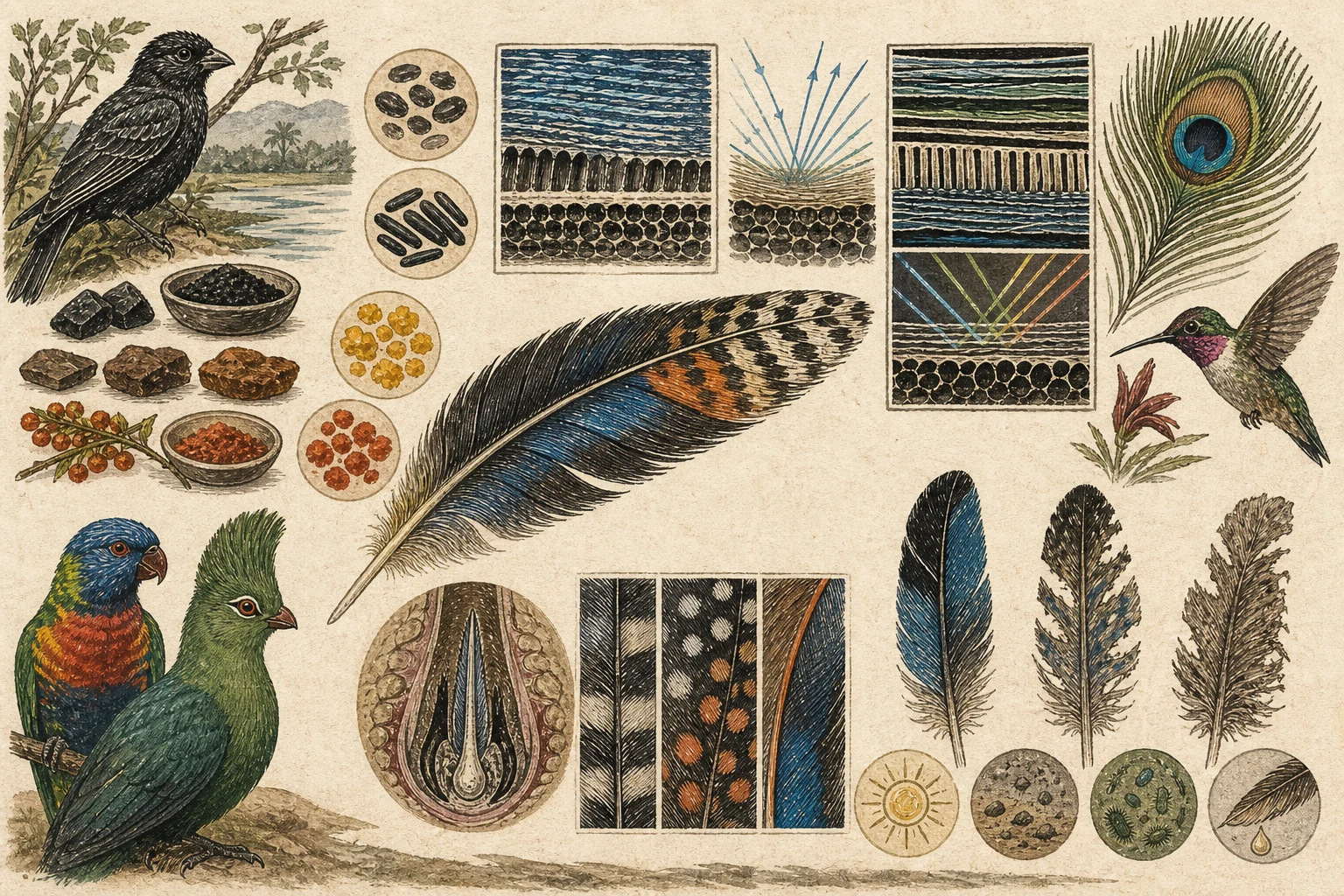
Growing feather cells place pigments and organize keratin, air spaces, and melanin bodies into precise structures. After the feather is dead, those materials absorb some wavelengths and scatter others, producing blacks, browns, reds, yellows, whites, blues, ultraviolet signals, and iridescence.
Last updated
Pigments subtract wavelengths
Chemical pigments color a feather by selectively absorbing certain wavelengths of incoming sunlight and reflecting the remainder back to the viewer's eye. Birds synthesize two forms of melanin inside specialized melanocytes: eumelanin, which produces jet blacks, slates, and dark browns, and pheomelanin, which yields warm buffs, chestnuts, and rufous reds—while also mechanically toughening wingtips against wind abrasion. By contrast, the vivid yellows, oranges, and scarlets of northern cardinals, goldfinches, and tanagers come from dietary carotenoids harvested from seeds, berries, or insects. A few bird families manufacture lineage-specific pigments, including the red and yellow psittacofulvins of parrots and the copper-bearing green turacoverdin and red turacin of African turacos. [1][2][3]
- Eumelanin and pheomelanin are synthesized directly by the bird and add mechanical wear resistance to dark outer primary tips.
- Carotenoid reds, oranges, and yellows must be ingested in food and enzymatically modified before deposition into growing feathers.
- Parrots synthesize unique psittacofulvin pigments for their reds and yellows, while turacos produce true green and red copper porphyrin pigments.
Structure selects light without blue pigment
Hold a shed eastern bluebird (Sialia sialis), Steller's jay, or indigo bunting feather up against a bright sky—backlighting it so light passes through rather than reflecting off the surface—and the vivid blue vanishes into dull smoky gray-brown. Almost no bird possesses a blue chemical pigment. Instead, the spongy medullary layer inside each feather barb consists of a nanoscale channel-or-sphere matrix of beta-keratin and air pockets whose spacing coherently scatters short-wavelength blue and ultraviolet light while letting longer red and yellow wavelengths pass through to be soaked up by a dark basal curtain of melanin granules. Most green feathers, outside turacos, layer yellow carotenoid or psittacofulvin pigment over that structural blue scatterer. [1][4][5]
- Backlit blue jay, bluebird, and indigo bunting feathers look dull brown because they contain only melanin and nanoscale keratin-air channels.
- A basal layer of dark melanosomes beneath the spongy keratin matrix absorbs unreflected long wavelengths so scattered blue looks saturated.
- Bright yellow and red carotenoid feathers also rely on underlying white structural scattering of the barb medulla to reflect light strongly.
Ordered nanostructures produce iridescence
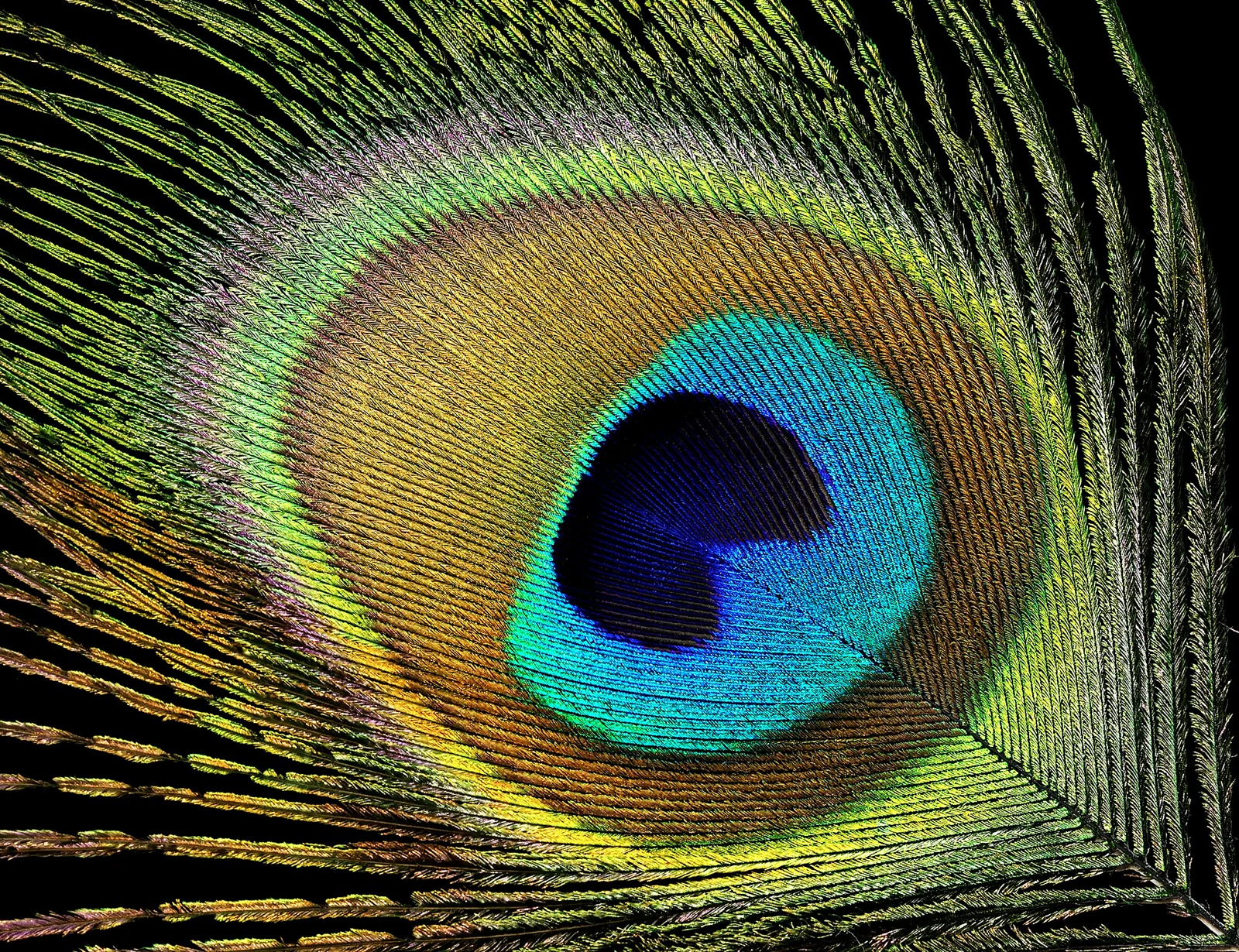
Whereas non-iridescent blue feathers scatter light broadly from quasi-ordered spongy keratin, the metallic greens, violets, and rubies of Indian peafowl (Pavo cristatus) train feathers, Mallard speculums, starlings, and hummingbird gorgets arise from highly ordered photonic crystals inside the microscopic barbules. During feather development, rod-, platelet-, or hollow tube-shaped melanosomes self-assemble into precise crystalline lattices embedded in beta-keratin. Light waves reflecting from successive nanoscale layers interfere constructively at specific wavelengths determined by lattice spacing and refractive index. When a male hummingbird turns its head a few degrees toward the sun, the optical path length changes instantly, flashing its throat from velvet black to fiery magenta. [4][5]
- Iridescent barbules pack solid or hollow melanosomes into ordered multi-layer arrays that act as thin-film reflectors and photonic crystals.
- Small changes in sun angle or observer viewing geometry shift the constructive interference wavelength, making gorgets flash from black to brilliant color.
- Melanosome shape—solid rods, flattened platelets, or air-filled tubules—controls both hue saturation and brilliance across bird lineages.
Color is built, displayed, and perceived
Complex bars, chevrons, and eyespots are programmed inside the tubular feather follicle as melanocytes pulse pigment transfer on and off along developing barb ridges. Once the keratin sheath flakes away, the mature feather is dead tissue without blood supply, yet its appearance still shifts across the year: feather-degrading bacteria and wind abrasion wear away pale buff tips on European starlings and house sparrows to expose glossy breeding plumage without a molt, while sunlight bleaches carotenoids. Furthermore, most diurnal birds are tetrachromats with a fourth cone type sensitive to ultraviolet light (300–400 nm) and colored oil droplets that sharpen spectral discrimination, revealing UV-reflective crown patches and plumage contrasts invisible to human eyes. [1][2][3]
- Mature feathers are dead keratin structures, but seasonal wear of pale feather tips can unveil darker or brighter breeding colors beneath.
- Avian retinas possess four single-cone classes—including an ultraviolet-sensitive cone—plus filtering oil droplets that expand color space beyond human vision.
- Many bird species that look monochromatic to human observers display sharp sex or age differences in ultraviolet reflectance.
Testing a color in the field
Understanding how feathers generate color directly improves field identification when lighting is tricky. If a dark-looking grackle, swallow, or hummingbird suddenly flares metallic violet, bronze, or emerald as it pivots into direct sun, you are looking at ordered barbule iridescence whose apparent blackness in deep forest shade is an optical angle effect rather than a different plumage morph. Non-iridescent structural blues on jays and buntings keep their hue across wider viewing angles in open light, yet turn leaden against bright overcast backlighting. Conversely, carotenoid reds and melanin browns stay recognizable even in flat, diffused woodland light. [1][4][5]
- If a feather patch switches from coal black to glowing jewel tones with a slight turn of the bird's head, the color comes from ordered iridescent barbules.
- Non-iridescent structural blues hold their color across wider angles in frontlighting but turn dark silhouettes when backlit against bright sky.
- Pigment-based rusts, buffs, and yellows remain stable in hue under flat cloud cover where structural blues and iridescent gorgets go muted.
Related guides
Get Fauna and identify it in the field.
Where this guide comes from
Source-checked editorial guide. Last updated . This guide teaches identification and field skills; it is not a substitute for expert verification when it matters.
- Smithsonian — When is a blue bird not blue? ↗
- Frontiers in cell and developmental biology — Avian Pigment Pattern Formation: Developmental Control of Macro- (Across the Body) and Micro- (Within a Feather) Level of Pigment Patterns ↗
- International journal of molecular sciences — Bird Integumentary Melanins: Biosynthesis, Forms, Function and Evolution ↗
- Applied microscopy — Melanin-based structural coloration of birds and its biomimetic applications ↗
- Biology letters — Carotenoids need structural colours to shine ↗