How birds fly
A flying bird redirects air with a wing whose camber, angle, area, and motion continually change. The resulting aerodynamic force can be oriented upward for weight support or forward for propulsion; muscles, joints, feathers, tail, and sensory feedback tune each wingbeat.
Last updated
A wing redirects air and feels an equal force
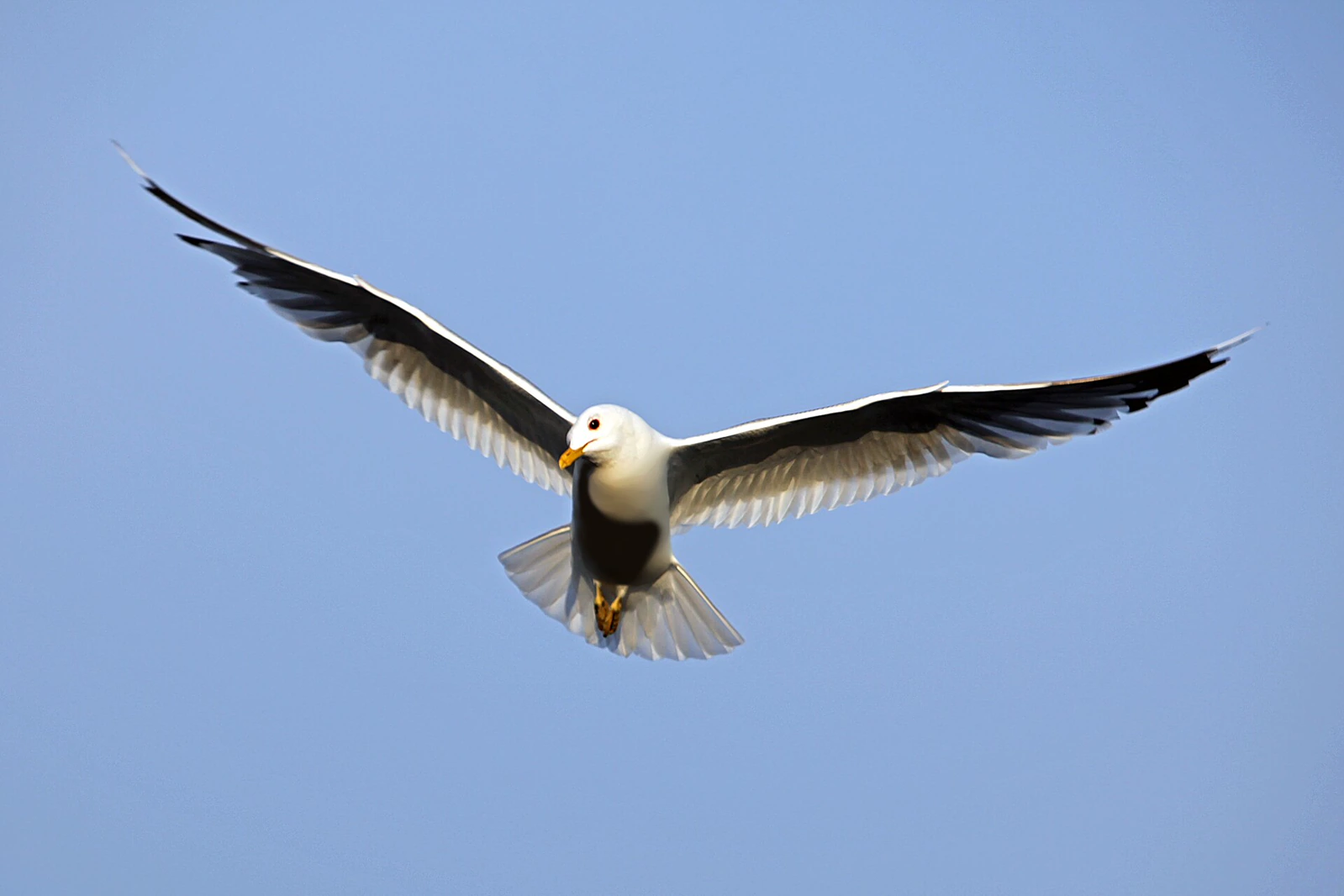
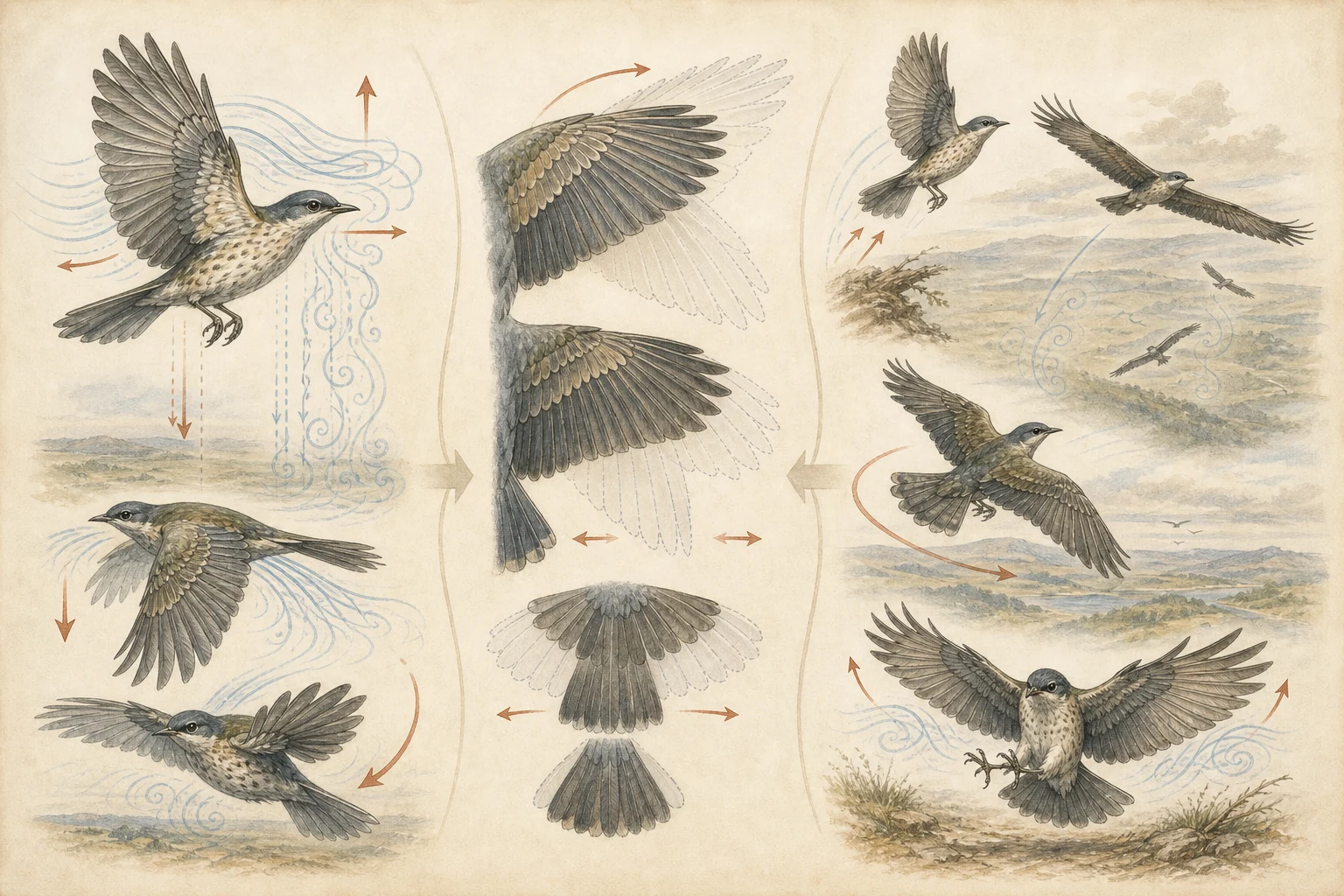
Whether a common gull (Larus canus) glides into a sea breeze or a swift powers across a meadow, flight rests on Newton's laws of motion and fluid circulation: the cambered, angled wing accelerates a mass of air downward and backward, and the air exerts an equal and opposite aerodynamic reaction force on the bird. Lower pressure over the curved dorsal surface and higher pressure beneath the ventral surface are inseparable from the bound circulation and trailing vortex wake shed behind the wingtips. Popular explanations that rely solely on air molecules racing to meet at the trailing edge miss how angle of attack, camber, and downwash actually generate lift. [1][2]
- A bird wing generates lift by deflecting oncoming air downward, creating a pressure difference across the upper and lower surfaces.
- Angle of attack and wing camber together govern how strongly the airfoil circulates and redirects airflow.
- Every lifting wing sheds a trailing vortex wake whose downward momentum balances the bird's weight.
Flapping joins lift and propulsion
Unlike a fixed-wing aircraft that separates static lifting wings from spinning propellers, a flapping bird combines lift and thrust in the same appendage. The massive pectoralis muscle—anchored to the deep keel of the sternum—pulls the humerus powerfully downward and forward during the downstroke, tilting the aerodynamic force vector so it simultaneously supports body weight and pulls the bird ahead against drag. To recover the wing without fighting heavy air resistance, the smaller supracoracoideus muscle beneath it loops a tendon through the shoulder's triosseal canal like a pulley, lifting and supinating the partially flexed wing through the upstroke. [2][3][4]
- The large pectoralis muscle drives the power downstroke that generates most of a bird's vertical support and forward thrust.
- The supracoracoideus muscle sits on the sternum yet lifts the wing from above via a tendon routed through the shoulder's pulley-like triosseal canal.
- Birds flex the wrist and elbow or rotate primary feathers during the upstroke to minimize downward drag.
Feathers make the wing both firm and changeable
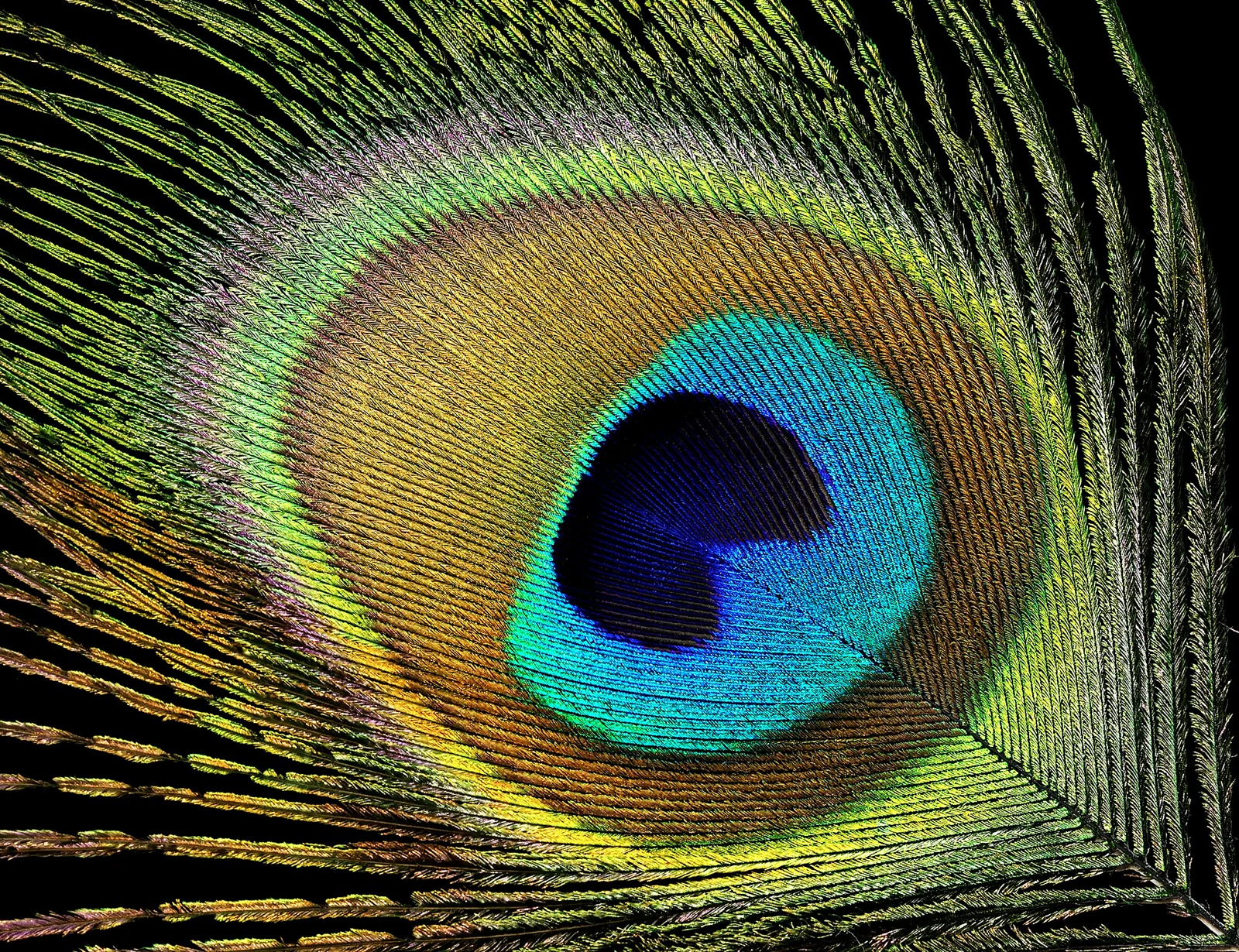
A bird's flight surface is built from overlapping primary and secondary remiges whose stiff, asymmetric keratin shafts and hooked barbules form a lightweight, self-healing airfoil. Electron microscopy and biomechanical testing show that thousands of microscopic lobate cilia and hooked rami between overlapping flight feathers slide and lock together with directional friction—functioning like tiny mechanical fasteners that prevent primaries from separating into gaps when the wing extends, yet release smoothly when the wing folds against the flank. By flexing shoulder, elbow, and wrist joints while fanning or twisting the tail, a bird morphs its wing area, aspect ratio, and sweep mid-wingbeat. [1][5]
- Asymmetric vanes on outer primary feathers resist twisting forces when air presses against the wingtip.
- Microscopic directional hooks between overlapping flight feathers lock the extended wing into a continuous, gap-free surface.
- Joint flexion lets a bird shift seamlessly from broad, high-lift wings during slow turns to swept, low-drag wings in fast glides.
Takeoff, soaring, and landing use forces differently
Different phases of a flight demand completely different force balances. At takeoff, songbirds and pigeons generate most of their initial upward velocity from a powerful hindlimb jump before sweeping their wings through steep, high-amplitude strokes; waterbirds such as loons, swans, and grebes must patter across the water surface to build airspeed. Once aloft, broad-winged vultures, eagles, and storks circle inside rising thermal columns, while long-winged albatrosses exploit wind-shear gradients over ocean waves. High-speed force-plate experiments with Pacific parrotlets (Forpus coelestis) reveal that during steep takeoffs and perching stalls, birds even orient their wings so aerodynamic drag helps support body weight and brake forward momentum. [2][4]
- Hindlimb push-off supplies the majority of initial takeoff velocity in perching birds before the first full downstroke completes.
- High-speed kinematic studies of parrotlets show birds tilt their wings so aerodynamic drag assists weight support during takeoff and braking at landing.
- Soaring raptors and seabirds harvest external energy from rising thermal air or wind gradients to stay aloft with minimal muscle work.
Related guides
Get Fauna and identify it in the field.
Where this guide comes from
Source-checked editorial guide. Last updated . This guide teaches identification and field skills; it is not a substitute for expert verification when it matters.
- Applied bionics and biomechanics — Experimental Investigation of Aerodynamics of Feather-Covered Flapping Wing ↗
- Royal Society open science — Forward flight of birds revisited. Part 1: aerodynamics and performance ↗
- Philosophical transactions of the Royal Society of London. Series B, Biological sciences — Muscle function in avian flight: achieving power and control ↗
- Nature communications — Birds repurpose the role of drag and lift to take off and land ↗
- Science — How flight feathers stick together to form a continuous morphing wing ↗