Why birds have air sacs
Bird lungs do not inflate and collapse like mammalian lungs. Expanding air sacs shift air through branching bronchi and parabronchi; in the best-known pathway, fresh flow continues across gas-exchange tissue during both inhalation and exhalation, while the sacs themselves exchange little gas.
Last updated
The lungs exchange gas; the sacs move air
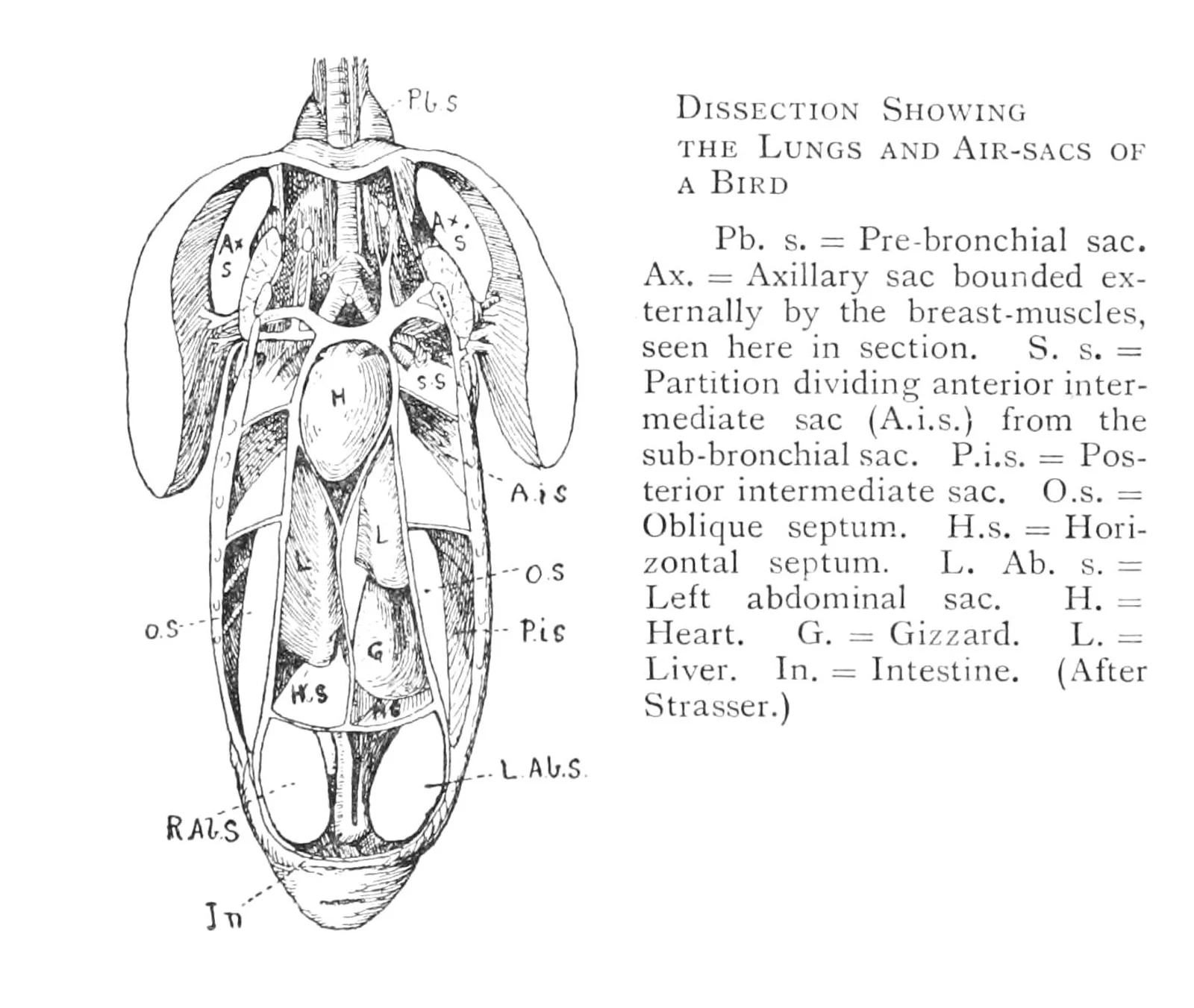
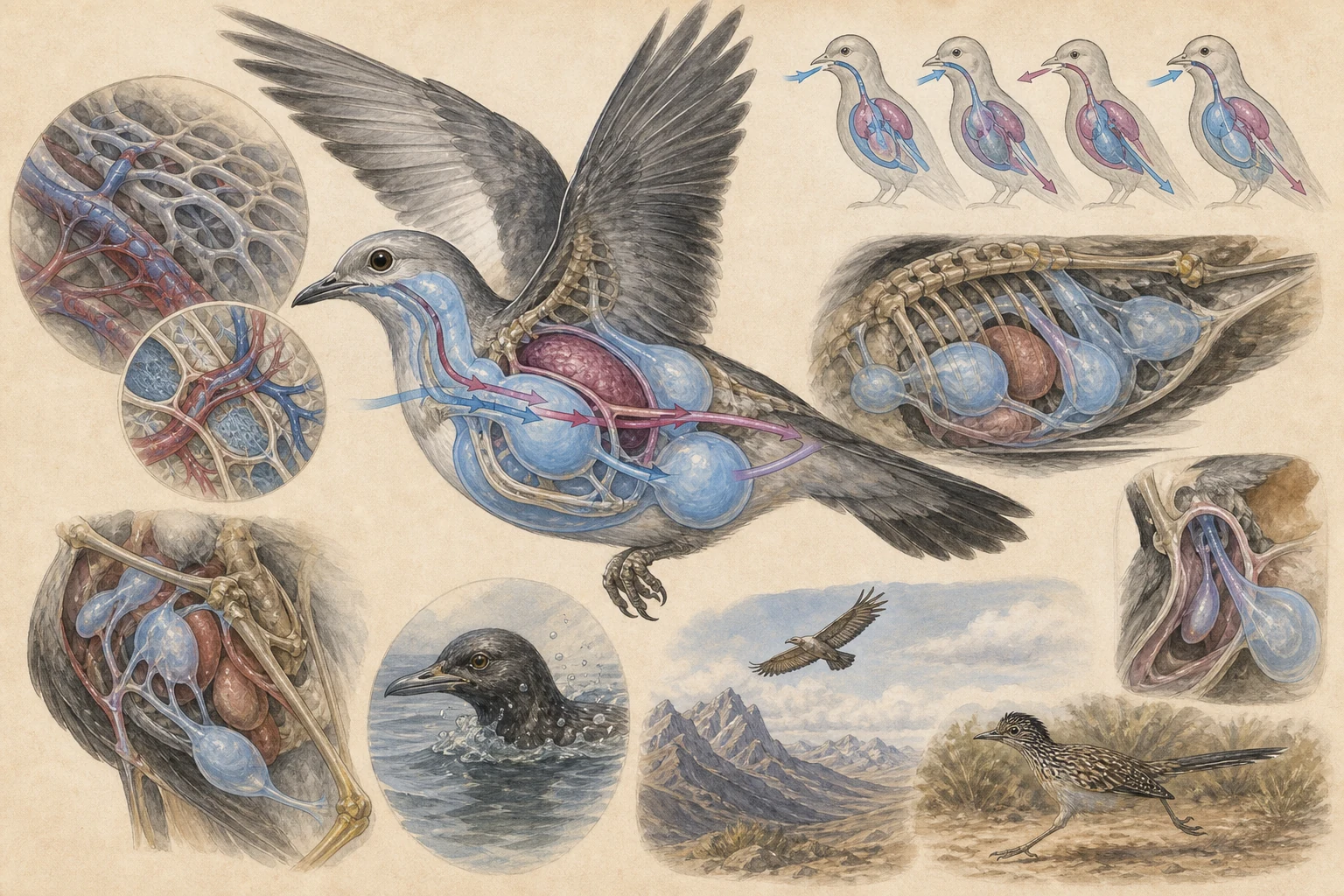
Mammalian lungs combine pumping and gas exchange inside the same elastic, blind-ended alveolar sacs, which must inflate and deflate with every breath. Birds decouple those two jobs completely. A bird's dorsal lungs are small, dense, and wedged tightly against the thoracic vertebrae and ribs so their volume barely changes during breathing. Instead, seven to nine thin-walled, compliant air sacs—grouped into cranial (cervical, clavicular, cranial thoracic) and caudal (caudal thoracic, abdominal) sets—fill much of the body cavity. As rib and sternal muscles rock the breastbone down and up, those poorly vascularized air sacs act as mechanical bellows that pump air through the rigid lung's microscopic parabronchial tubes. [1][2]
- Avian lungs are compact, rigid structures fixed against the dorsal ribcage that scarcely change volume between inhalation and exhalation.
- Thin-walled cranial and caudal air sacs have minimal blood supply and perform virtually no direct oxygen exchange.
- Rocking movements of the sternum and uncinate-braced ribs expand and compress the air sacs like mechanical bellows.
One parcel of air spans multiple breaths
Because the air sacs sit both upstream and downstream of the gas-exchanging lung, a single inhaled breath takes two full respiratory cycles to pass through a bird's body. On the first inhalation, fresh air travels down the trachea and primary bronchus into the posterior air sacs (while a portion also enters the lung). On the first exhalation, those posterior sacs squeeze that oxygen-rich air forward through the parallel paleopulmonic parabronchi. On the second inhalation, spent air leaves the lung into the anterior air sacs, and the second exhalation vents it out the trachea. Aerodynamic valving at bronchial junctions—rather than muscular flap valves—steers this largely unidirectional loop. [1][3]
- A single parcel of inhaled air requires two full inhalation-exhalation cycles to travel from the nostrils back out of the body.
- Fluid-dynamic valving at bronchial branch points directs air from caudal sacs forward across the paleopulmonic parabronchi during both breath phases.
- Many songbirds, pigeons, and ducks also possess a bidirectional neopulmonic network alongside the unidirectional paleopulmonic tubes.
Continuous flow supports a high-performance exchanger
Inside each parabronchus, air diffuses radially into microscopic air capillaries that intertwine with dense blood capillaries at right angles, forming a cross-current gas exchanger across an exceptionally thin blood-gas barrier. Because rigid parabronchi never collapse like mammalian alveoli can, bird lungs support far smaller, thinner-walled air capillaries without risking structural failure. That high oxygen-extraction efficiency powers bar-headed geese (Anser indicus) and Rüppell's vultures flying at extreme altitudes where oxygen partial pressure is a fraction of sea-level values, and sustains running ostriches and diving penguins just as effectively. Comparative anatomy shows that unidirectional airflow and air-sac diverticula evolved deep in archosaur ancestors long before powered avian flight. [1][2][4]
- Cross-current blood-to-air geometry and an ultra-thin blood-gas barrier let birds extract a higher fraction of inhaled oxygen than mammals of similar size.
- High-efficiency parabronchial gas exchange enables bar-headed geese and migrating shorebirds to sustain flapping flight in thin high-altitude air.
- Unidirectional lung airflow and skeletal pneumaticity originated in non-avian archosaurs before the evolution of flight.
The system also moves heat and connects spaces
Beyond ventilating the lungs, avian air sacs send out blind-ended diverticula that surround visceral organs, cushion the syrinx during vocalization, and invade the marrow cavities of pneumatic bones such as the humerus, sternum, coracoid, and cervical vertebrae. Watch a hawk, cormorant, or songbird perched in summer sun and you may see rapid throat fluttering (gular flutter) or open-bill panting: evaporating moisture from the upper respiratory tract and moving air through the expansive air-sac system dumps excess metabolic heat generated during hard flight without over-ventilating the gas-exchanging parabronchi and causing respiratory alkalosis. [2][3][4]
- Air-sac diverticula extend into the hollow cores of pneumatic bones such as the humerus, vertebrae, and pelvis in many soaring and perching birds.
- Diving birds such as penguins and loons reduce skeletal pneumaticity and air-sac volume so excess buoyancy does not hinder underwater pursuit.
- Evaporative cooling across respiratory surfaces and air sacs helps flying and sun-exposed birds shed intense metabolic heat.
Related guides
Get Fauna and identify it in the field.
Where this guide comes from
Source-checked editorial guide. Last updated . This guide teaches identification and field skills; it is not a substitute for expert verification when it matters.
- Philosophical transactions of the Royal Society of London. Series B, Biological sciences — Structure and function of the avian respiratory system ↗
- Philosophical transactions of the Royal Society of London. Series B, Biological sciences — Avian air sacs and neopulmo: their evolution, form and function ↗
- Philosophical transactions of the Royal Society of London. Series B, Biological sciences — Unidirectional airflow, air sacs or the horizontal septum: what does it take to make a bird lung? ↗
- Smithsonian — Archosaur air-sac breathing apparatus ↗