How sharks sense electric fields
Sharks sample tiny voltage differences through the ampullae of Lorenzini. Arrays of surface pores connect to sensory chambers, letting the nervous system compare signals across space and distinguish external fields from some self-generated activity.
Last updated
Collect voltage through pores and canals
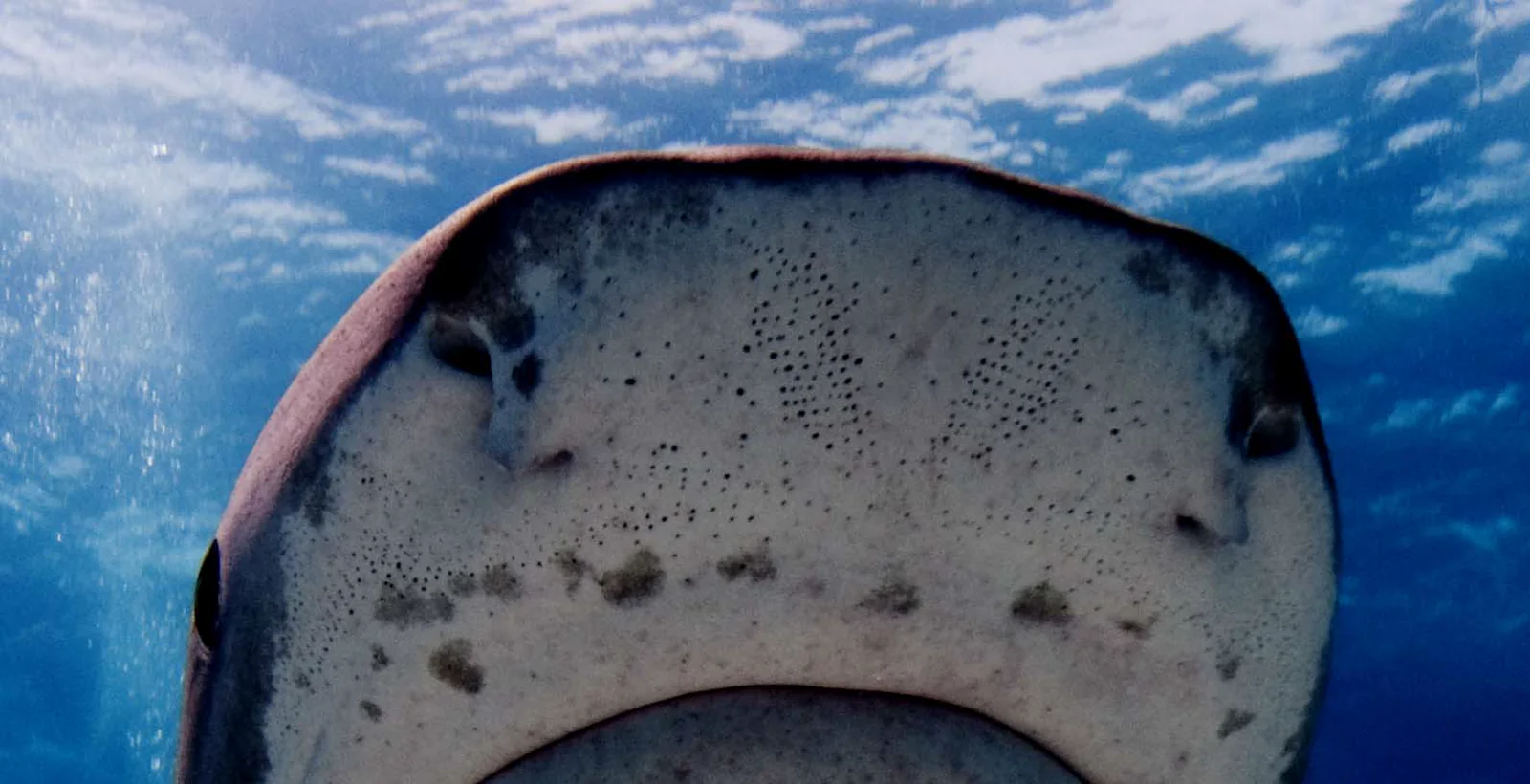
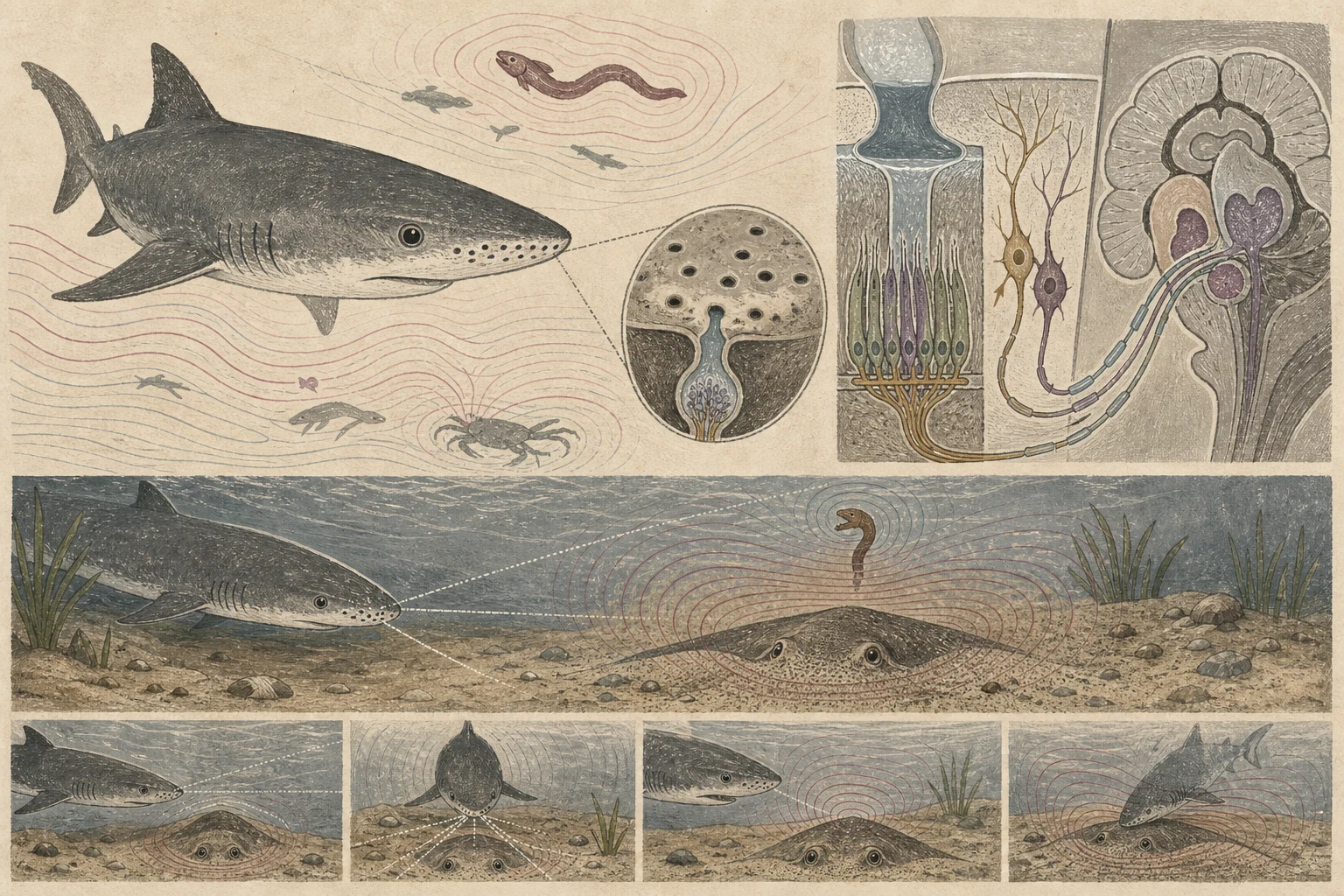
Look closely at the underside of a tiger shark's snout or the broad pectoral disk of a skate and you will see hundreds of dark, pepper-like surface pores arranged in symmetrical clusters. Each pore is the external opening of a tube filled with a keratan-sulfate mucopolysaccharide hydrogel that has exceptional proton and ionic conductivity, while the canal wall itself is tightly insulated by high-resistance epithelial junctions. Because minimal voltage drops along the gel column, each canal delivers the electrical potential at its surface pore directly to a deep sensory bulb—the ampulla proper—allowing the animal to compare voltages across the width and length of its head. [1][4]
- Dark snout pores lead into insulated canals filled with a highly conductive mucopolysaccharide gel
- Deep ampullary bulbs sit clustered in capsules while their pores spread across the head and jaw margins
- Differing canal lengths and orientations let the shark measure voltage gradients along multiple spatial axes
Convert a field into nerve activity
Lining the alveolar pouches of each ampulla are specialized hair-like electroreceptor cells whose apical membranes face the canal gel and whose basal ribbon synapses contact primary afferent nerve fibers. Minute voltage gradients—down to nanovolts per centimeter in marine species—open voltage-gated calcium channels paired with calcium-activated potassium channels in the receptor membrane, modulating continuous neurotransmitter release onto the sensory nerve. Molecular comparisons between sharks and skates show that subtle variations in the structure and coupling of these two ion channels tune the receptor's electrical oscillation frequency to match the bioelectric signals most relevant to each species' foraging ecology. [2][4]
- Coupled voltage-gated calcium and potassium channels amplify nanovolt-scale potential differences across the ampulla
- Receptor cells fire tonically at rest so weak positive or negative fields either speed up or slow down nerve activity
- Hindbrain circuits subtract regular electrical rhythms caused by the shark's own gill ventilation movements
Locate living sources at close range
Every living crab, flounder, or polychaete worm in seawater leaks a weak, low-frequency bioelectric dipole created by ion transport across its gills and rhythmic muscle contractions during breathing. Because electric fields decay steeply with distance in conductive salt water, passive electroreception guides the final tens of centimeters of an attack—often overriding visual or odor cues at the last moment so a benthic shark or ray can strike accurately into bare sand where a flatfish lies buried out of sight. Remarkably, encased embryos of bamboo sharks (Chiloscyllium punctatum) also use this sense inside their egg cases, freezing their gill movements when exposed to predator-like electric fields. [1][3]
- Ion leakage and respiratory muscle potentials around fish gills generate low-frequency dipole fields in seawater
- Electroreception acts at short range (typically under half a meter) to guide the final strike onto hidden prey
- Encased bamboo shark embryos cease gill ventilation when their ampullae detect low-frequency predator fields
Separate evidence from magnetic speculation
While close-range prey localization and predator detection by the ampullae of Lorenzini are established through behavioral and neurophysiological experiments, the role of these organs in open-ocean geomagnetic navigation remains an active scientific question rather than a settled mechanism. Physically, a shark swimming across Earth's magnetic field lines induces an electric voltage proportional to its velocity and heading, which is strong enough in principle to stimulate ampullary receptors. Even so, distinguishing induced magnetic voltages from ocean-current fields and water-temperature shifts is complex, and pore density and canal geometry vary dramatically between coastal benthic hunters and pelagic cruisers. [1][3][4]
- Swimming through Earth's magnetic field induces small voltages that ampullary receptors could theoretically detect
- Hammerhead cephalofoils and wide skate disks spread electroreceptor pores across a broader spatial baseline
- Ampullary gel also responds to temperature changes, requiring neural filtering to isolate true electrical stimuli
Related guides
Get Fauna and identify it in the field.
Where this guide comes from
Source-checked editorial guide. Last updated . This guide teaches identification and field skills; it is not a substitute for expert verification when it matters.
- Neuroscience letters — Semiconductor gel in shark sense organs? ↗
- Frontiers in cellular neuroscience — Excitatory and inhibitory synaptic mechanisms at the first stage of integration in the electroreception system of the shark ↗
- PloS one — Survival of the stillest: predator avoidance in shark embryos ↗
- Nature — Molecular tuning of electroreception in sharks and skates ↗