How corals build reefs
A coral reef is built colony by colony and generation by generation. Living polyps add skeletal cups at the surface, while older skeletons, binding organisms, sediments, growth, breakage, and erosion shape the framework below.
Last updated
Build a colony from repeated polyps
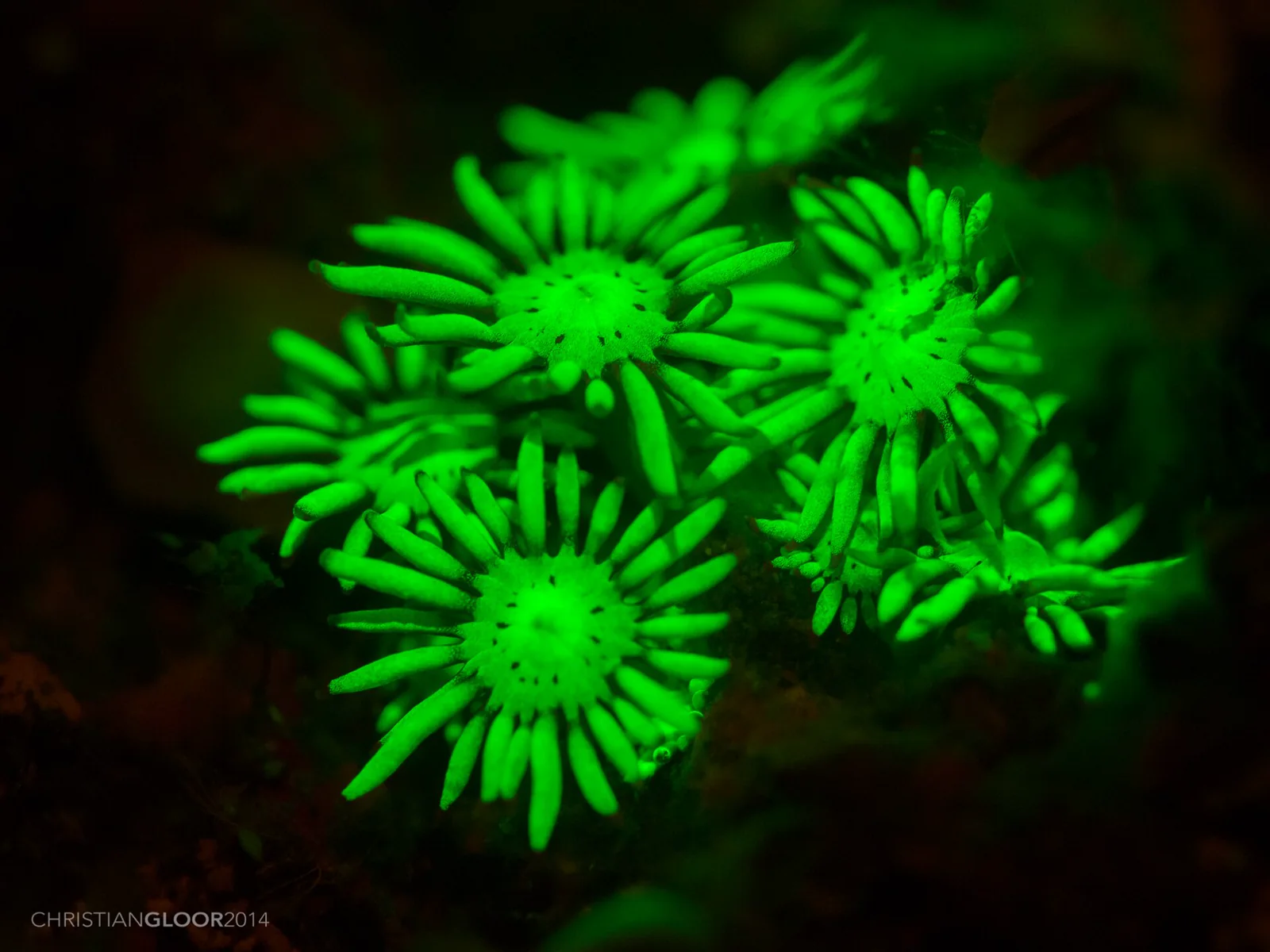
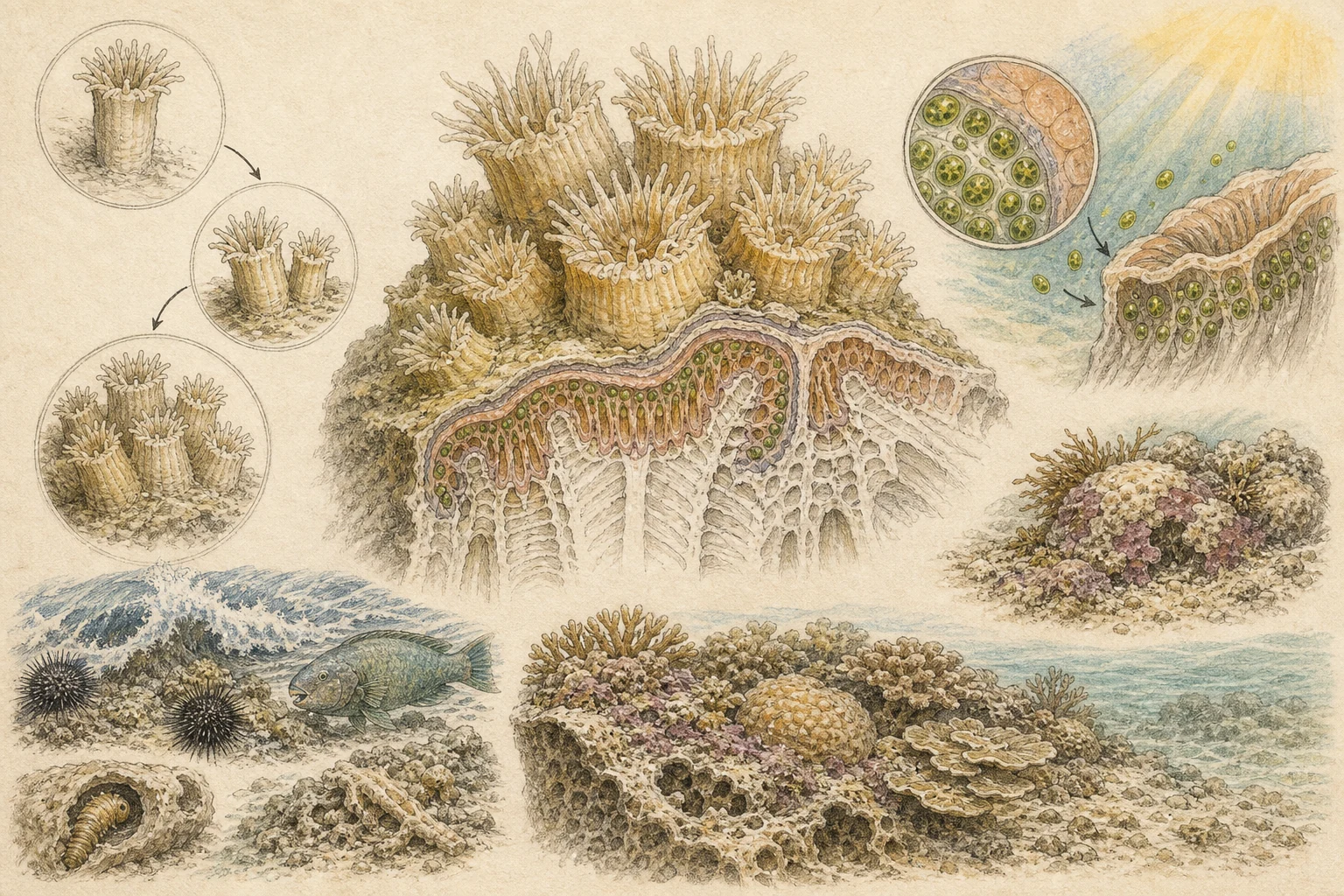
Every stony coral head begins with a single planktonic planula larva that settles onto hard substrate and metamorphoses into a founder polyp—a soft-bodied cnidarian animal armed with a ring of stinging tentacles around a central mouth. By asexual budding, that founder repeatedly divides into thousands of genetically identical polyps linked by a thin sheet of living tissue called the coenosarc, which allows neighbors to share nutrients and signals across the colony surface. Depending on how polyps bud and where they deposit skeleton, colonies grow into staghorn thickets (Acropora), furrowed brain domes, flat tables, or wave-resistant crusts. [1][2][3]
- Each stony coral colony is a sheet of cloned cnidarian polyps connected by living coenosarc tissue
- Individual polyps sit inside cup-like skeletal calices studded with radiating mineral ridges called septa
- Budding geometry and water energy shape colonies into branching, massive, plating, or encrusting forms
Deposit calcium carbonate underneath
Beneath the bottom cell layer of a stony coral—the calicoblastic ectoderm—the colony maintains a microscopic, semi-enclosed fluid space isolated from open seawater. Specialized ion pumps move calcium ions into this calcifying fluid while pumping protons out, raising local pH and carbonate saturation so needle-like crystals of aragonite (a crystalline form of calcium carbonate) precipitate onto an organic matrix scaffold. As the living tissue sheet lays down fresh mineral plates beneath itself, it lifts slowly upward and outward over time, leaving behind a porous limestone architecture that was always snow-white inside long before any bleaching event. [2][3][4]
- Calicoblastic cells pump protons out of a microscopic sub-tissue space to promote aragonite precipitation
- Living coral tissue forms a thin veneer only millimeters thick over decades or centuries of limestone skeleton
- Bleached corals turn white because transparent living tissue has lost its brown algal symbionts, exposing the skeleton below
Fuel growth through partnership
Clear tropical waters are famous for high visibility precisely because they are poor in dissolved nutrients and plankton, yet shallow stony corals calcify rapidly there by hosting dense populations of photosynthetic dinoflagellates (family Symbiodiniaceae) inside their gastrodermal cells. During daylight, these microscopic algae fix carbon and pass sugars, glycerol, and amino acids to the coral host, supplying the metabolic energy needed to pump ions and build aragonite, while polyps extend stinging tentacles—especially at night—to capture passing zooplankton for nitrogen and phosphorus. Prolonged thermal stress breaks this vital partnership down, triggering symbiont loss and coral bleaching. [1][3][4]
- Intracellular Symbiodiniaceae algae supply most of the carbon compounds that power rapid daytime calcification
- Coral polyps expand stinging tentacles at night to capture zooplankton that supply essential nitrogen and phosphorus
- Sustained water temperatures only one to two degrees Celsius above seasonal maxima can trigger bleaching
Balance construction against loss
A geological reef framework emerges only when calcium carbonate deposition by corals and calcifying reef organisms outpaces physical breakage, chemical dissolution, and biological erosion. Pink crustose coralline algae overgrow dead coral rubble and cement loose fragments into wave-resistant ridges, while foraminiferans, mollusks, and Halimeda green algae fill framework cavities with carbonate sand. Operating in the opposite direction, parrotfishes scrape the limestone surface, sponges and bivalves bore internal galleries, storms snap branching colonies, and ocean acidification lowers seawater carbonate ion concentrations—slowing skeletal growth and making porous reef rock more vulnerable to chemical dissolution and storm damage. [1][3][4]
- Pink crustose coralline algae act as living mortar, binding loose coral skeletons into a solid reef crest
- Parrotfish grazing, boring sponges, and storm waves break coral skeletons down into carbonate reef sand
- Ocean acidification reduces carbonate ion availability in seawater, raising the energetic cost of calcification
Reading a reef surface
When snorkeling or peering into a tropical reef flat, start by recording colony growth forms—branching, massive, foliaceous, or encrusting—because those shapes reflect both species identity and wave exposure from the surf zone to the sheltered lagoon. If you encounter a stark white colony, look closely with a mask before assuming it is dead: a bleached coral still carries a translucent film of living polyps over the white aragonite, whereas a dead skeleton is rapidly colonized by fuzzy turf algae. Notice too the pink crusts of coralline algae cementing rubble and the paired tooth scars of grazing parrotfishes. [1][2][3][4]
- Living bleached coral retains a translucent tissue sheen and polyps, whereas dead skeleton quickly grows algal turf
- Wave-battered reef crests favor low, encrusting, or stoutly branched colonies alongside pink coralline algal ridges
- Never stand on, touch, or kick sediment onto coral heads, as abraded tissue invites rapid disease and algal overgrowth
Related guides
Get Fauna and identify it in the field.
Where this guide comes from
Source-checked editorial guide. Last updated . This guide teaches identification and field skills; it is not a substitute for expert verification when it matters.