How jellyfish swim
A jellyfish swims by cycling its flexible bell through contraction and refill. The pulse transfers momentum to water, while bell shape determines whether a narrow jet or broad rowing motion dominates and whether vortices return useful energy.
Last updated
Contract a bell around water
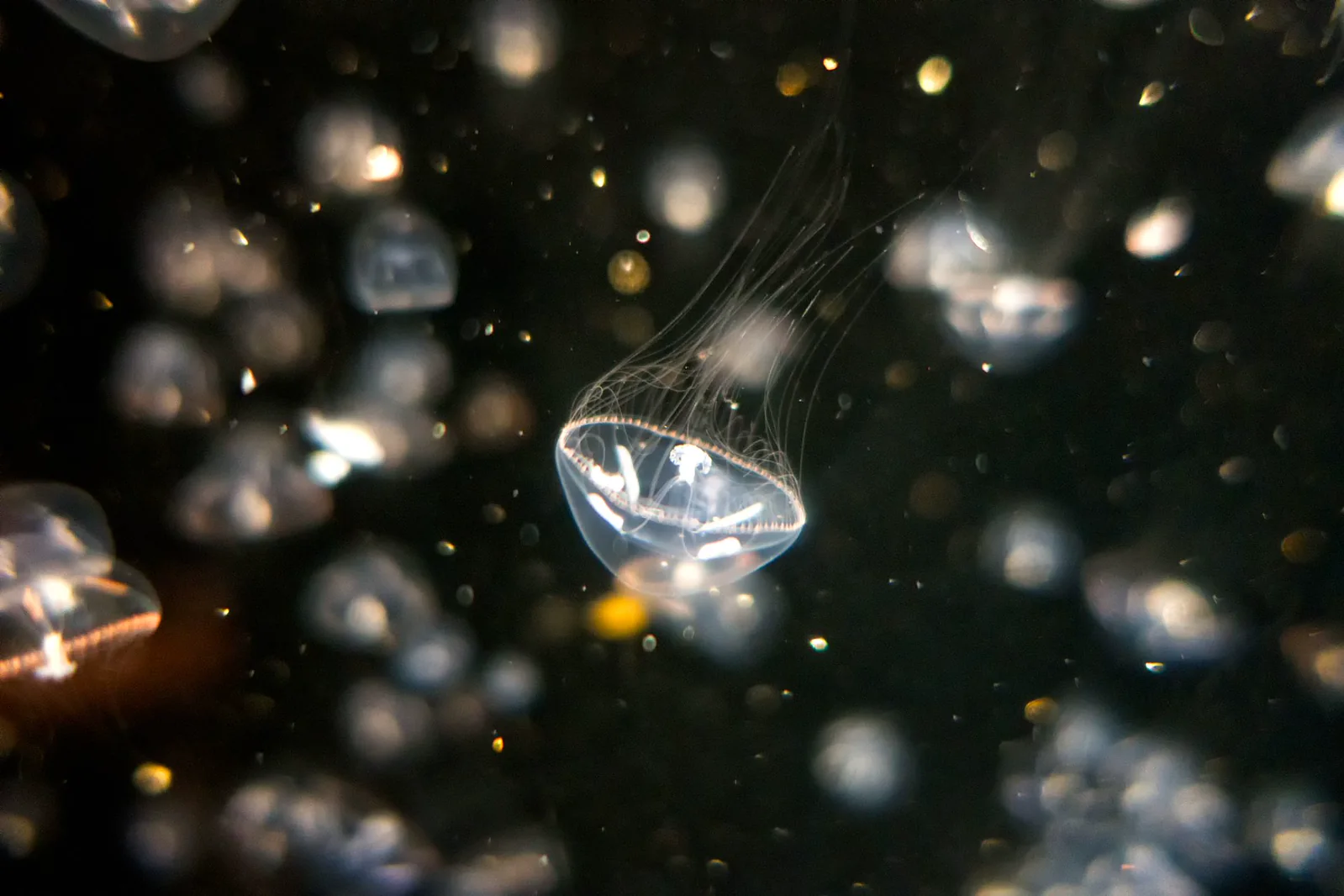
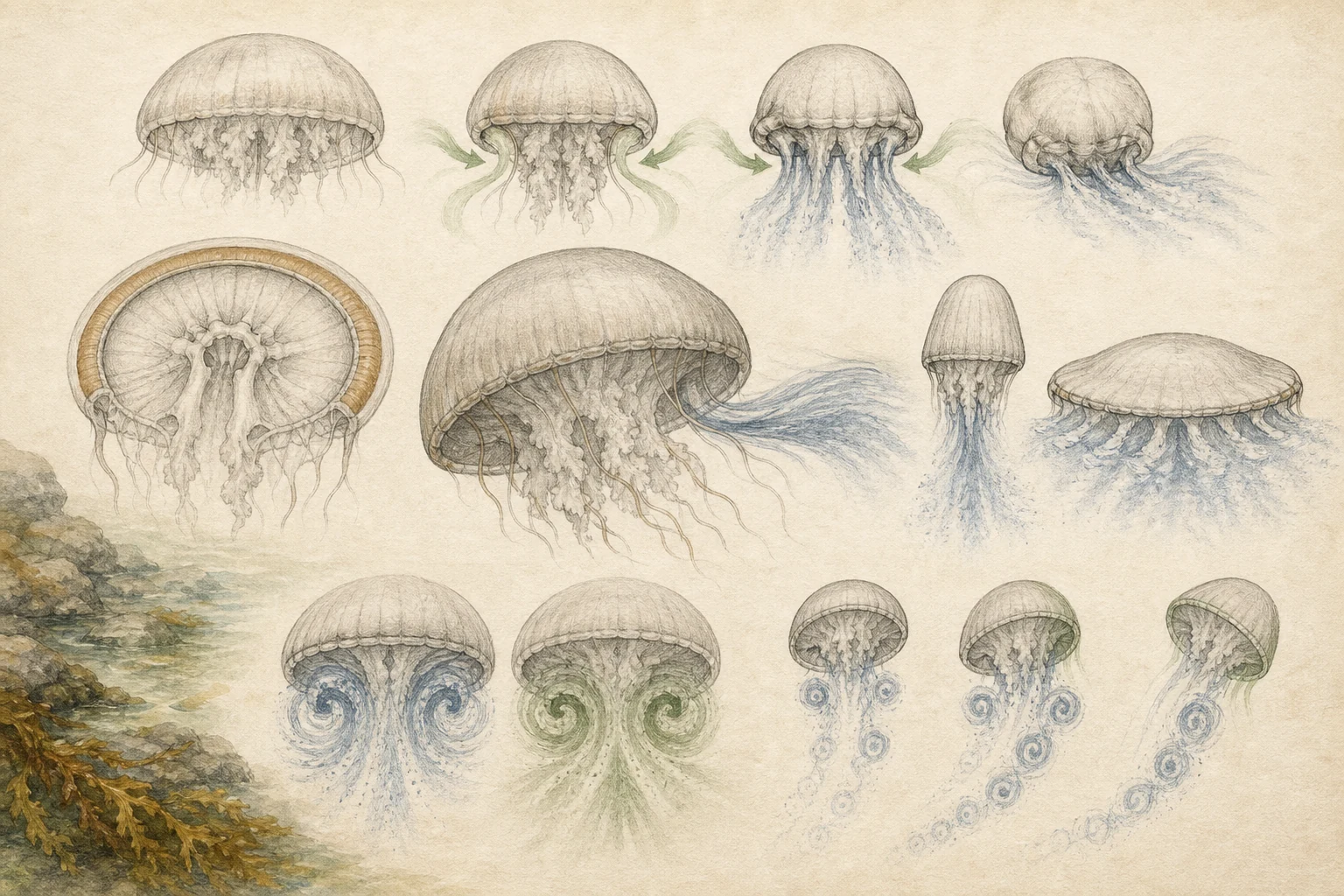
A jellyfish lacks bones, fins, or antagonistic re-extension muscles; its swimming engine is a thin subumbrellar sheet of coronal (circular) striated muscle lining the concave underside of a gelatinous bell. When pacemaker nerve rings fire, that muscle sheet contracts, narrowing the bell opening and squeezing the enclosed water volume backward to propel the medusa ahead. As the muscle fibers relax, elastic collagenous fibers embedded in the thick, fibrous mesoglea wall recoil like a compressed spring, reopening the bell and drawing fresh water inside without requiring a second set of muscles to pull the dome apart. [1][4]
- A single layer of circular subumbrellar muscle contracts to expel water from beneath the dome
- Elastic fibers in the gelatinous mesoglea store strain energy during contraction and reopen the bell passively
- Bell margin flexibility shapes how smoothly water separates at the rim during each swimming pulse
Jet with tall bells, row with broad ones
Medusae do not all push water the same way: bell fineness (height divided by diameter) divides swimmers into jetters and rowers. Small, bullet-shaped hydromedusae such as Sarsia and agile box jellyfishes (Chironex, Tripedalia) contract rapidly and force water through a constricted velum or velarium opening as a high-speed, narrow jet. Because muscle force scales with cross-sectional area while enclosed water mass scales with volume, large scyphozoans such as moon jellies (Aurelia) adopt broad, saucer-like bells whose flexible margins sweep outward and inward like oars, accelerating a wide mass of water slowly at much higher Froude efficiency. [1][4]
- Tall, narrow bells with muscular velar rims expel fast, concentrated jets suited to rapid darting
- Broad, saucer-shaped bells use flexible marginal flaps to row large volumes of water at lower energetic cost
- Developing scyphozoan medusae often shift from jet-like juvenile pulses toward rowing as their bells widen
Recover energy during refill
Flow-visualization studies using laser-illuminated particles around swimming moon jellies (Aurelia aurita) revealed why their cost of transport is lower than that of almost any other metazoan swimmer. During active bell contraction, the curling margin sheds a spinning doughnut of water—the starting vortex ring—behind the animal. As the muscle relaxes and the elastic bell expands to refill, low pressure inside the opening pulls a second, oppositely spinning stopping vortex ring into the subumbrellar cavity, pressing upward against the underside of the dome and giving the jellyfish a second forward boost of thirty percent or more while its muscles rest. [2][3][4]
- Active contraction sheds a starting vortex ring while elastic expansion rolls a stopping vortex beneath the bell
- High pressure between the counter-rotating vortices pushes the jellyfish forward during the passive pause between beats
- Waiting briefly after full bell expansion allows moon jellies to capture this secondary thrust before pulsing again
Steer by making the pulse uneven
Around the notched margin of a scyphozoan bell sit club-shaped sensory structures called rhopalia, which house gravity-sensing statocysts, photoreceptors, and pacemaker neurons that trigger each swimming beat. When a jellyfish swims straight, excitation spreads symmetrically around the margin and sheds a level vortex ring behind the dome. To turn toward light, away from turbulence, or upright after a wave rolls it over, pacemakers fire earlier or radial muscles contract more strongly on one side of the bell, folding that rim inward first and tilting the expelled vortex wake so the bell pivots into the turn. [1][2]
- Marginal rhopalia combine gravity sensors and pacemakers to detect tilt and set the rhythm of bell pulses
- Asymmetric contraction on one side of the bell tilts the vortex ring and turns the medusa toward the contracted side
- Gentle swimming turns and vertical migrations position jellyfish within currents that carry them over kilometer scales
Related guides
Get Fauna and identify it in the field.
Where this guide comes from
Source-checked editorial guide. Last updated . This guide teaches identification and field skills; it is not a substitute for expert verification when it matters.
- Journal of Experimental Biology — Biological Jet Propulsion in Marine Invertebrates ↗
- Communicative & integrative biology — Exploring vortex enhancement and manipulation mechanisms in jellyfish that contributes to energetically efficient propulsion ↗
- Proceedings of the National Academy of Sciences of the United States of America — Passive energy recapture in jellyfish contributes to propulsive advantage over other metazoans ↗
- Scientific reports — Ontogenetic transitions, biomechanical trade-offs and macroevolution of scyphozoan medusae swimming patterns ↗