How electric fish generate signals
Electric fishes organize specialized electrocytes into electric organs. Neural commands make many cells change voltage together, and their summed outputs form either powerful discharges or continuous weak fields rich in sensory information.
Last updated
Transform excitable tissue into an organ
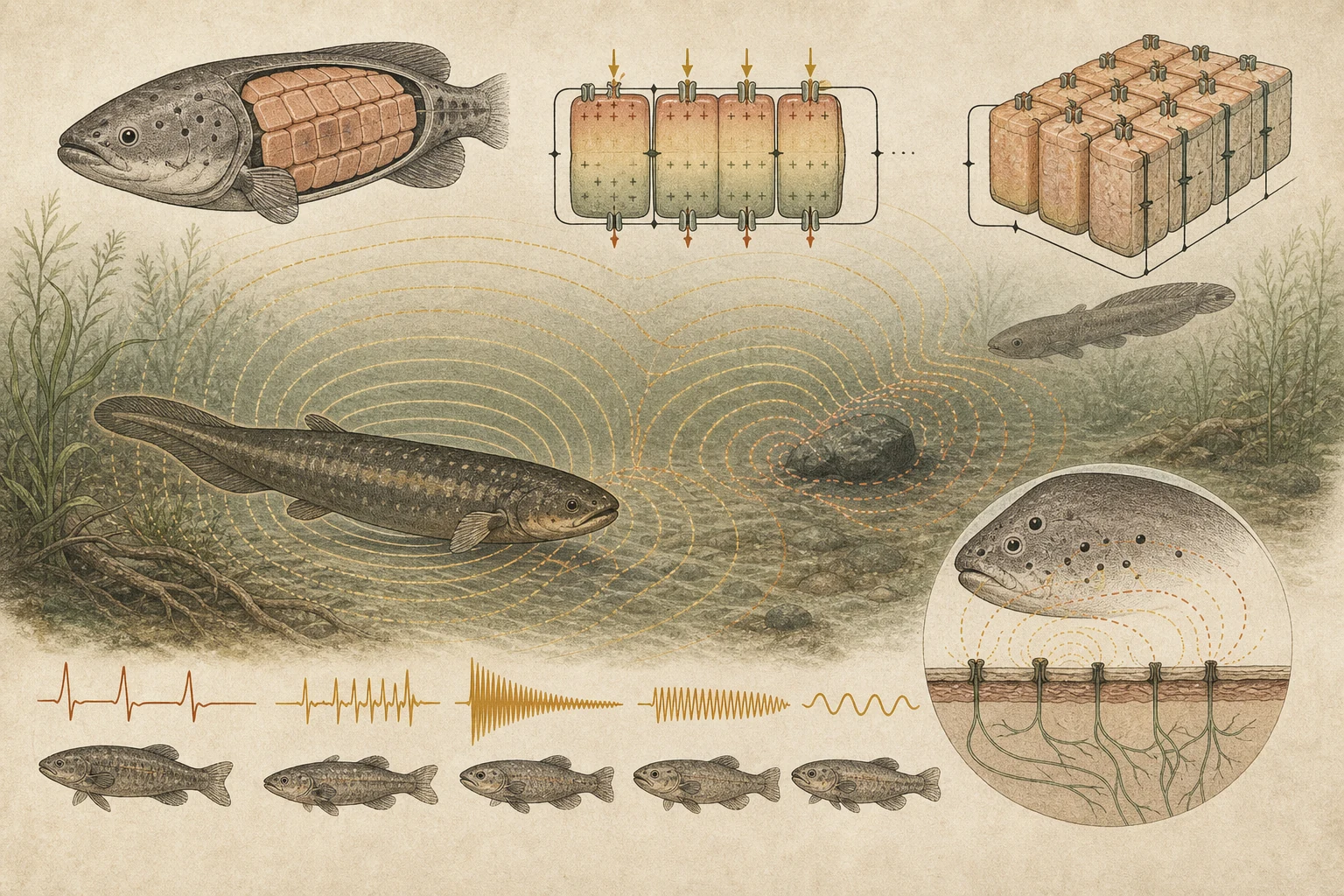
Every contracting muscle fiber in a swimming trout or minnow generates a tiny electrical potential, and several lineages of fishes independently modified skeletal muscle—or in one adult knifefish family, spinal motor axons—into dedicated electric organs. During embryonic and larval development, muscle precursor cells fuse into specialized electrocytes and disassemble their contractile sarcomere machinery while retaining dense membrane arrays of voltage-gated sodium, potassium, and acetylcholine-receptor ion channels. Because Neotropical gymnotiform knifefishes, African mormyrid elephantfishes, electric catfishes, stargazers, and marine electric rays evolved these organs separately, their electrocyte geometries, body positions, and discharge waveforms differ markedly across families. [1][3]
- Most electric organs develop from modified skeletal muscle cells that have lost their contractile filaments
- Adult apteronotid ghost knifefishes uniquely generate their electric organ discharge from modified spinal nerve axons
- Independent evolution across at least six fish lineages produced both weak-field sensors and high-voltage stunners
Add many small cellular voltages
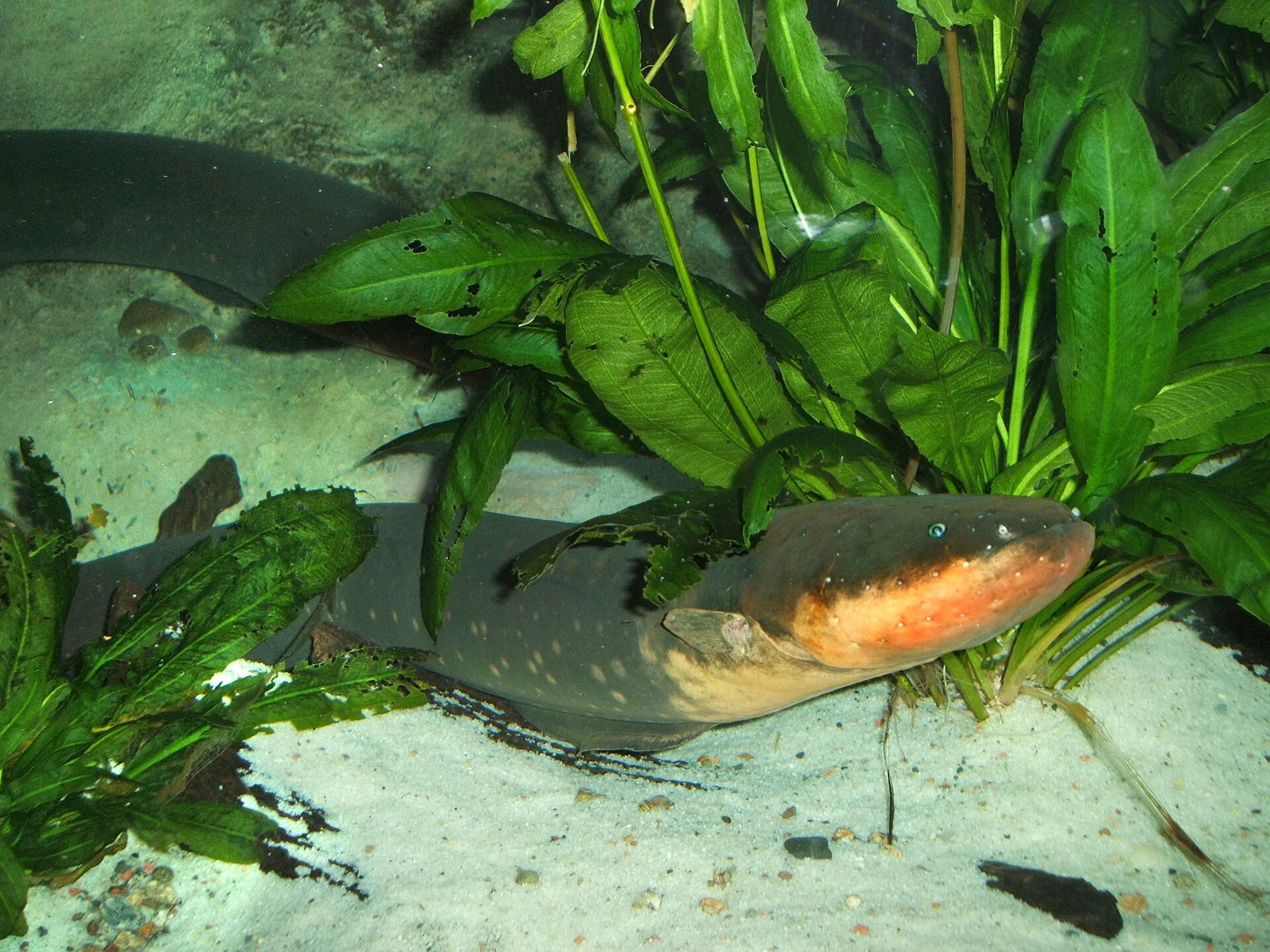
A single resting electrocyte holds a membrane potential of only about a tenth of a volt, so an electric organ builds usable field strength through anatomical geometry and sub-millisecond neural timing. When a pacemaker nucleus in the hindbrain fires, electromotor neurons release acetylcholine onto only one face of each flattened electrocyte, inverting the voltage on that innervated membrane while the opposite face stays negative. Stacking thousands of cells end-to-end in long longitudinal columns sums their voltages in series—reaching hundreds of volts in an electric eel (Electrophorus)—while bundling multiple columns side by side adds current in parallel. [1][4]
- Asymmetric innervation depolarizes one face of an electrocyte first, creating a net transcellular voltage
- Longitudinal series stacks sum voltage, whereas parallel columns increase total electrical current in conductive water
- Hindbrain pacemaker circuits equalize conduction delays so distant electrocytes fire in tight synchrony
Probe nearby space with a weak field
Nocturnal Neotropical knifefishes and African mormyrids emit continuous weak discharges—measured in millivolts to a few volts—and read the resulting dipole field with tuberous and ampullary electroreceptors spread across their skin. Any nearby object whose electrical conductivity or capacitance differs from the surrounding river water warps those field lines: a living insect larva or small fish concentrates current and casts an electrical bright spot onto the skin, whereas a dry stone or submerged root casts an electrical shadow. By ribbon-finning forward and backward past a target, a knifefish scans this electrical image across its head and trunk within a body length of range. [2][4]
- Living prey with salty body fluids conduct current better than freshwater and create localized voltage peaks on the skin
- Rocks and dead wood act as insulators that cast measurable electrical shadows across epidermal receptors
- Weakly electric fishes often swim with stiff bodies propelled by an undulating anal or dorsal fin to keep their field geometry stable
Encode identity and intent in timing
Weakly electric fishes fall into two broad signaling styles: wave species, which emit a nearly sinusoidal hum at a steady species- and sex-specific frequency, and pulse species, which fire brief clicks separated by variable silent intervals. Subtle modulations in frequency, waveform duration, or pulse pauses broadcast sex, individual dominance, courtship readiness, and territorial aggression to neighbors, though low-frequency components can also betray the sender to electroreceptive predators such as catfishes and electric eels. Some gymnotiform knifefishes reduce that risk by shifting adult waveforms toward higher-frequency, multiphasic signals that cloak their discharges from ampullary predator receptors. [1][3][4]
- Wave-type species maintain continuous frequency hums, whereas pulse-type species vary the intervals between brief clicks
- Brief frequency chirps or abrupt discharge pauses function as courtship, threat, or submission signals during encounters
- Electric eels carry both a low-voltage organ for active electrolocation and high-voltage organs for stunning prey
Related guides
Get Fauna and identify it in the field.
Where this guide comes from
Source-checked editorial guide. Last updated . This guide teaches identification and field skills; it is not a substitute for expert verification when it matters.
- EvoDevo — The diversity and evolution of electric organs in Neotropical knifefishes ↗
- Communicative & integrative biology — Active sensing: Pre-receptor mechanisms and behavior in electric fish ↗
- Journal of physiology, Paris — Phantoms in the brain: ambiguous representations of stimulus amplitude and timing in weakly electric fish ↗
- Bioscience — Signal Cloaking by Electric Fish ↗