How octopuses change color
Octopuses do not repaint individual skin cells. Their brains control thousands of pigment-filled chromatophore organs, revealing or hiding color in coordinated patterns that interact with reflective layers and adjustable skin texture.
Last updated
Expand pigment organs with muscle
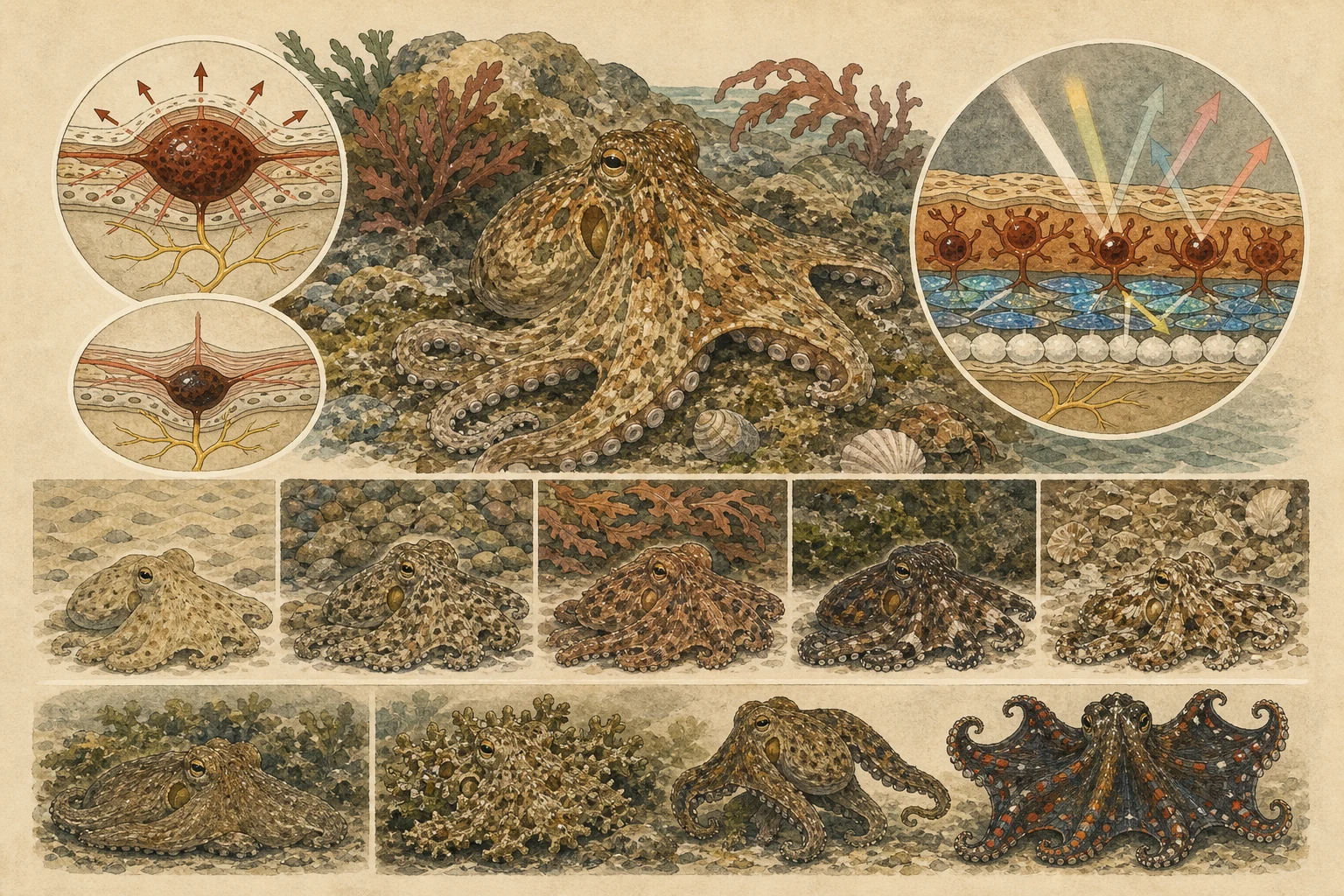
Unlike vertebrate melanophores, which slowly shuttle pigment granules inside a fixed cell boundary, each cephalopod chromatophore is a multicellular neuromuscular organ seated in the outer dermis. At its center lies a cytoelastic sacculus packed with yellow, orange-red, or dark brown-black pigment granules and ringed by fifteen to twenty-five radial muscle fibers directly innervated by motor neurons from the brain's chromatophore lobes. When those radial muscles contract together, they stretch the pigment sac into a flat disk many times its resting diameter; when the nerves fall silent, elastic recoil snaps the sac back to a nearly invisible pinpoint in a fraction of a second. [1][4]
- Each chromatophore organ pairs an elastic pigment sac with a ring of radially arranged muscle fibers
- Direct neural control from the brain expands or retracts pigment disks in tenths of a second
- Yellow, red, and dark brown chromatophores sit in stacked dermal tiers that can be activated in any combination
Layer reflection beneath pigment
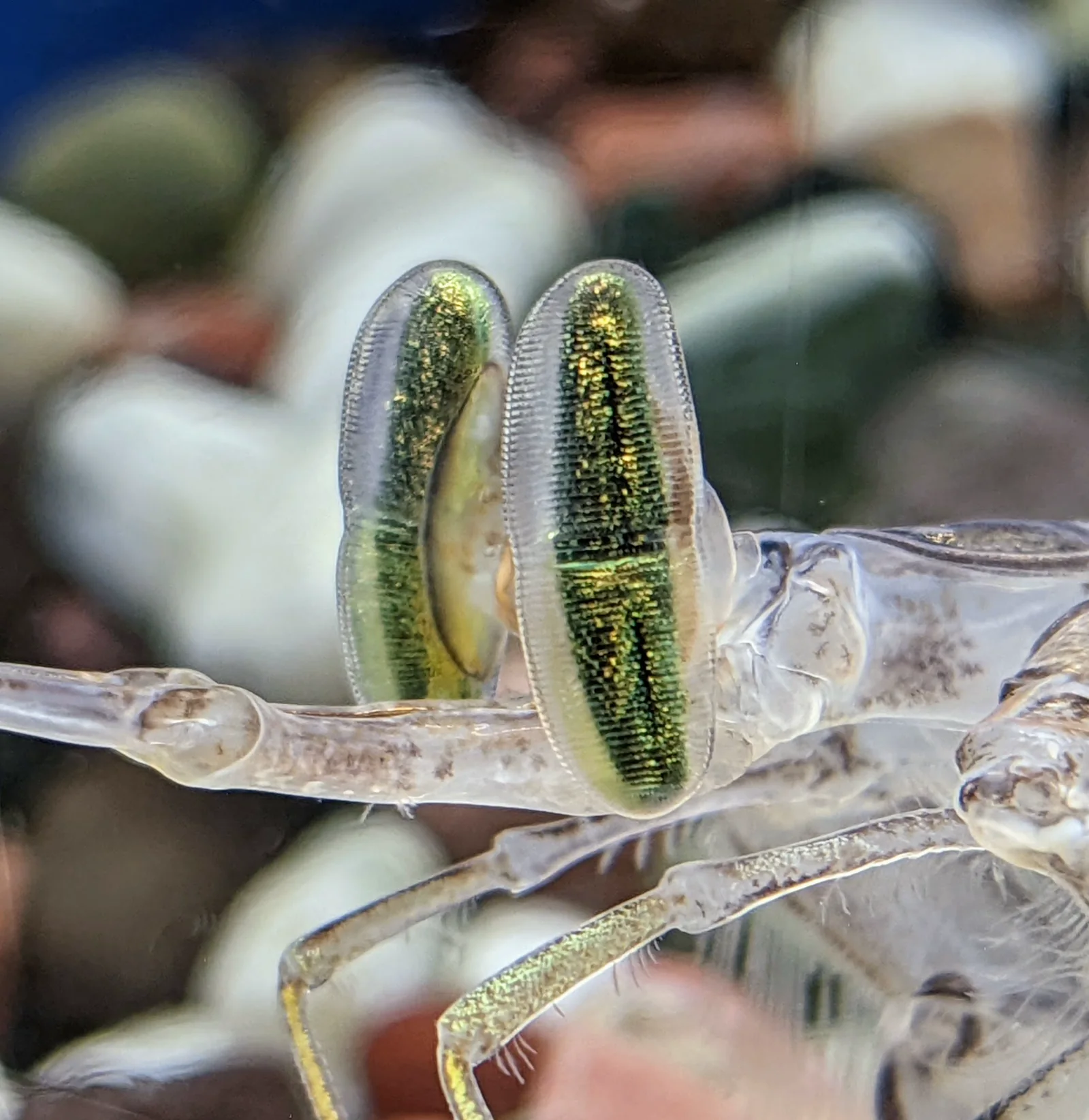
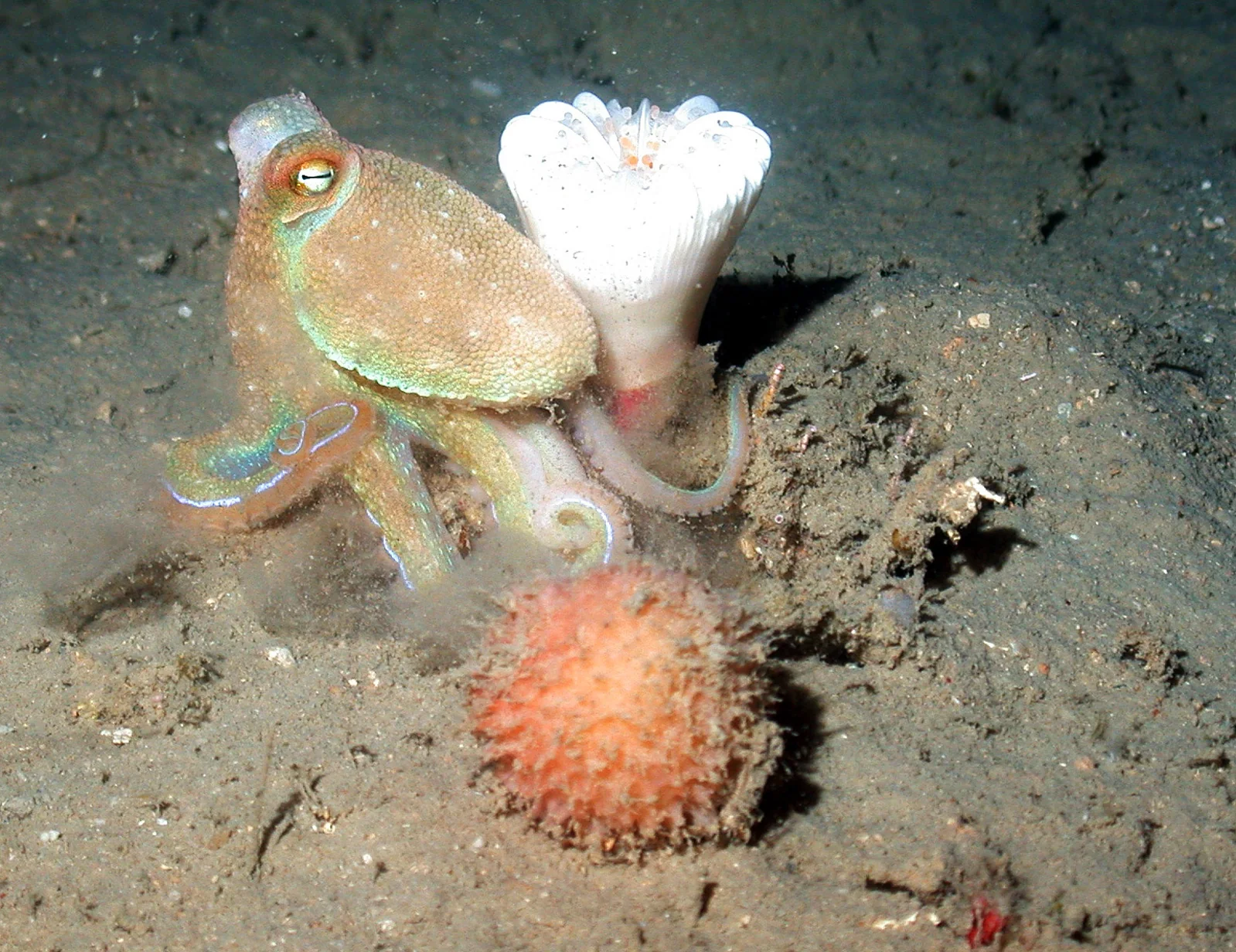
Pigment sacs alone cannot produce the cool blues, metallic greens, and chalky whites seen on a reef octopus or cuttlefish. Directly beneath the chromatophores sit iridophores—cells containing stacks of thin protein plates (reflectins) that generate structural greens, blues, and polarized reflections through thin-film interference—and deeper leucophores that scatter ambient light broadly across all visible wavelengths. Because leucophores reflect whatever spectrum illuminates the water at that depth, they help a camouflaged octopus match the prevailing underwater light field while overlying chromatophores mask, filter, or frame those structural gleams into fine mottles, bars, and contrasting skin bands. [1][2]
- Iridophores beneath the pigment layer use stacked protein plates to reflect iridescent blues, greens, and polarized light
- Broadband leucophores scatter ambient light so pale skin patches match the color cast of surrounding water
- Expanding dark chromatophores over reflective cells can switch a bright structural patch off almost instantly
Choose a pattern, not a photograph
Behavioral experiments with common octopuses (Octopus vulgaris) and cuttlefish show that the animal does not copy every pebble beneath it like a scanner, but instead selects from a modular repertoire of uniform, mottled, and disruptive body patterns. Visual cues in the scene—especially background contrast, spatial scale of light and dark patches, and defined object edges—determine which neural pattern components the brain recruits and how strongly they are expressed. Even though most studied octopuses possess only a single opsin pigment in their retinas, combining leucophore reflectance with contrast-tuned chromatophore arrays produces remarkably convincing matches on rubble, sand, and algal beds. [3][4]
- Cephalopods assemble camouflage from modular uniform, mottle, and disruptive pattern components
- Visual assessment of pebble size, edge sharpness, and brightness contrast guides which skin modules turn on
- Broadband light scattering by leucophores helps monochromatic-vision octopuses match colored backgrounds
Coordinate color with shape and behavior
In a tidepool or across a coral head, an octopus pairs its chromatic pattern with physical 3D skin sculpture controlled by hydrostatic muscular papillae. Within a second, smooth skin can erupt into blunt warts, branched flaps matching crusty coralline algae, or tall conical spikes over the eyes, breaking up the body's true silhouette so predators fail to detect an edge. Conversely, when a hunting or startled octopus abandons crypsis, it can flatten its arms into a pale, dark-rimmed disk, flash bold passing clouds, or raise contrasting eye rings—confirming that the same skin machinery serves both stealth and dramatic visual signaling. [2][4]
- Muscular skin papillae raise bumps, ridges, or branched projections that match seaweed and encrusted rock
- Posture and arm arrangement work alongside skin texture to hide the telltale outline of the mantle and eyes
- Sudden blanching, dark eye rings, or sweeping chromatic waves usually signal alarm, hunting, or courtship
Related guides
Get Fauna and identify it in the field.
Where this guide comes from
Source-checked editorial guide. Last updated . This guide teaches identification and field skills; it is not a substitute for expert verification when it matters.
- Australian Museum — Molluscs (cephalopods) ↗
- Journal of the Royal Society, Interface — Mechanisms and behavioural functions of structural coloration in cephalopods ↗
- PloS one — Camouflaging in a complex environment--octopuses use specific features of their surroundings for background matching ↗
- Philosophical transactions of the Royal Society of London. Series B, Biological sciences — Cephalopod dynamic camouflage: bridging the continuum between background matching and disruptive coloration ↗