How animals detect magnetic fields
Experiments support sensitivity to field direction, inclination, or intensity in multiple taxa; radical-pair chemistry, magnetic particles, and electromagnetic induction are leading mechanism classes, not one confirmed universal sensor.
Last updated
A compass and a map are different tasks
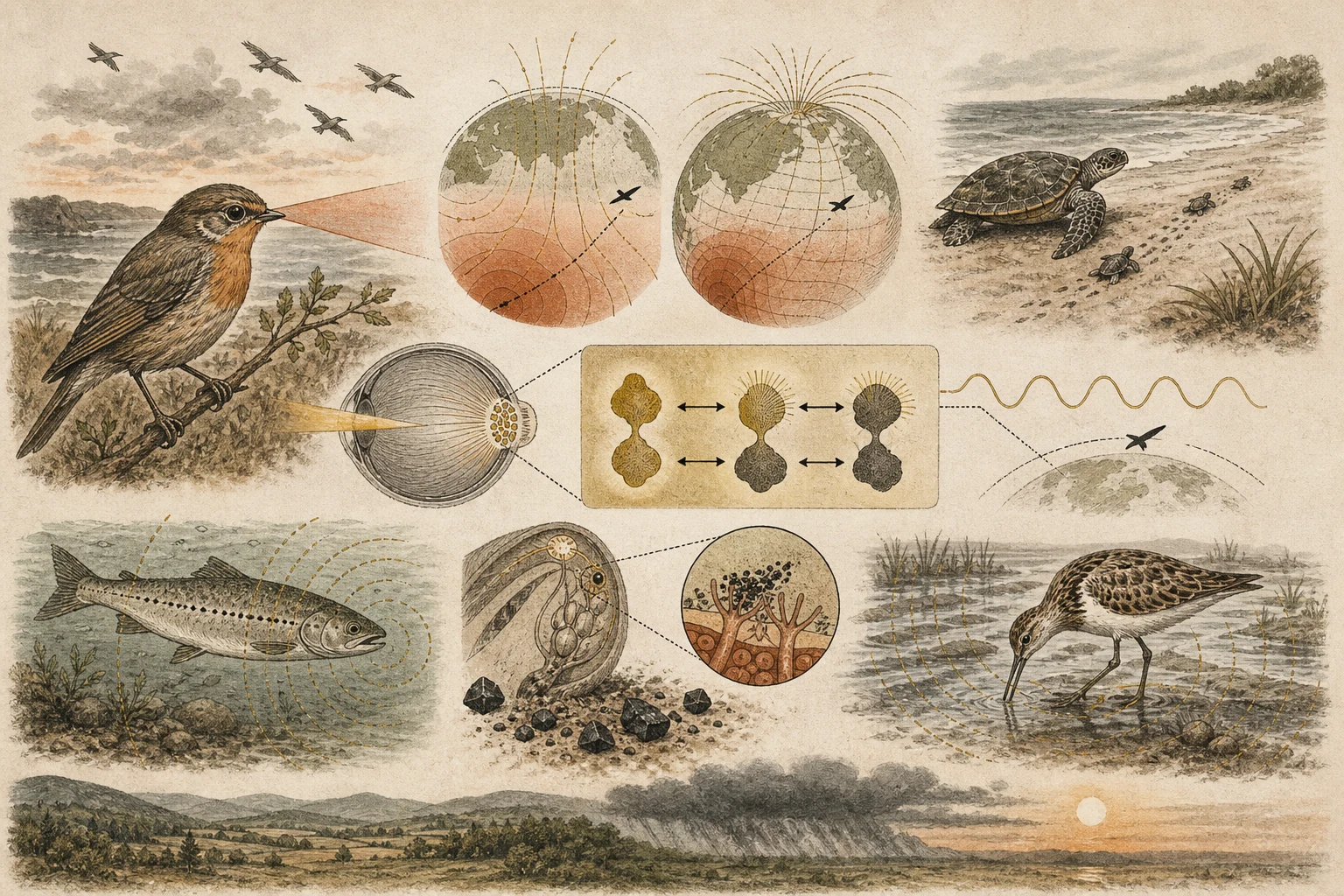
Earth's geomagnetic field offers two distinct kinds of navigational information, and animals use them for different tasks. Field lines exit the southern hemisphere, run parallel to the surface near the magnetic equator, and plunge steeply into the northern hemisphere. A magnetic compass gives directional heading—in migratory songbirds and sea turtles, often an inclination compass that distinguishes poleward (steep field lines) from equatorward (shallow field lines) rather than north-south polarity. A magnetic map, by contrast, reads regional variations in total field intensity and inclination angle to estimate geographic position, helping hatchling loggerhead turtles stay within ocean gyres and displaced salmon or lobsters orient toward home. [4][5]
- Separate compass orientation (maintaining a directional heading) from map navigation (reading intensity and inclination gradients for position).
- Note that many migratory birds use an inclination compass based on the dip angle of magnetic field lines rather than simple polarity.
- Remember that wild navigators integrate magnetic cues with celestial stars, polarized sunset light, wind, odors, and coastlines.
Radical pairs could make chemistry field-sensitive
How can a geomagnetic field of roughly 30 to 60 microteslas—far weaker than a refrigerator magnet—alter a biochemical reaction whose thermal energy is millions of times larger? The leading quantum-chemical hypothesis is the radical-pair mechanism: when blue or UV-A light strikes a flavoprotein photoreceptor such as cryptochrome in the retina, electron transfer creates a short-lived pair of radicals whose correlated electron spins interconvert between singlet and triplet states at rates sensitive to the direction of an external magnetic field. Behavioral tests show that night-migrating songbirds require specific wavelengths of dim light to orient magnetically and become disoriented under weak oscillating radio-frequency fields. [1][3][5]
- Radical-pair magnetoreception proposes that light-activated cryptochrome proteins in the retina form spin-correlated radical pairs sensitive to field angle.
- A radical-pair compass is naturally axial—sensitive to the inclination axis of field lines rather than north-versus-south polarity—and requires ambient light.
- Finding magnetic sensitivity in a purified protein is an important step, but researchers are still mapping the full downstream neural circuit.
Particles and induction offer other routes
Light-dependent chemistry cannot easily explain how animals orient in total darkness inside burrows or the deep sea, or how they detect tiny fractional changes in magnetic intensity for a geographic map. A second major hypothesis proposes that microscopic crystals of biogenic magnetite (or maghemite) coupled to mechanosensitive ion channels exert torque or tension as they align with the external field, though distinguishing true sensory magnetite receptors from non-sensory iron-rich macrophages has proved technically demanding. A third route, electromagnetic induction, applies to sharks, rays, and skates moving through conductive seawater, where swimming across magnetic field lines induces weak voltages potentially detectable by the ampullae of Lorenzini. [2][4][5]
- Magnetite-based models propose that microscopic iron-oxide crystals convert magnetic torque into mechanical gating of nerve channels.
- In elasmobranchs (sharks and rays), swimming through conductive seawater across Earth's field generates small induced electric potentials.
- Some migratory vertebrates may use a light-dependent radical-pair compass for heading and a particle-based system for magnetic map intensity.
The honest answer still includes unknowns
Magnetoreception is famously described in sensory biology as a sense with compelling behavioral evidence but a still-debated primary receptor cell. Because magnetic fields pass freely through biological tissue, an animal needs no external antenna, lenses, or eardrum on its body surface, making anatomical localization extraordinarily difficult; microscopic iron contamination from laboratory tools and urban radio-frequency interference further complicate experiments. When reading or discussing wildlife navigation in the field, state clearly what behavioral experiments have demonstrated—such as inclination compass orientation in warblers or magnetic map responses in sea turtles—while keeping the underlying cellular transducers framed as active, lineage-specific hypotheses. [3][4][5]
- Keep behavioral evidence (coil experiments showing orientation shifts) distinct from unsettled questions about exact receptor cells.
- Avoid claiming a single universal magnetic organ across bacteria, insects, fishes, turtles, birds, and mammals.
- Look for multi-cue integration in the field: overcast skies, sunset glow, and coastal topography change which cue a migrant prioritizes.
Related guides
Get Fauna and identify it in the field.
Where this guide comes from
Source-checked editorial guide. Last updated . This guide teaches identification and field skills; it is not a substitute for expert verification when it matters.
- Proceedings of the National Academy of Sciences of the United States of America — Chemical magnetoreception in birds: the radical pair mechanism ↗
- Journal of the Royal Society, Interface — Magnetic particle-mediated magnetoreception ↗
- Annual review of neuroscience — Identifying Cellular and Molecular Mechanisms for Magnetosensation ↗
- PLoS biology — Magnetoreception-A sense without a receptor ↗
- Nature Reviews Neuroscience — The physics and neurobiology of magnetoreception ↗