How fish breathe with gills
Gills pair a large, delicate exchange surface with controlled flows of water and blood. Closely spaced lamellae shorten diffusion distance, while opposing flows can preserve an oxygen gradient across much of the surface.
Last updated
Keep water moving across the gills
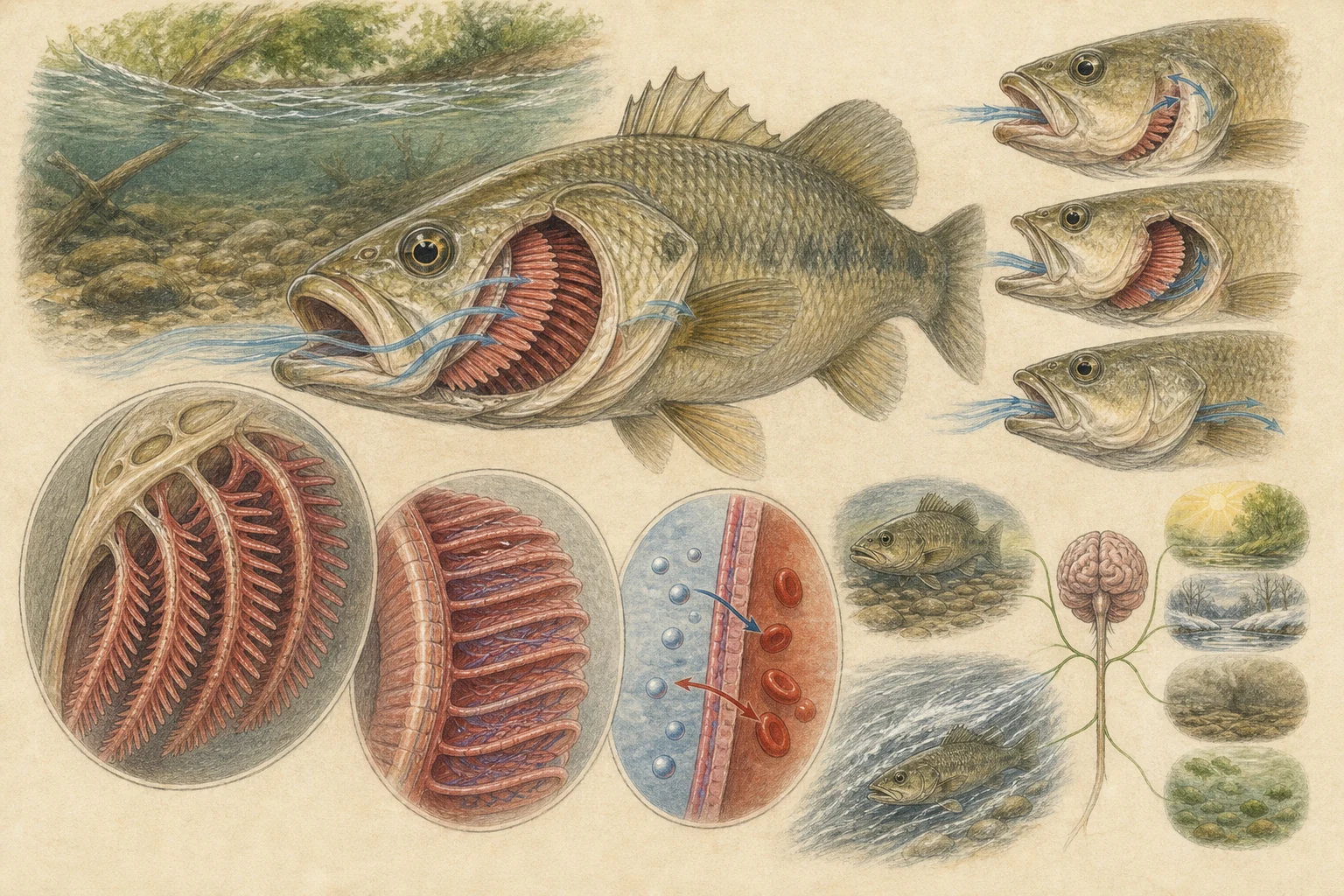
Water holds only a small fraction of the oxygen present in an equal volume of air and is roughly eight hundred times denser, so a fish must drive a nearly one-way stream across its gills rather than sloshing water in and out of a dead-end sac. A resting sunfish, trout, or sculpin runs a two-stage buccal-opercular pump: depressing the mouth floor draws water in through the jaws while the gill covers stay sealed, and compressing the mouth while flaring the opercula pulls that water across the gill curtain and out the rear slits. Fast pelagic swimmers such as tunas and mackerels switch to ram ventilation, holding the mouth slightly open so forward swimming drives the flow. [1][4]
- Rhythmic mouth opening and gill-cover flaring work out of phase as a two-chamber suction-and-pressure pump
- Many active fishes switch from active buccal pumping at rest to open-mouth ram ventilation while cruising
- Bottom-dwelling skates and rays often draw cleaner water in through dorsal spiracles rather than a buried mouth
Spread exchange across thin lamellae
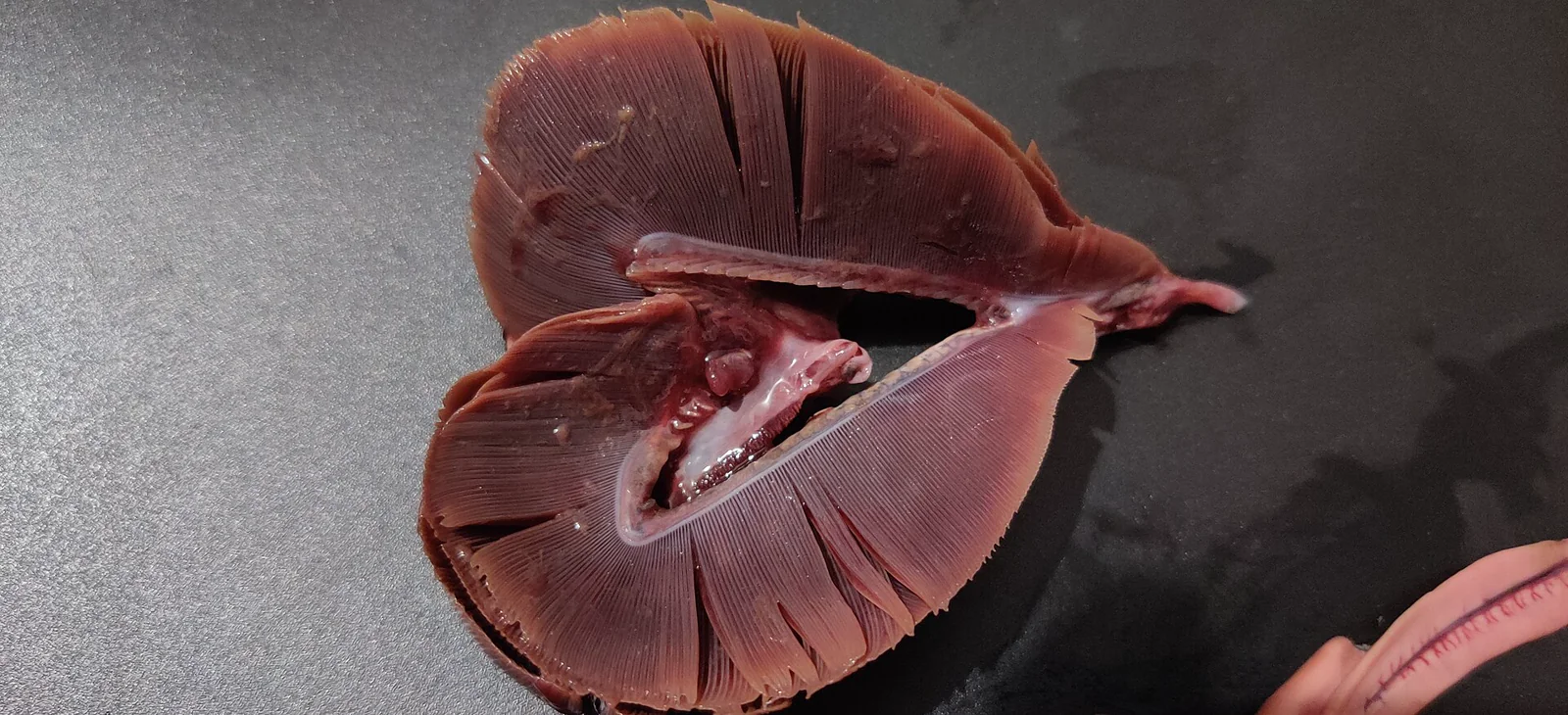
Beneath a bony fish's gill cover sit four pairs of curved gill arches, each supporting a double fringe of primary filaments that look like the teeth of a comb. Along the upper and lower surfaces of every filament stand thousands of microscopic, blood-filled plates called secondary lamellae, whose thin epithelial walls separate capillary blood from passing water by only a few micrometers. Fluid-dynamic modeling across fish species shows that lamellar spacing is tightly constrained: packing plates closer together adds respiratory surface area, but narrowing the interlamellar channels too far chokes water flow with viscous resistance. [2][3]
- Four pairs of gill arches support comb-like filaments covered in microscopic secondary lamellae
- Blood inside secondary lamellae is separated from ventilated water by an epithelium only micrometers thick
- Active pelagic fishes pack more closely spaced lamellae per millimeter of filament than sluggish benthic species
Maintain a diffusion gradient
Gills do not break the chemical bonds of H2O; they extract molecular O2 gas that is already physically dissolved between water molecules. Diffusion proceeds only while the partial pressure of oxygen in the water exceeds that in the blood, and bony fishes maximize this transfer through countercurrent exchange. Blood flows through the capillary sheet of each secondary lamella in the direction opposite to the water streaming between the plates. As blood picks up oxygen along the lamella, it continually encounters fresher incoming water with an even higher oxygen tension, allowing extraction efficiencies far above what concurrent flow could achieve. [2][3][4]
- Fish extract dissolved O2 gas whose partial pressure in water exceeds that of venous blood entering the gill
- Countercurrent flow routes capillary blood opposite to water movement across each secondary lamella
- Opposing flows maintain a positive diffusion gradient along almost the entire length of the exchange surface
Adjust breathing to conditions
Chemoreceptors on the gill arches and in the brainstem continuously monitor dissolved oxygen, carbon dioxide, and pH, adjusting both the frequency and amplitude of buccal-opercular strokes to match metabolic demand. In warm summer shallows—where water holds less dissolved oxygen just as a fish's metabolic rate climbs—observers can see sunfish, carp, or minnows ventilating rapidly or skimming the oxygen-rich surface film. Because the same thin gill epithelium that admits oxygen also leaks water and ions, fishes restrict blood perfusion to only part of their lamellar area at rest and open additional capillary beds during exercise or hypoxia. [1][4]
- Warm or stagnant water lowers dissolved oxygen and visibly increases opercular beat rate and stroke depth
- Resting fish perfuse only a fraction of their gill lamellae to limit costly water and ion fluxes across the skin
- Gills also excrete ammonia and regulate acid-base and salt balance alongside respiratory gas exchange
Related guides
Get Fauna and identify it in the field.
Where this guide comes from
Source-checked editorial guide. Last updated . This guide teaches identification and field skills; it is not a substitute for expert verification when it matters.
- Journal of Experimental Biology — The Control of Breathing in Fishes ↗
- Journal of anatomy — Structure, function and evolution of the gas exchangers: comparative perspectives ↗
- Proceedings of the National Academy of Sciences of the United States of America — Optimal lamellar arrangement in fish gills ↗
- Journal of Experimental Biology — Control of Respiration and Circulation in Fish ↗