How primate grooming builds social bonds
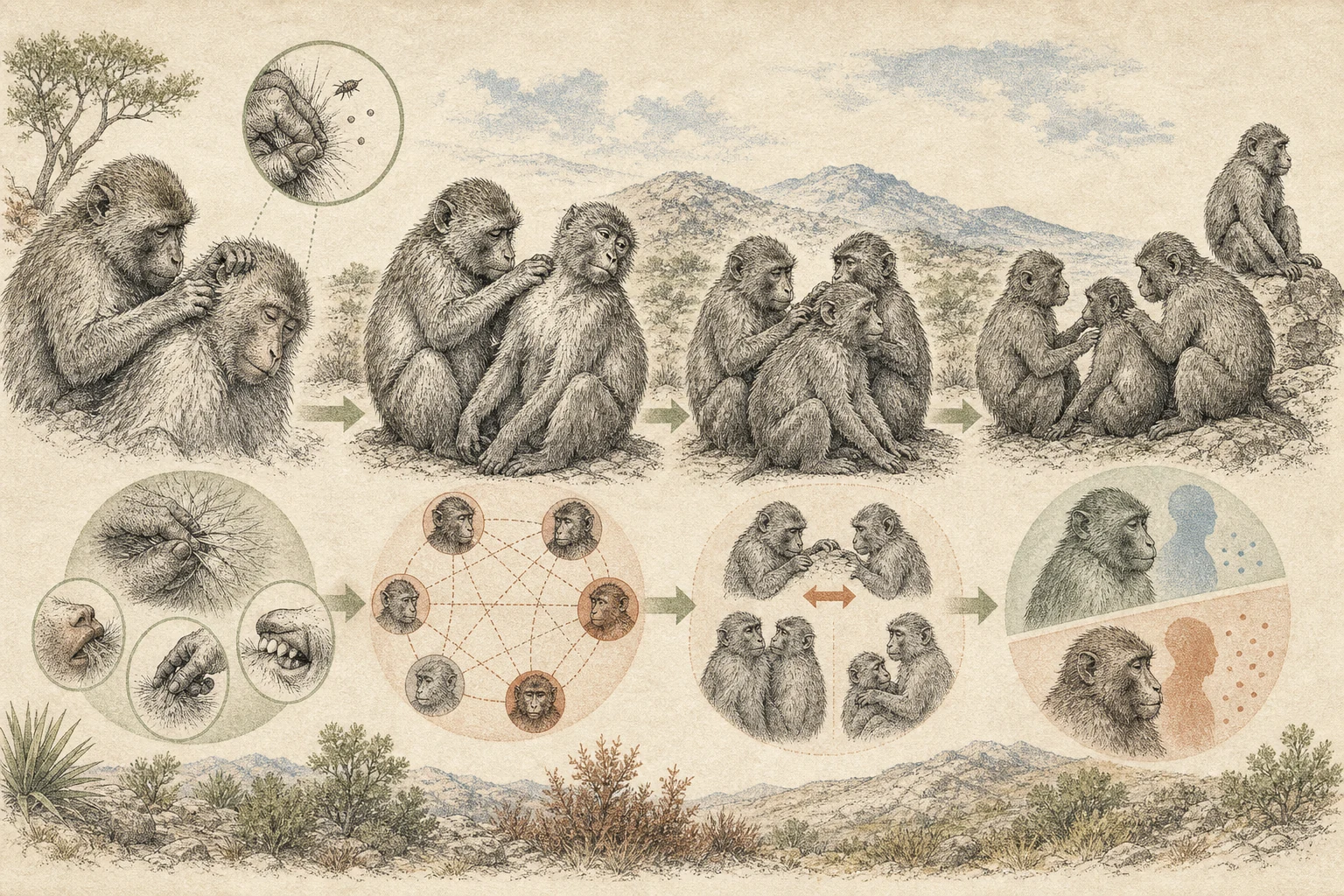
Allogrooming is both body care and social interaction. Who initiates it, who receives it, how long it lasts, and what happens before and afterward create a record of affiliation that can stabilize preferred partnerships, although the balance need not be immediate or symmetrical.
Last updated
Grooming works on fur and relationships
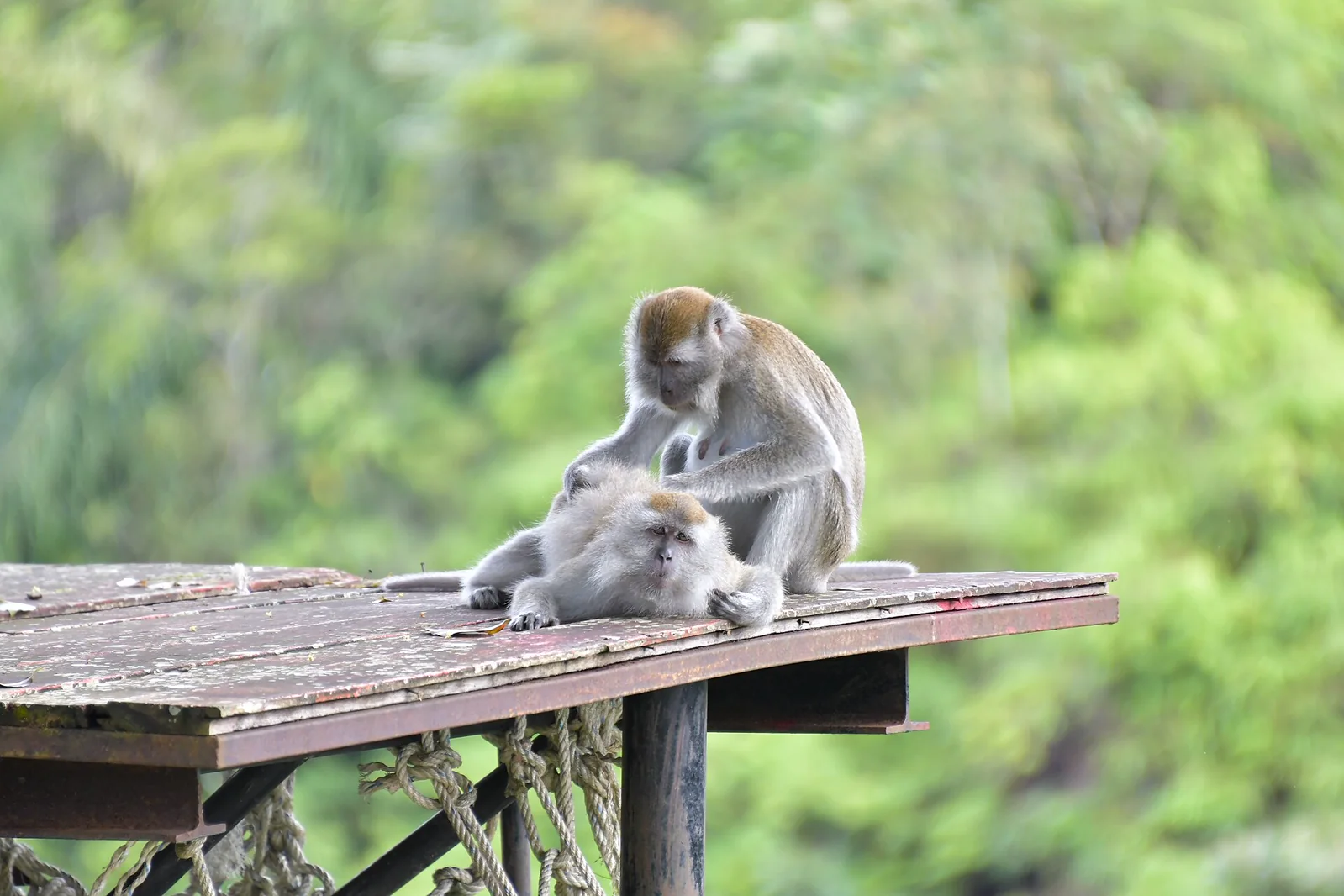
Watch two macaques, baboons, or chimpanzees sitting together in shade and you will see nimble fingers, opposable thumbs, lips, or toothcombs systematically parting hair across the neck, shoulders, and back—areas an individual cannot easily inspect or clean on its own. That careful picking removes ticks, lice, dried skin flakes, burrs, and plant sap, serving an immediate hygienic need. Yet primates routinely continue allogrooming long after the coat is clean, spending up to a fifth of their waking day in quiet tactile contact. Slow, rhythmic stroking of the skin activates specialized C-tactile afferent nerve fibers and central neurochemical pathways that promote calm tolerance between sitting partners. [3][5]
- Allogrooming concentrates on the head, neck, shoulders, and back—body regions a primate cannot easily reach by self-grooming.
- Gentle, rhythmic parting and stroking of fur stimulates specialized social-touch nerve fibers in addition to removing ectoparasites.
- Soliciting postures such as presenting the flank, lowering the head, or lip-smacking signal readiness for close peaceful contact.
A bond is a pattern, not one bout
Primatologists do not judge a social bond from a single brief grooming session after a squabble. Instead, they track dyadic interaction histories across months and years, combining grooming duration and symmetry with how often two individuals sit within arm's reach, feed side by side without displacement, reconcile after aggression, or back each other in coalition disputes. Within the same troop, a brief, tense grooming bout directed up the hierarchy toward a dominant rival looks and functions very differently from relaxed, alternating bouts between maternal sisters or long-term male allies. Only repeated partner choice across changing seasons reveals enduring social affiliation. [2][3]
- Researchers measure bond strength by combining grooming rates, spatial proximity, feeding tolerance, and coalition support over time.
- Enduring partners tend to alternate roles as groomer and groomee more equitably than casual or strictly rank-driven pairs.
- Short grooming bouts also serve immediate tactical functions, such as reconciling after a fight or calming a nearby dominant.
Exchange happens across time and currencies
A comparative meta-analysis spanning 48 social groups across 22 female primate species confirmed that females preferentially groom groupmates who groom them most often, even after statistically controlling for maternal kinship. At the same time, grooming operates within a broader biological marketplace where time invested in combing another's coat can trade against other social currencies: tolerating a subordinate beside a rich fruiting branch, allowing safe handling of a newborn infant, sharing meat, or joining a defensive coalition. Rather than settling accounts minute for minute within a single afternoon, established partners balance these exchanges across weeks or months. [1][5]
- Across 22 primate species, females direct the most grooming toward partners who reciprocate over time, independent of kinship.
- Subordinate individuals often groom higher-ranking troop members in contexts linked to feeding tolerance or coalition support.
- Mothers with young infants frequently attract grooming from groupmates seeking close access to inspect or touch the baby.
The stress story needs context
Popular accounts often portray primate grooming as a simple, automatic tranquilizer for the recipient, but field endocrinology tells a more nuanced story. In free-ranging female Barbary macaques (Macaca sylvanus), fecal glucocorticoid metabolite levels—a measure of physiological stress—were lower in individuals that gave more grooming rather than those that merely received it, highlighting how active social investment buffers daily tension. Conversely, longitudinal hormone tracking in wild female baboons found that heightened allogrooming was followed by elevated glucocorticoids when grooming occurred during social instability, rank competition, or demanding ecological periods, showing that social maintenance carries energetic and emotional costs as well as rewards. [2][4]
- In wild Barbary macaques, giving grooming correlated more strongly with lower fecal glucocorticoid stress hormones than receiving it.
- In wild female baboons, intense grooming bouts during tense social periods were followed by higher physiological stress markers.
- Hormonal outcomes depend on whether an animal is resting with a trusted ally or negotiating rank and conflict.
Related guides
Get Fauna and identify it in the field.
Where this guide comes from
Source-checked editorial guide. Last updated . This guide teaches identification and field skills; it is not a substitute for expert verification when it matters.
- Biology letters — Grooming reciprocation among female primates: a meta-analysis ↗
- Biology letters — Grooming in Barbary macaques: better to give than to receive? ↗
- Neuroscience — Social and affective touch in primates ↗
- Biology letters — More allogrooming is followed by higher physiological stress in wild female baboons ↗
- Smithsonian Q?rius — Primate social behavior ↗