How dolphins sleep with half their brain
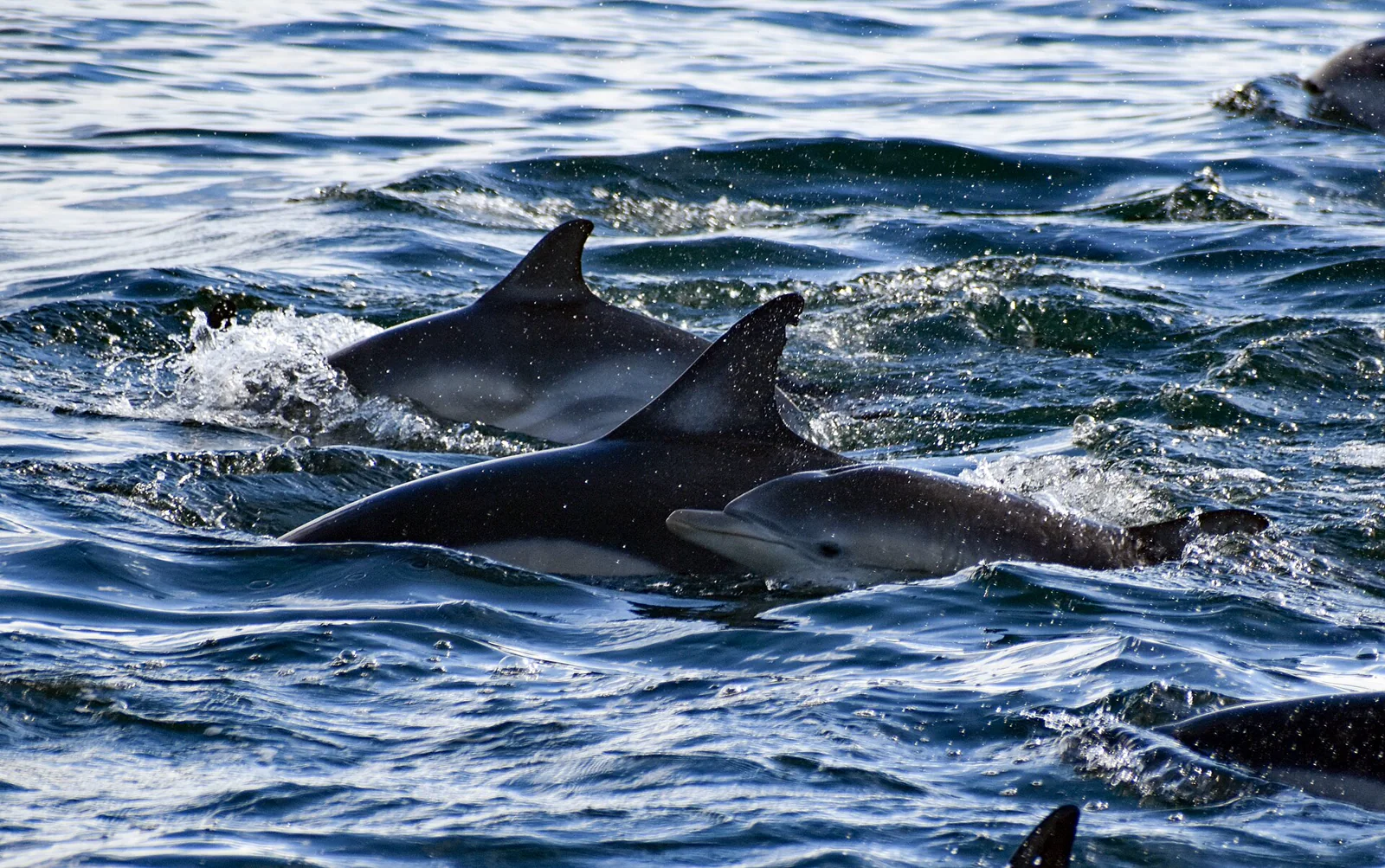
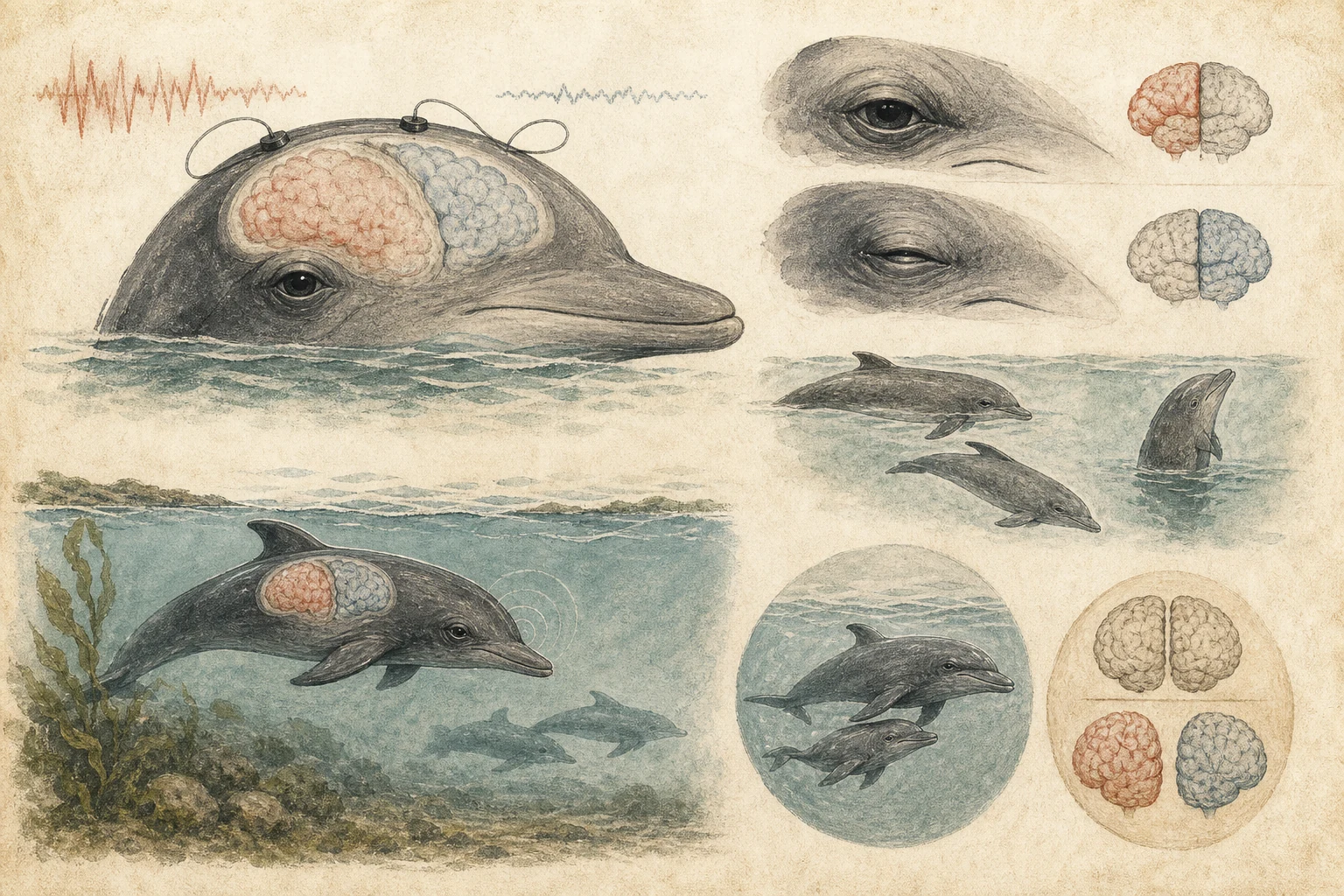
During unihemispheric sleep, strong slow waves occupy one cerebral hemisphere while the other remains in a more wake-like state. The sides alternate over time; this is neither total wakefulness nor a neat division in which exactly half of every brain system switches off.
Last updated
EEG, not stillness, reveals the sleeping side
Watch a pod of common bottlenose dolphins (Tursiops truncatus) cruising slowly across a calm bay or floating like logs at the surface, and outward behavior alone will not tell you which half of the brain is asleep. Neurobiologists first documented cetacean unihemispheric slow-wave sleep (USWS) through electroencephalography (EEG) recordings in bottlenose dolphins, harbor porpoises, Amazon river dolphins, and belugas. During a USWS bout, one cerebral hemisphere generates high-amplitude, low-frequency delta waves typical of deep non-REM sleep while the opposite hemisphere displays low-voltage, fast desynchronized activity characteristic of wakefulness; after roughly one to two hours, the two hemispheres trade roles. [1][2]
- Electroencephalograms show high-amplitude delta slow waves in one cerebral hemisphere while the other hemisphere remains wake-like.
- Sleeping dolphins may float quietly at the surface (logging), rest on the bottom in shallows, or swim slowly in tight circles.
- Left and right cerebral hemispheres alternate slow-wave sleep bouts across the 24-hour cycle so both sides recover.
One open eye is a clue, not a sleep meter
Because the optic nerve fibers of cetaceans cross almost completely at the optic chiasm, the eye opposite (contralateral to) the waking cerebral hemisphere usually stays open during unihemispheric sleep, while the eye opposite the sleeping hemisphere closes. In slow-swimming groups, dolphins often position that open eye toward pod mates—and mothers and calves turn their open eyes toward each other—so they can maintain formation without colliding. However, simultaneous video and EEG monitoring in white whales (Delphinapterus leucas) and bottlenose dolphins shows brief periods where both eyes close or open independently of cortical slow waves, meaning eyelid state is a strong behavioral correlate rather than an infallible gauge. [1][3]
- Complete optic nerve crossing means the open eye usually feeds visual input to the contralateral waking hemisphere.
- Swimming dolphins frequently orient their open eye toward pod companions or a mother-calf partner to hold group spacing.
- Simultaneous EEG and video studies in belugas and dolphins show occasional mismatches between eyelid closure and cortical sleep state.
Breathing and vigilance continue during sleep
Unlike terrestrial mammals whose brainstem reflexes keep lungs ventilating automatically during unconscious bilateral sleep, cetaceans are conscious breathers that must actively swim to the air-water interface, judge surface chop, and open the muscular blowhole only above water. Unihemispheric slow-wave sleep preserves subcortical motor coordination and unilateral cortical processing so a resting dolphin can execute smooth, rhythmic surfacing breaths, generate body heat through slow fluke strokes in cold water, and scan for sharks, killer whales, or obstacles. In controlled acoustic trials, bottlenose dolphins maintained continuous echolocation target detection for up to 15 days without measurable cognitive decline by sleeping one hemisphere at a time. [1][4][5]
- Voluntary blowhole control requires coordinated surfacing movements that bilateral unconsciousness would disrupt in open water.
- Slow, continuous swimming during unihemispheric sleep helps maintain muscle thermogenesis and pod cohesion.
- Trained bottlenose dolphins sustained accurate echolocation monitoring for 15 consecutive days by alternating hemispheric sleep.
Cetacean sleep still resists familiar categories
Every terrestrial mammal studied exhibits both bilateral slow-wave sleep and rapid-eye-movement (REM) sleep accompanied by generalized muscle atonia, yet electrophysiological recordings in cetaceans show virtually no bilateral slow-wave sleep and no clear EEG signature of REM sleep—likely because full-body paralysis and loss of thermoregulation underwater would risk drowning or chilling. Even more striking, newborn bottlenose dolphin and killer whale calves swim nonstop alongside their mothers for the first month of life, fitting brief, fragmented bouts of unihemispheric sleep into constant motion with both eyes frequently open. Because invasive EEG studies are limited to a handful of smaller odontocetes in managed care, how giant baleen whales partition sleep at sea remains an open frontier. [1][2][5]
- Studied cetaceans show little or no classic REM sleep, avoiding the full-body muscle paralysis that accompanies REM in land mammals.
- Newborn dolphin calves and their mothers swim continuously for weeks after birth, snatching sleep while in constant motion.
- Direct electrophysiological sleep records come from a few toothed whale species, leaving free-ranging baleen whale sleep largely inferred from dive tags.
Related guides
Get Fauna and identify it in the field.
Where this guide comes from
Source-checked editorial guide. Last updated . This guide teaches identification and field skills; it is not a substitute for expert verification when it matters.
- Nature and science of sleep — Unihemispheric sleep and asymmetrical sleep: behavioral, neurophysiological, and functional perspectives ↗
- Handbook of behavioral neuroscience — Sleep in Aquatic Mammals ↗
- Behavioural brain research — Unihemispheric slow wave sleep and the state of the eyes in a white whale ↗
- PloS one — Dolphins can maintain vigilant behavior through echolocation for 15 days without interruption or cognitive impairment ↗
- Whale and Dolphin Conservation — How do whales and dolphins sleep? ↗