Why animals play
Look for actions that are modified from their ordinary function, repeated but not rigid, initiated in relatively relaxed conditions, and balanced by signals or self-handicapping; compare sequences before labeling them play.
Last updated
Play borrows actions and changes their rules
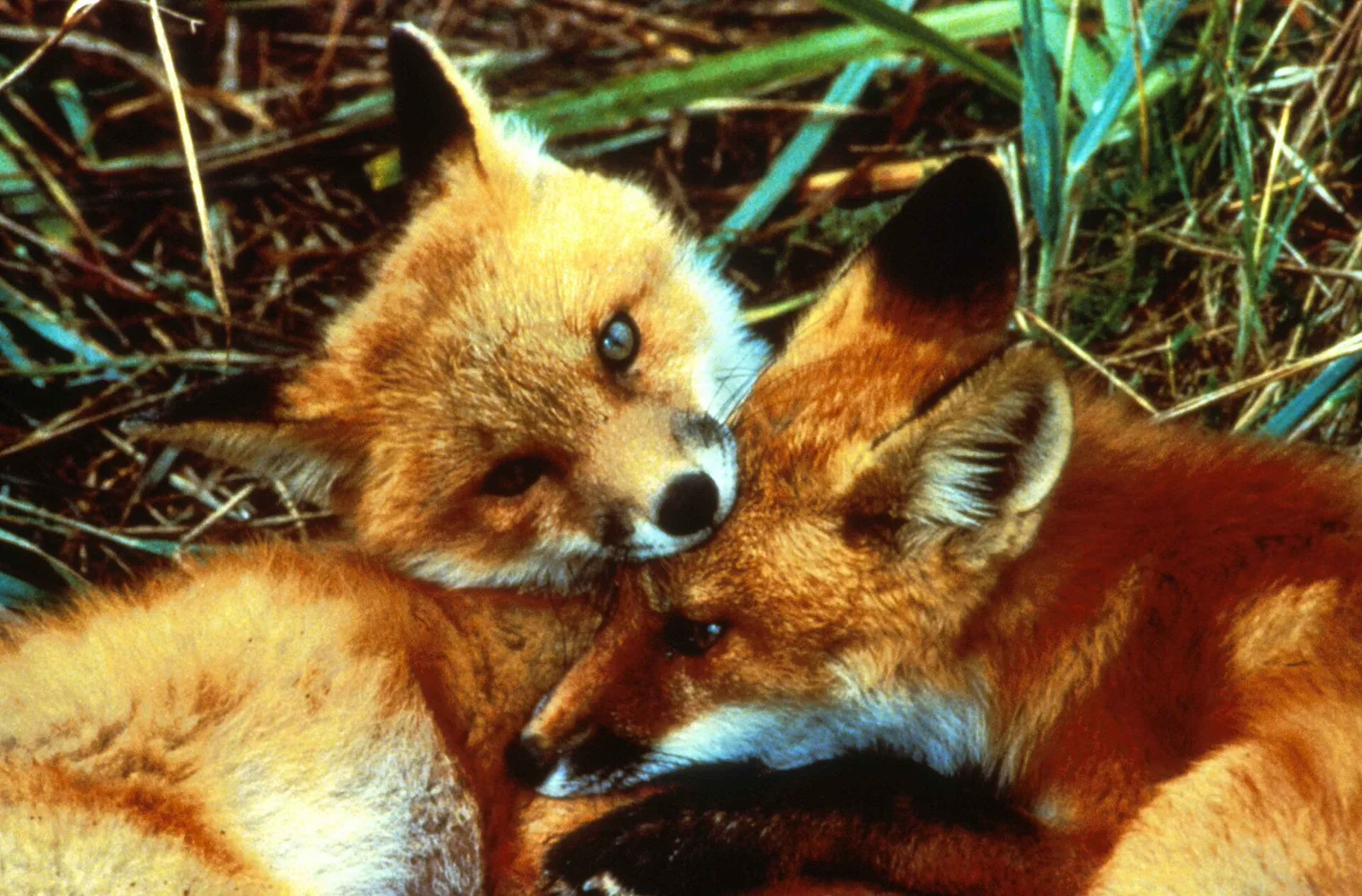
Watching two red fox kits pounce and wrestle outside a spring den, a raven slide repeatedly down a snowbank, or an otter juggle a smooth river pebble, you see motor patterns borrowed from predation, combat, antipredator escape, or courtship—yet rearranged so they do not achieve their serious survival endpoint. Ethologists identify play not by a single posture, but by five working criteria: the behavior is incompletely functional in the immediate context; it is spontaneous or voluntary; its form or sequence is exaggerated, reordered, or truncated; it is repeated flexibly rather than locked into a rigid stereotypy; and it occurs when the animal is free from acute hunger, thermal stress, or predator threat. [1][2]
- Distinguish locomotor-rotational play (leaps, spins, slides), object play (manipulating sticks or stones), and social play (wrestling and chasing).
- Look for reordered, exaggerated, or truncated action sequences that stop short of real injury, prey consumption, or escape.
- Separate flexible, varied play bouts from rigid, repetitive pacing or head-tossing stereotypies caused by stress or confinement.
Partners negotiate a safe version
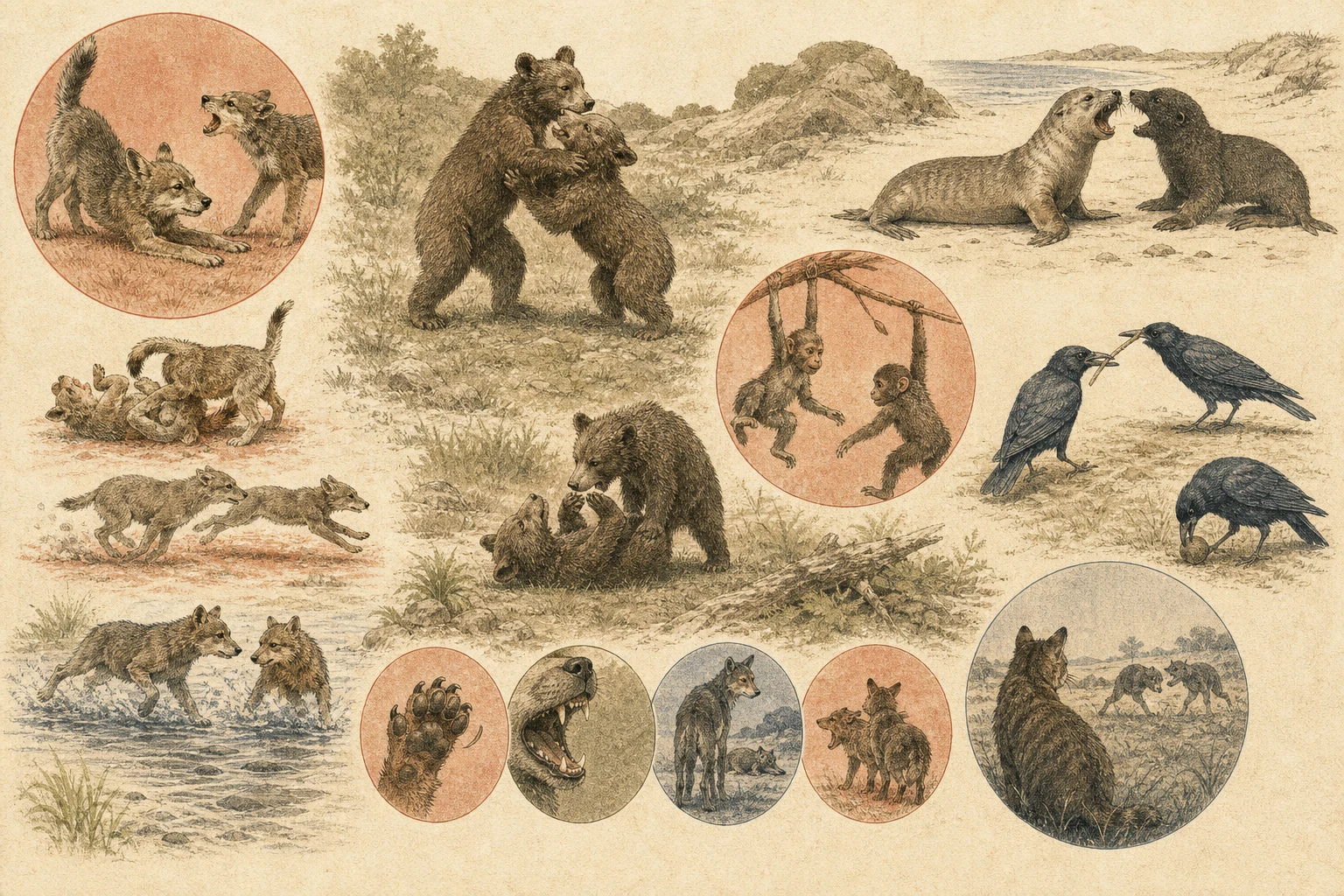
Because social play recruits fighting and predatory motor patterns—neck bites, tackles, ambushes, and chases—partners must continuously signal that the interaction remains non-serious. Canids drop into front-leg play bows, primates and bears display relaxed open-mouth play faces, and felids retract claws, inhibit bite pressure, and alternate between chaser and chased. Crucially, stable social play relies on role reversals and self-handicapping, in which a larger or dominant partner rolls onto its back or restrains its force so the subordinate stays engaged. In domestic and wild cats alike, quiet mutual wrestling with role switches and relaxed pauses differs sharply from tense, vocal, one-sided chasing where one animal repeatedly tries to flee. [1][3]
- Watch for role reversals and self-handicapping—such as a larger sibling rolling supine or letting a smaller partner pin it.
- Look for species-specific play signals like canid play bows, relaxed open-mouth faces, and bouncy, exaggerated approach gaits.
- If one animal flattens its ears, vocalizes in distress, hides, or repeatedly tries to escape without re-initiating, score agonistic conflict rather than play.
Practice is plausible but not the only hypothesis
Why expend energy and risk sprains or predator distraction on actions with no immediate payoff? Evolutionary models of play emphasize that practice can calibrate neuromuscular coordination, refine predatory or evasive maneuvers, test social relationships, and train the nervous system to cope with unexpected physical or social loss of control. Yet different categories of play can serve distinct functions within the same animal, and benefits may be immediate in juvenile life rather than delayed solely until adulthood. Because play peaks when food is abundant and safe cover is nearby, researchers test specific predictions linking play types to motor skill, social competence, or behavioural flexibility rather than assuming one cure-all story. [2][4]
- Avoid assuming object play, solitary acrobatics, and social wrestling all evolved for the exact same developmental purpose.
- Recognize the training-for-the-unexpected hypothesis, in which deliberately losing balance or position builds recovery skills.
- Note how local food supply and predator pressure shape play rates: hungry or heavily threatened animals quickly curtail play.
Describe first and infer feeling cautiously
To human eyes, tumbling fox kits or leaping dolphins immediately suggest joy, and animal-welfare research often uses play as an indicator that basic nutritional, thermal, and safety needs are met. Even so, careful psychobiological reviews caution that social play does not always reflect a purely positive emotional state—play can occasionally mask social tension, transition into real dominance contests, or serve as a coping response after mild stress. When documenting suspected play in the field, record the concrete behavioral sequence first: participant ages, who initiated, specific motor acts, bite or strike restraint, pause intervals, role switches, and whether both partners voluntarily re-engaged after breaks. [3][4]
- Record concrete sequence details—initiations, pauses, role switches, and voluntary re-engagement—before applying the label play.
- Remember that a bout that starts as mutual play can escalate into real aggression if one partner bites too hard or refuses to yield.
- Keep observable behavioral criteria separate from assumptions about human-like emotions in your field journal.
Related guides
Get Fauna and identify it in the field.
Where this guide comes from
Source-checked editorial guide. Last updated . This guide teaches identification and field skills; it is not a substitute for expert verification when it matters.
- Frontiers in veterinary science — Are These Cats Playing? A Closer Look at Social Play in Cats and Proposal for a Psychobiological Approach and Standard Terminology ↗
- Ecology and evolution — The practicality of practice: A model of the function of play behaviour ↗
- Animals : an open access journal from MDPI — Nuancing 'Emotional' Social Play: Does Play Behaviour Always Underlie a Positive Emotional State? ↗
- Animal Behaviour — Animal play and animal welfare ↗