How animal courtship displays work
Courtship is an exchange of signals and responses, not a decorative routine with one guaranteed outcome. Its components can help animals recognize suitable mates, coordinate readiness, assess a performance, or reduce conflict, and their meaning depends on the species and situation.
Last updated
Treat courtship as an exchange
A courtship display gains biological meaning only through the receiver's response. Depending on the lineage and the stage of the encounter, signaling can confirm species identity, advertise physiological condition, synchronize reproductive readiness, or allow two defensive animals to close distance without triggering aggression or predation. Because either sex may court, both partners may perform mutual displays, and sex roles can reverse entirely across mating systems, treating the familiar male-performer and female-chooser script as a universal rule misreads much of what happens in the wild. [1][2]
- Courtship signals can confirm species identity, advertise vigor, synchronize physiology, or lower aggression
- Depending on the species, males, females, or both partners together may perform and evaluate displays
- Watch the receiver's posture and orientation alongside the performer's routine to read the interaction
Follow every sensory channel
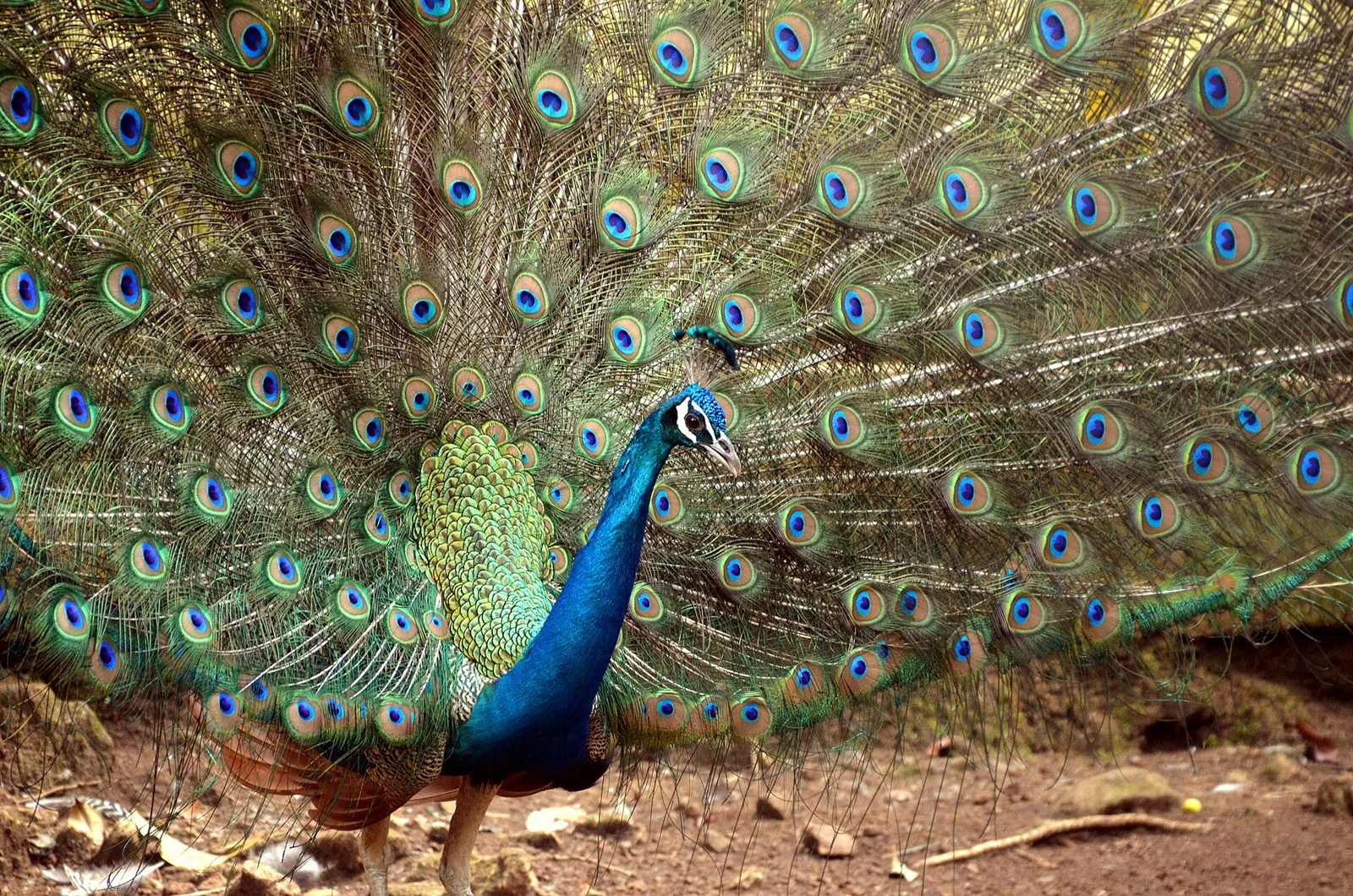
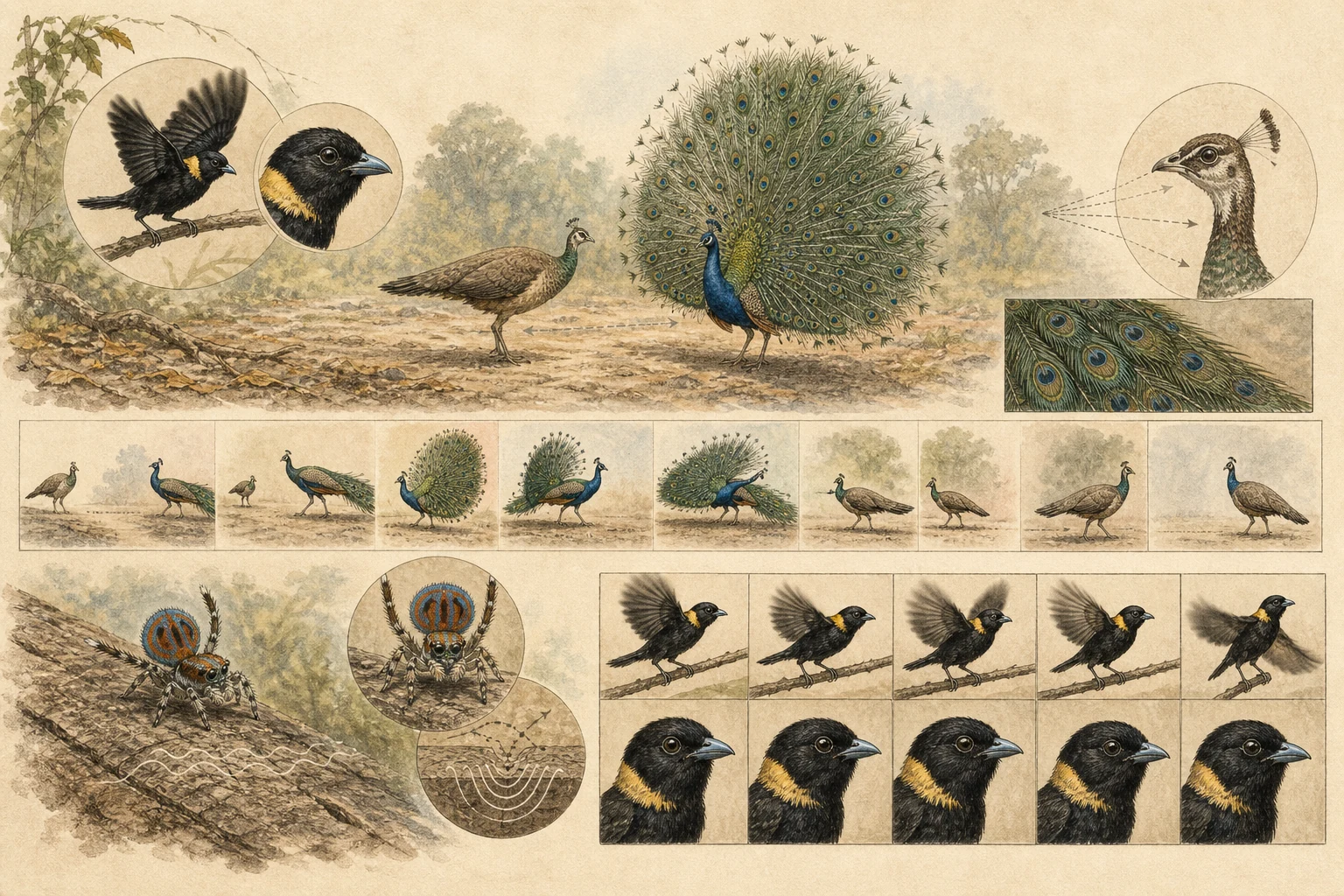
Many animal displays are multimodal, delivering coordinated cues across two or more sensory channels that reinforce, modify, or gate one another. A courting male peacock spider raises and waves his iridescent abdominal flaps while drumming vibrations through the leaf litter that the female detects through her legs. An Indian peacock fans his eyespot train while rattling his quills at resonant frequencies that generate both visual shimmer and low-frequency sound. Observing only color with binoculars or recording only audio misses how the channels work together. [2][3][4]
- Multimodal displays combine visual, acoustic, vibratory, chemical, or tactile cues in one coordinated routine
- Peacock spiders pair colorful leg and abdomen semaphore with substrate-borne seismic vibrations
- Displaying peafowl vibrate tail-covert quills at resonant frequencies that couple visual motion with sound
Performance and attention both matter
Static ornaments alone do not decide an encounter; both motor skill and receiver attention shape the outcome. High-speed video of golden-collared manakins in Panama shows that males differ by milliseconds in the choreography and wing-snap timing of their acrobatic jump displays, while miniature eye-tracking cameras fitted to peahens reveal that females scan mostly the lower train and shaking feathers rather than staring at the upper crest or head. Biomechanical constraints on feathers and muscles make a display an athletic test that only an attentive receiver evaluates. [4][5][6]
- High-speed recordings of manakins reveal fine-scale individual differences in acrobatic speed and wing-snap timing
- Eye-tracking experiments show peahens focus mainly on the lower edge and motion of a peacock's train
- An ornament's effect depends on how skillfully the signaler moves it and whether the receiver is attending
Describe the sequence before the motive
In the field, record the observable sequence before interpreting intent: note who initiated approach, the distance and angle between individuals, each posture or vocal phrase, how the partner moved or looked away, and whether a rival interrupted. Comparing season, site fidelity, and repeated bouts helps separate courtship from territorial boundary displays or dominance challenges. Avoid projecting human emotions onto animal gestures, and remember that in many species the majority of full courtship performances end with the receiver walking or flying away without mating. [1][2][6]
- Log approach distance, body angle, display steps, receiver movements, and how the encounter ends
- Context, season, and partner response help distinguish courtship from territorial or agonistic displays
- Even elaborate, uninterrupted courtship routines frequently end without mating when the receiver departs
Related guides
Get Fauna and identify it in the field.
Where this guide comes from
Source-checked editorial guide. Last updated . This guide teaches identification and field skills; it is not a substitute for expert verification when it matters.
- Smithsonian National Museum of Natural History — Sexual selection ↗
- Ethology : formerly Zeitschrift fur Tierpsychologie — Evolution and function of multimodal courtship displays ↗
- PloS one — Multi-modal courtship in the peacock spider, Maratus volans (O.P.-Cambridge, 1874) ↗
- PloS one — Biomechanics of the Peacock's Display: How Feather Structure and Resonance Influence Multimodal Signaling ↗
- Smithsonian Research Online — High-speed video of manakin courtship ↗
- The Journal of experimental biology — Through their eyes: selective attention in peahens during courtship ↗