How kangaroo pouches work
The pouch is a muscular fold of abdominal skin, not a second womb. After a short gestation, the highly undeveloped joey crawls from the birth opening to a teat, remains attached while its organs mature, and later leaves and returns while continuing to nurse.
Last updated
The pouch is a living fold of skin
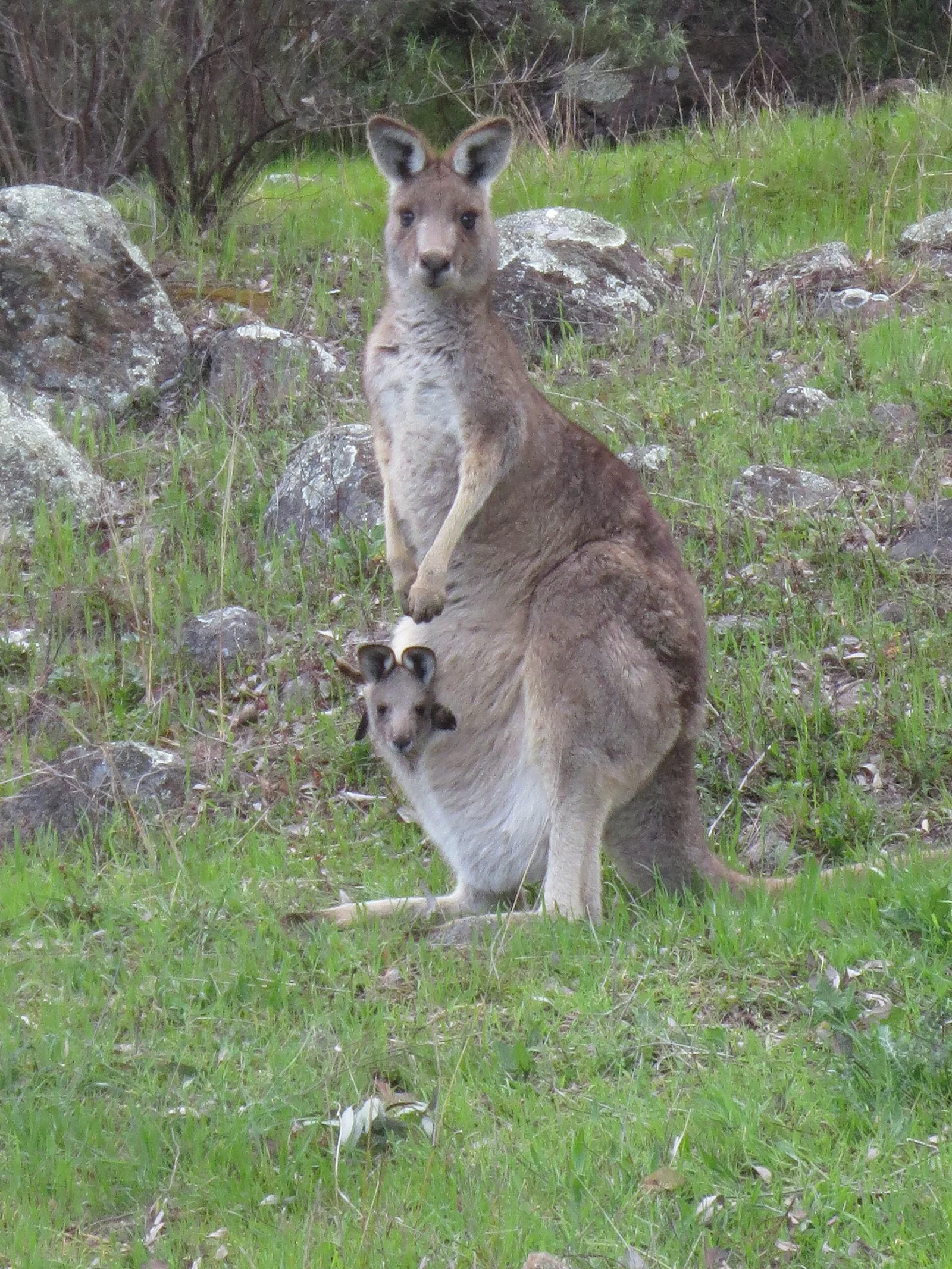
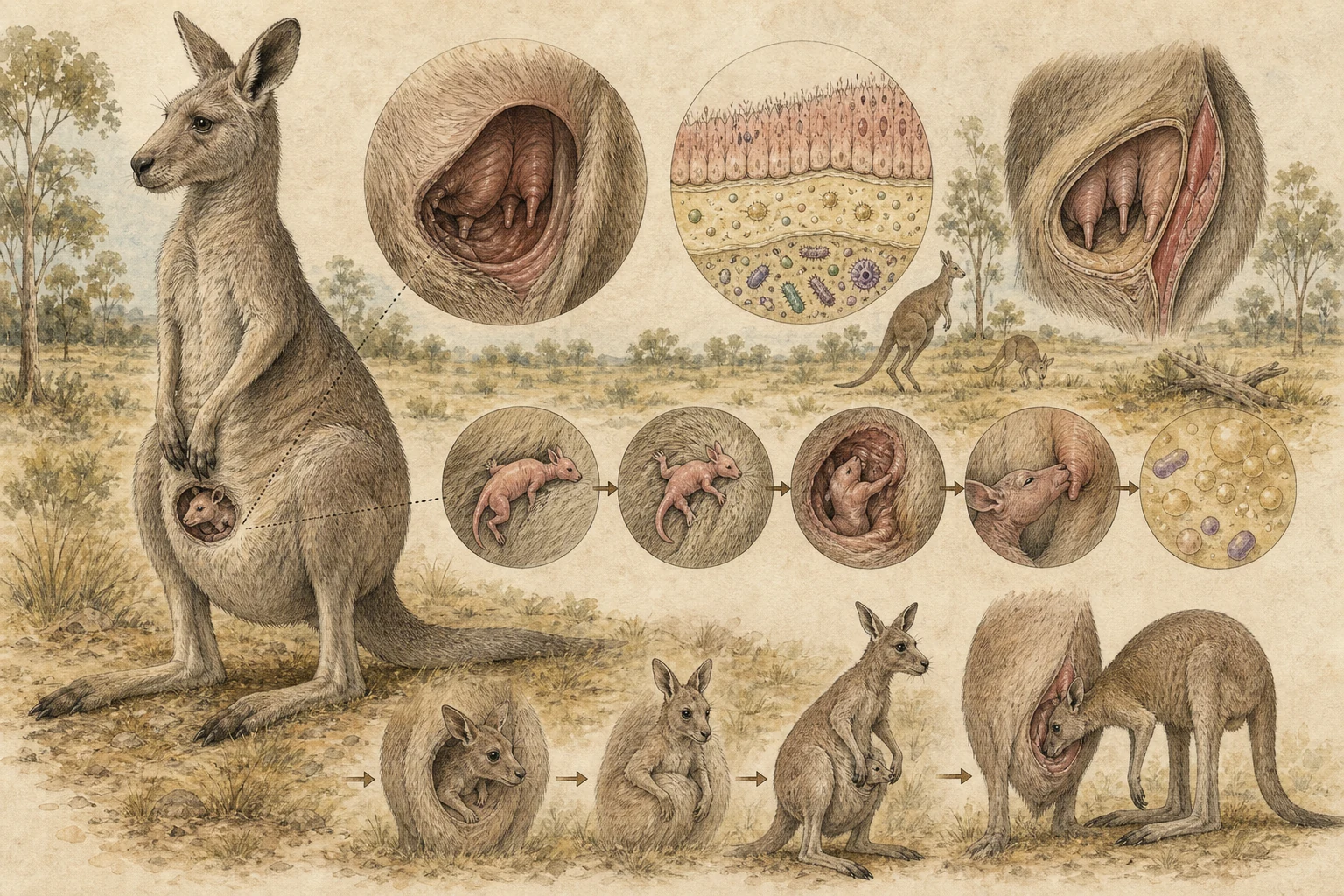
In kangaroos and wallabies (family Macropodidae), the pouch—or marsupium—is a deep, forward-opening fold of abdominal skin enclosing four mammary glands and their teats, rimmed by a muscular sphincter that the mother can draw tight while hopping or swimming and relax to groom inside. Far from being a dry leather pocket, the inner pouch lining is warm, humid, vascularized skin containing sebaceous and apocrine glands whose secretions and resident microbiota shift dramatically before birth. Across the wider marsupial infraclass, however, pouches take many forms: burrowing wombats and bandicoots have rearward-opening pouches that keep dug soil out, while some small dasyurids develop only temporary lateral skin folds. [2][4][5]
- Kangaroos and wallabies have deep, forward-opening pouches with a muscular rim that contracts to hold the joey secure during hopping.
- Burrowing marsupials such as wombats and bandicoots have backward-facing pouches that prevent dirt from filling the chamber while digging.
- Before birth, maternal hormones alter the pouch skin's secretions and microbial community to prepare a cleaner nursery.
The newborn makes the climb
After a remarkably brief gestation of about 31 to 36 days, an eastern grey kangaroo (Macropus giganteus) or tammar wallaby gives birth to a pink, hairless neonate the size of a jellybean and weighing less than a gram—roughly 1/30,000 of its mother's mass. While its hind limbs are mere embryonic buds and its eyes and ears are sealed, the newborn's shoulder girdle, clawed forelimbs, olfactory system, and inner-ear gravity sensors are precociously developed. As the mother sits back with her tail extended between her legs and licks a damp path through her belly fur, the tiny joey hauls itself upward with alternating swimming strokes of its forelegs, crosses the pouch rim in minutes, and latches onto one of the four teats. [1][3]
- A newborn kangaroo weighs less than a gram at birth after roughly five weeks of gestation, with sealed eyes and rudimentary hindlimb buds.
- Precociously muscled forelimbs with temporary deciduous claws allow the neonate to climb unassisted through the belly fur into the pouch.
- Once inside the marsupium, the joey locates one of four teats by scent and touch, and the teat tip swells inside its mouth to lock it in place.
A teat supplies a changing developmental diet
Because marsupials trade a brief uterine pregnancy for months of external lactation, the mammary gland acts as a dynamic physiological regulator. Early in pouch life, a kangaroo secretes dilute milk rich in complex oligosaccharides, specific amino acids, and maternal antibodies suited to an ectothermic, hairless young permanently attached to the teat; later, as the joey grows fur, opens its eyes, and regulates its own body heat, milk composition shifts toward high-energy lipids and proteins while carbohydrates drop. Remarkably, a female kangaroo can practice asynchronous concurrent lactation—simultaneously secreting thin, low-fat milk from one teat for a tiny newborn joey while an adjacent mammary gland pumps thick, lipid-rich milk from an elongated teat for an older young-at-foot. [2][3]
- Marsupial milk changes radically in carbohydrate, protein, and fat concentration across lactation to match the joey's organ maturation.
- Asynchronous concurrent lactation lets a mother produce two completely different milk formulas from adjacent teats at the same time.
- The pouch young stays continuously attached to the swollen teat for its first months before jaw development lets it release and reattach.
Pouch life ends gradually
Because a newborn joey enters the non-sterile pouch before its own thymus, spleen, and adaptive immune system have developed, survival depends on maternal hygiene—frequent licking of the pouch interior—combined with potent antimicrobial peptides (such as cathelicidins) and lysozymes secreted in the milk and pouch skin. Over six to nine months in large kangaroos, the joey develops fur, pokes its head out to sniff and nibble grass while the mother grazes, and begins making short, wobbly hops outside before diving headfirst back in at any alarm. Eventually the mother tightens her pouch sphincter to bar re-entry, though the gangly young-at-foot continues thrusting its head inside to nurse from its dedicated teat for several more months. [1][2][4][5]
- Cathelicidins and other antimicrobial compounds in marsupial milk and pouch secretions shield the immunologically naive newborn from pathogens.
- Growing joeys progress from poking their heads out to crop grass while the mother feeds to making brief hops beside her.
- Even after permanent pouch exit, an older young-at-foot continues reaching its head into the pouch to suckle from its original teat.
Related guides
Get Fauna and identify it in the field.
Where this guide comes from
Source-checked editorial guide. Last updated . This guide teaches identification and field skills; it is not a substitute for expert verification when it matters.
- Australian Museum — Eastern grey kangaroo ↗
- PeerJ — Marsupial and monotreme milk-a review of its nutrient and immune properties ↗
- EMBO reports — The kangaroo genome. Leaps and bounds in comparative genomics ↗
- Frontiers in microbiology — Antimicrobial Protection of Marsupial Pouch Young ↗
- San Diego Zoo — Marsupial pouches ↗