How animals care for their young
Care for offspring is much broader than feeding a recognizable baby. Animals may prepare or defend a nest, clean or oxygenate eggs, regulate temperature, transport young, provision food, teach specialized skills in rare documented cases, or receive help from non-parent caregivers—and many successful life histories use little care after eggs are laid.
Last updated

Count care before birth or hatching
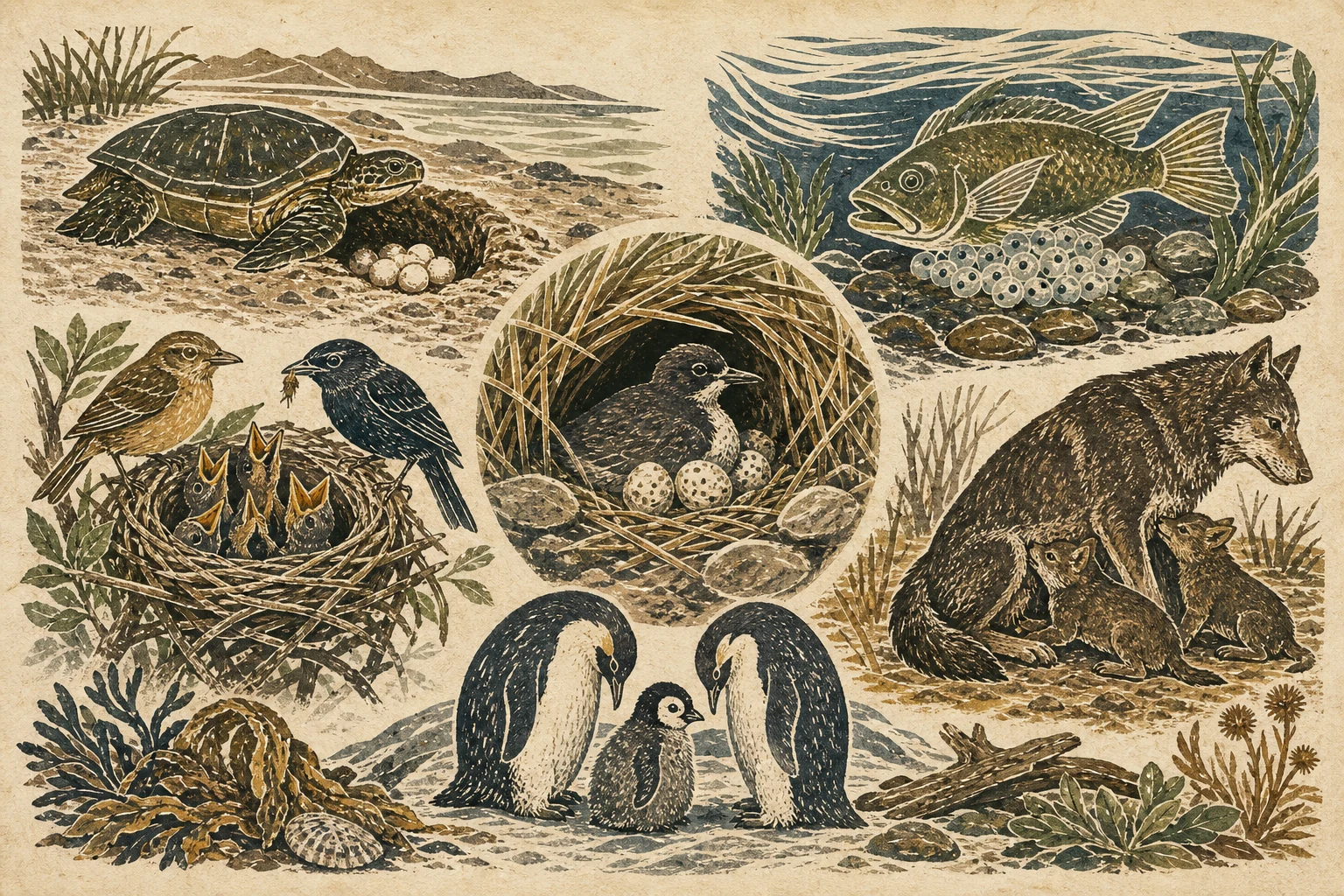
Biologists define parental care as any post-fertilization parental trait or behavior that enhances offspring survival, growth, or developmental stability. Much of that investment happens before a mobile juvenile ever emerges: adults excavate thermally buffered burrows, coat eggs with antimicrobial secretions, fan water over submerged clutches to supply oxygen, or brood embryos internally or externally. After hatching or birth, direct food provisioning is only one option alongside brooding warmth, dorsal or oral transport, sanitation, and predator defense. [1][2]
- Site preparation, egg cleaning, fanning, and thermal brooding are major forms of pre-hatching parental care
- Post-hatching care includes carrying, shading, warming, and guarding young even in species that never bring food
- Internal gestation and live birth represent evolutionary extensions of embryo protection and provisioning
Expect many routes to the same benefit
Unrelated lineages solve early-life hazards through remarkably different behaviors. Guarding a clutch keeps egg predators at bay, brooding accelerates embryonic development so young spend less time in their most vulnerable stage, and provisioning boosts juvenile body mass before independence. In a handful of rigorously documented mammals and birds—such as wild meerkats bringing live, disabled scorpions to pups according to the pups' age-linked vocal calls—adults even modify their behavior to facilitate skill acquisition, meeting strict scientific criteria for teaching. [1][2]
- Parental warming and oxygenation shorten the time embryos spend in vulnerable early developmental stages
- Duration of attendance ranges from brief egg guarding in insects and fishes to multi-year care in large mammals
- Adult meerkats adjust whether they bring dead, sting-removed, or intact scorpions as pups mature
Do not assume who the caregiver is
Across the animal kingdom, maternal-only, paternal-only, biparental, and cooperative alloparental care all occur, often varying sharply between closely related groups. While female care predominates in mammals and reptiles, male-only care is the most common form of parental attendance among bony fishes that tend clutches, and biparental care is the norm in birds. Neurobiological research shows that conserved neural circuits for caregiving can be activated in mothers, fathers, and non-breeding alloparents alike, so field observers should record which individual performs each task rather than assuming sex from caregiving alone. [3][4][6]
- Male-only clutch guarding and fanning is widespread among bony fishes with external fertilization
- Alloparental helpers—siblings or unrelated group members—assist with feeding, carrying, and guarding in cooperative breeders
- Conserved brain circuits support caregiving across sexes, so observe plumage or anatomy before assuming a caregiver's sex
Care has benefits, costs, and alternatives
Every hour and calorie invested in current offspring carries an evolutionary cost: a tending parent may lose body condition, face higher predation risk at a fixed nest, or forfeit opportunities to mate again or produce additional clutches. How selection balances those trade-offs depends on juvenile mortality rates, fertilization mode, food predictability, and whether young are precocial or altricial. Species that lay well-provisioned eggs in hidden microhabitats and depart immediately are following an alternative life-history strategy, not failing at care. [1][2][4]
- Guarding or provisioning young drains parental energy reserves and can restrict future mating opportunities
- Precocial young often move and feed themselves soon after birth, shifting parental effort toward vigilance and leading
- Producing many well-yolked eggs in concealed sites is a successful evolutionary alternative to post-laying attendance
Related guides
Get Fauna and identify it in the field.
Where this guide comes from
Source-checked editorial guide. Last updated . This guide teaches identification and field skills; it is not a substitute for expert verification when it matters.
- Philosophical transactions of the Royal Society of London. Series B, Biological sciences — Evolutionary transitions in parental care and live bearing in vertebrates ↗
- Ecology and evolution — What are the benefits of parental care? The importance of parental effects on developmental rate ↗
- Science (New York, N.Y.) — Neural control of maternal and paternal behaviors ↗
- Proceedings. Biological sciences — The costs and benefits of paternal care in fish: a meta-analysis ↗
- Proceedings. Biological sciences — Variation in contributions to teaching by meerkats ↗
- Developmental neurobiology — The neurobiological causes and effects of alloparenting ↗