Why animals live in groups
Animals remain social when context-dependent benefits exceed costs for participating individuals; the balance shifts with food distribution, predators, pathogens, kinship, dominance, season, and group size.
Last updated
Predators change the arithmetic
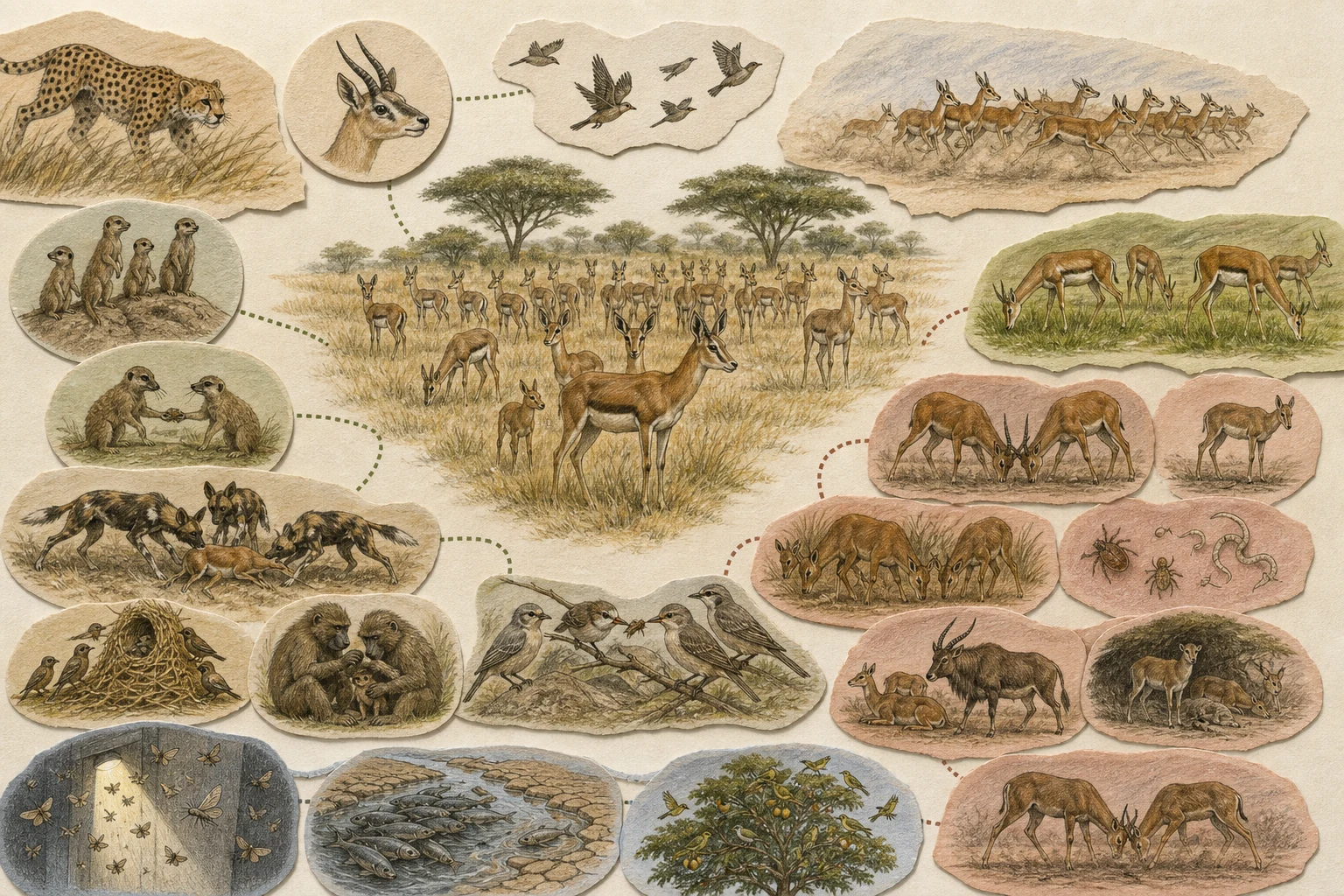
For a sandpiper in a tight coastal flock, a minnow in a shimmering school, or an elk in a winter herd, companions immediately alter predation risk through three distinct mechanisms: numerical dilution lowers any single individual's chance of being the one targeted in a strike; the many-eyes effect allows threats to be spotted earlier while letting each animal spend a smaller fraction of its time head-up scanning; and synchronized flash-expansion or wheeling creates a confusion effect that makes it harder for a falcon or pike to lock onto one trajectory. Yet spatial geometry is unequal—subordinates or latecomers pushed to the outer edge often face higher predation risk than dominant individuals in the center. [1][2]
- Compare individual head-up vigilance rates between solitary foragers and members of small versus large flocks or herds.
- Notice spatial position within a herd or roost: central positions and peripheral edges carry different predator exposure and foraging access.
- Remember that larger groups can also be more conspicuous from afar, so antipredator benefits depend on habitat cover and predator hunting style.
Information and cooperation create new options
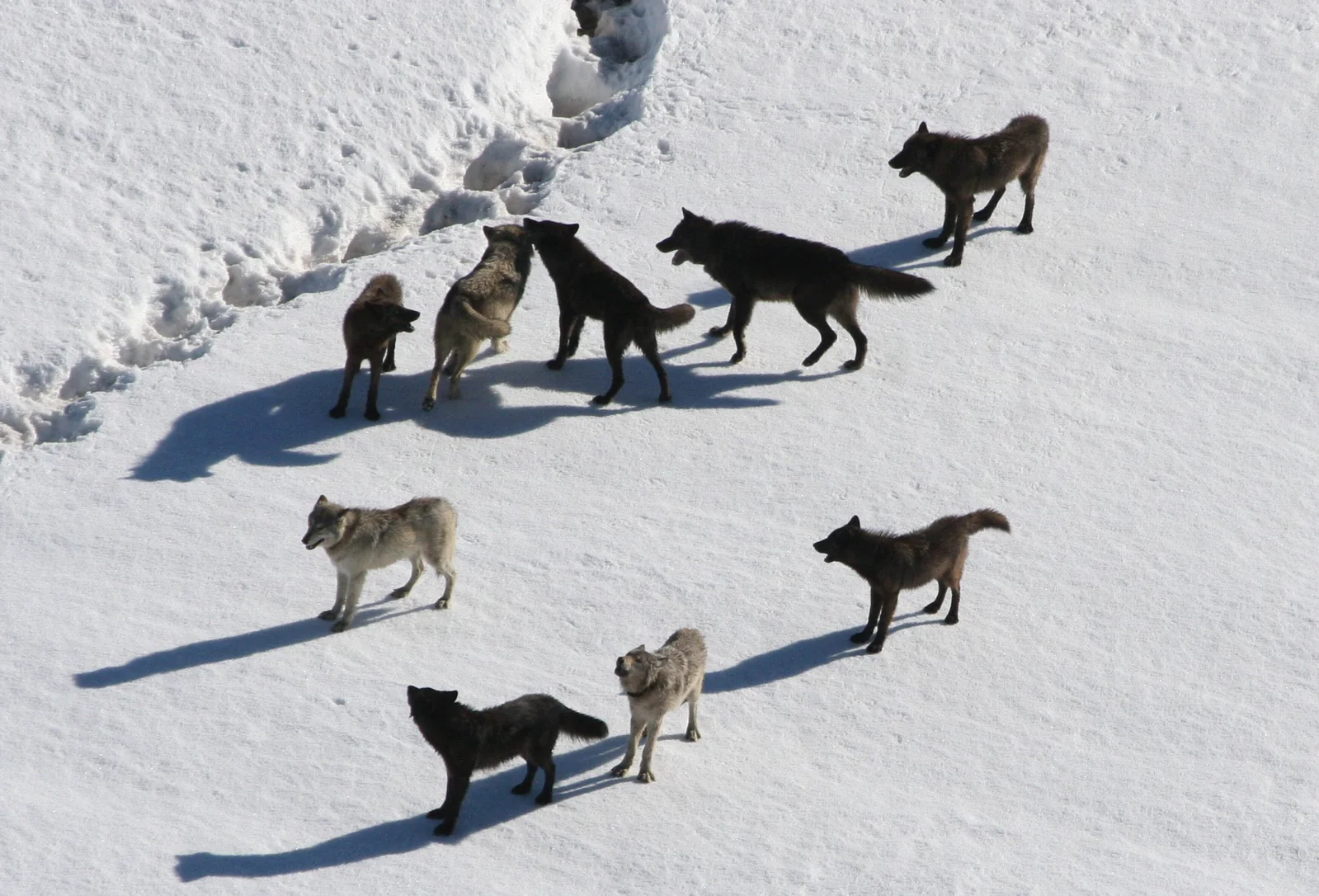
Beyond passive risk dilution, living in stable groups enables collective behaviors no solitary individual could pull off. Wolves, African wild dogs, and lions coordinate hunts or defend large carcasses against scavengers; colonial swallows and communal-roosting birds follow successful neighbors to patchy food; elephants, cetaceans, and primates share multi-generational ecological knowledge; and cooperative breeders such as meerkats, acorn woodpeckers, and naked mole-rats provision young and maintain shared burrows or granaries. Evolutionary theory shows that such cooperation can be stabilized by kin selection when helpers assist close relatives, as well as by mutualism, reciprocity, and group augmentation when all participants gain survival benefits. [2][3]
- Look for active cooperation such as sentinel rotation, shared territorial defense, communal pup-feeding, or coordinated hunting.
- Note how kinship and philopatry (offspring remaining on the natal territory) underpin many family-based mammal and bird societies.
- Distinguish active social recruitment and cooperative foraging from simple local enhancement where animals spot others feeding from afar.
Crowding has biological costs
Every companion that adds an extra pair of eyes also brings another mouth competing for local forage and another host capable of transmitting ectoparasites and respiratory or enteric pathogens. As group size climbs, patches deplete faster, forcing animals to travel farther each day; dominant individuals may monopolize prime feeding spots, safe roosts, or mating opportunities; and social friction requires constant time investment in dominance displays, submission signals, or allogrooming. Consequently, many mammals and birds adopt fission-fusion dynamics—splitting into small foraging parties when food is scattered and reassembling into large herds or roosts when predation risk or cold nights shift the balance. [1][4]
- Watch how foraging groups spread out, splinter into subgroups, or increase supplanting chases when food patches are small and clumped.
- Notice social maintenance behaviors such as primate allogrooming, greeting rituals, and dominance displays that manage within-group tension.
- Track seasonal shifts between solitary breeding territories in spring and large communal flocks or herds in winter.
Aggregation is not automatically a society
Fifty ladybugs wintering under one rock, moths swirling around a porch lamp, or herons spaced along a drying ditch are aggregations drawn independently to the same microclimate or resource, not necessarily a structured social group. Animal societies vary along axes of permanence, membership openness, individual recognition, dominance hierarchy, and division of labor—ranging from open shoals that swap members every minute to closed, stable wolf packs, matrilineal elephant families, and eusocial bee or ant colonies. When observing a gathering in the field, document coordination, spacing, communication, and subgroup stability rather than assuming every crowd is a tight-knit unit. [3][4]
- Separate resource-driven aggregations at a waterhole or light source from cohesive social groups that travel and interact together.
- Note whether group membership appears open (individuals freely joining and leaving) or closed (strangers repelled at boundaries).
- Record spacing, synchronized turns, dominance interactions, and role differentiation to characterize the group's social structure.
Related guides
Get Fauna and identify it in the field.
Where this guide comes from
Source-checked editorial guide. Last updated . This guide teaches identification and field skills; it is not a substitute for expert verification when it matters.
- Philosophical transactions of the Royal Society of London. Series B, Biological sciences — The adaptive value of sociality in mammalian groups ↗
- Nature Education — Primate sociality and social systems ↗
- Nature Education — Cooperation, conflict, and the evolution of complex animal societies ↗
- Association for the Study of Animal Behaviour (UK) ↗