How plants respond to touch
Touch, wind, rain, bending, and contact strain cell walls and membranes. Mechanosensitive channels and other sensors can initiate calcium, electrical, reactive-oxygen, and hormone signals. Specialized organs move in seconds, tendrils redirect growth, and repeated loading can produce shorter, thicker, more flexible stems over days or weeks.
Last updated
Mechanical force becomes a cellular signal
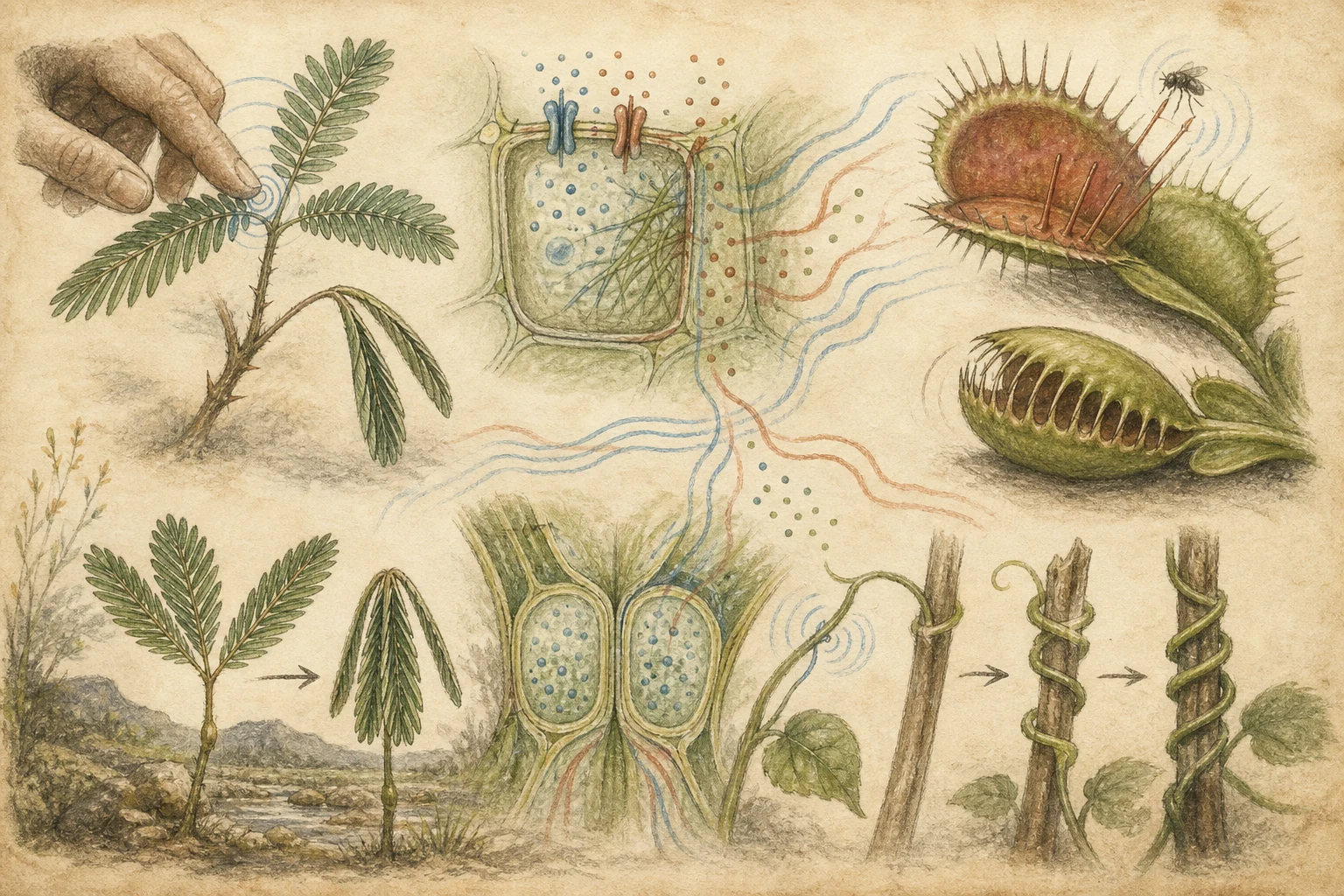
Every gust of wind, pelting raindrop, brushing animal, or soil pebble encountered by a growing root tip deforms plant cell walls and stretches plasma membranes. Plant cells sense that physical strain through distributed mechanosensors—including stretch-activated ion channels (such as MSL, MCA, and OSCA/PIEZO-like families) and receptor-like kinases anchored to the cell wall—that convert mechanical tension into an immediate influx of calcium ions, extracellular pH shifts, reactive oxygen bursts, and electrical membrane depolarizations. Within minutes, these local signals remodel the cytoskeleton and alter hundreds of touch-responsive genes, all without a central brain or animal-style nervous system. [2][3]
- Stretch-activated ion channels and cell-wall sensors convert physical bending or pressure into rapid calcium and electrical signals.
- Even brief brushing of a leaf alters expression of hundreds of genes involved in cell-wall remodeling, hormone balance, and stress defense.
- Plant mechanosensing is distributed across ordinary tissue cells rather than routed through neurons or a central nervous system.
Rapid movement uses specialized anatomy
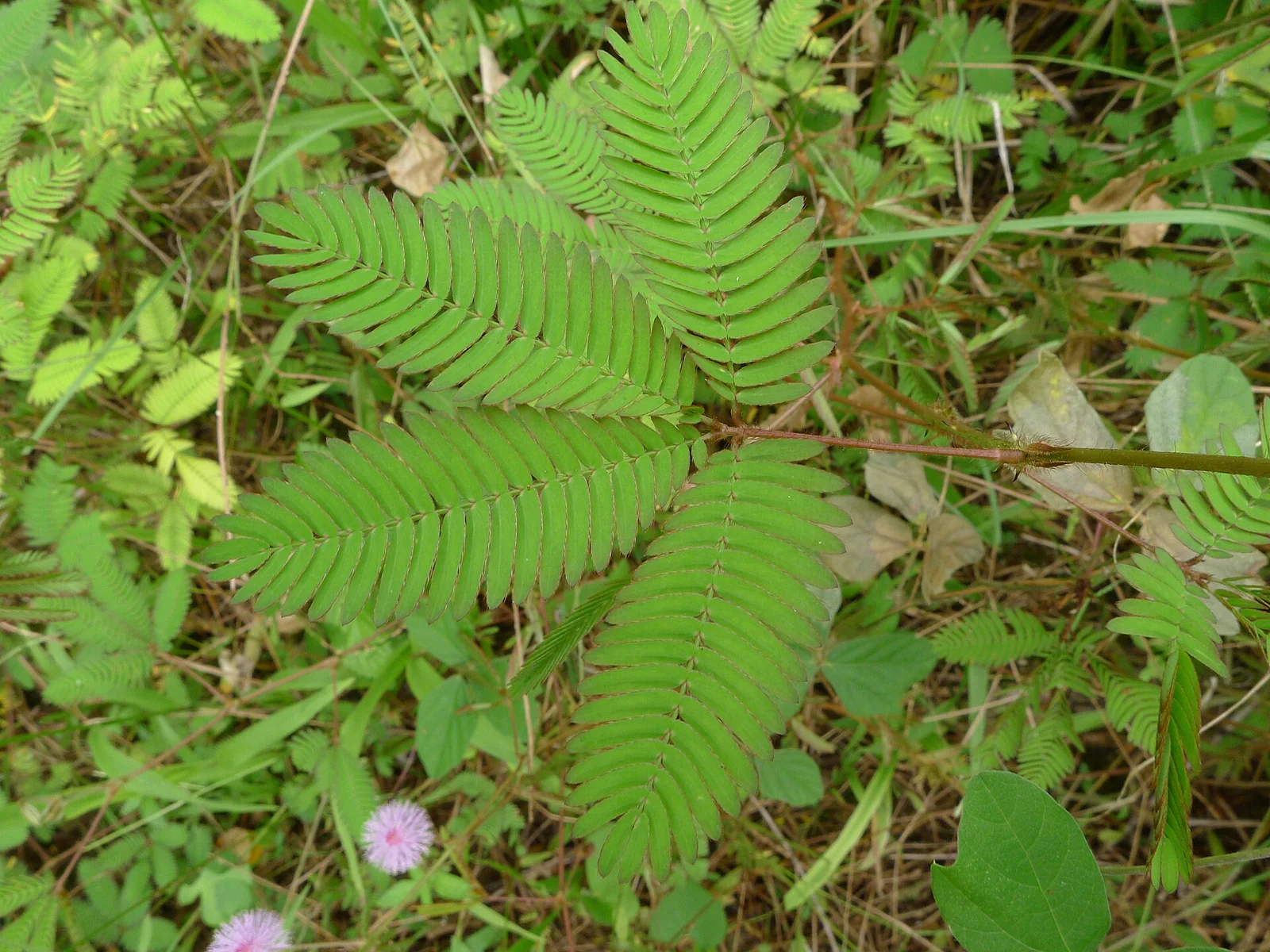
Most plants respond to mechanical stress by adjusting cell division and wall expansion over hours or days, but a few lineages execute visible movements in seconds. When a beetle or finger brushes the feathery compound leaf of the sensitive plant (Mimosa pudica), an electrical action potential races to swollen hinge-like motor organs called pulvini at the base of each leaflet and petiole. Flexor and extensor cells inside the pulvinus rapidly pump potassium and chloride ions across their membranes; water follows by osmosis through aquaporins, draining turgor pressure on one side of the joint so the leaflets fold upward and the whole petiole droops. Restoring turgor to reopen the leaf takes 10 to 30 minutes of metabolic work. [1][3]
- Mimosa pudica folds its leaflets within seconds by pumping ions and water out of specialized motor joints called pulvini.
- Other rapid mechanical movements include snap-buckling in Venus flytraps and touch-triggered stamen snapping in barberry and triggerplants.
- Rapid leaf folding can startle or dislodge insects and expose stem thorns, but costs photosynthetic time and metabolic energy to reset.
Growth can follow the direction or history of contact
Plant touch responses fall into three distinct functional categories depending on whether direction and growth are involved. Thigmonastic movements—like Mimosa leaflet folding or Venus flytrap closure—follow a pre-built anatomical hinge in the same direction regardless of which side was touched. Thigmotropic responses are directional growth adjustments: when a climbing pea, passionflower, or cucumber tendril brushes a twig, cells on the touched side shorten or slow elongation while the outer side expands, coiling the tendril tightly around the support, whereas roots use touch plus gravity to steer around buried stones. Over weeks, chronic wind or brushing drives thigmomorphogenesis—producing shorter, stockier, tougher stems that resist snapping in storms. [1][2][4]
- Thigmotropism is directional growth toward or around a touched object, as when climbing tendrils coil around a support twig.
- Thigmonasty is a rapid turgor movement whose direction is fixed by hinge anatomy rather than the direction of the touch.
- Thigmomorphogenesis is the slow developmental shift toward shorter, thicker, more wind-resistant stems under repeated mechanical flexing.
A response is not necessarily a message
Laboratory experiments show that lightly touching Arabidopsis or crop leaves for a few seconds can alter volatile organic emissions, boost resistance to fungal pathogens or caterpillars, and help seedlings detect crowding from neighboring foliage before shade even falls. In the field, however, interpreting these physiological cascades requires care. Calling electrical waves ‘plant nerves’ or describing touch-induced volatiles as ‘talking’ and ‘feeling pain’ confuses metaphorical shorthand with cellular physiology. Researchers test whether a touch response actually improves survival, anchorage, or competitor avoidance in nature rather than assuming every biochemical ripple is an intentional message to neighbors. [3][4]
- Brief leaf contact from neighboring plants can serve as an early crowding cue before canopy shading intensifies.
- Touch-induced jasmonate surges often increase resistance to subsequent insect feeding or fungal infection.
- Electrical and chemical signaling in plants is a non-conscious physiological process; terms like memory or pain are metaphors, not mechanisms.
Related guides
Get Fauna and identify it in the field.
Where this guide comes from
Source-checked editorial guide. Last updated . This guide teaches identification and field skills; it is not a substitute for expert verification when it matters.
- Plant signaling & behavior — Plants on the move: towards common mechanisms governing mechanically-induced plant movements ↗
- Frontiers in plant science — Mechanosensitive control of plant growth: bearing the load, sensing, transducing, and responding ↗
- Journal of experimental botany — A force of nature: molecular mechanisms of mechanoperception in plants ↗
- PloS one — Plant Responses to Brief Touching: A Mechanism for Early Neighbour Detection? ↗